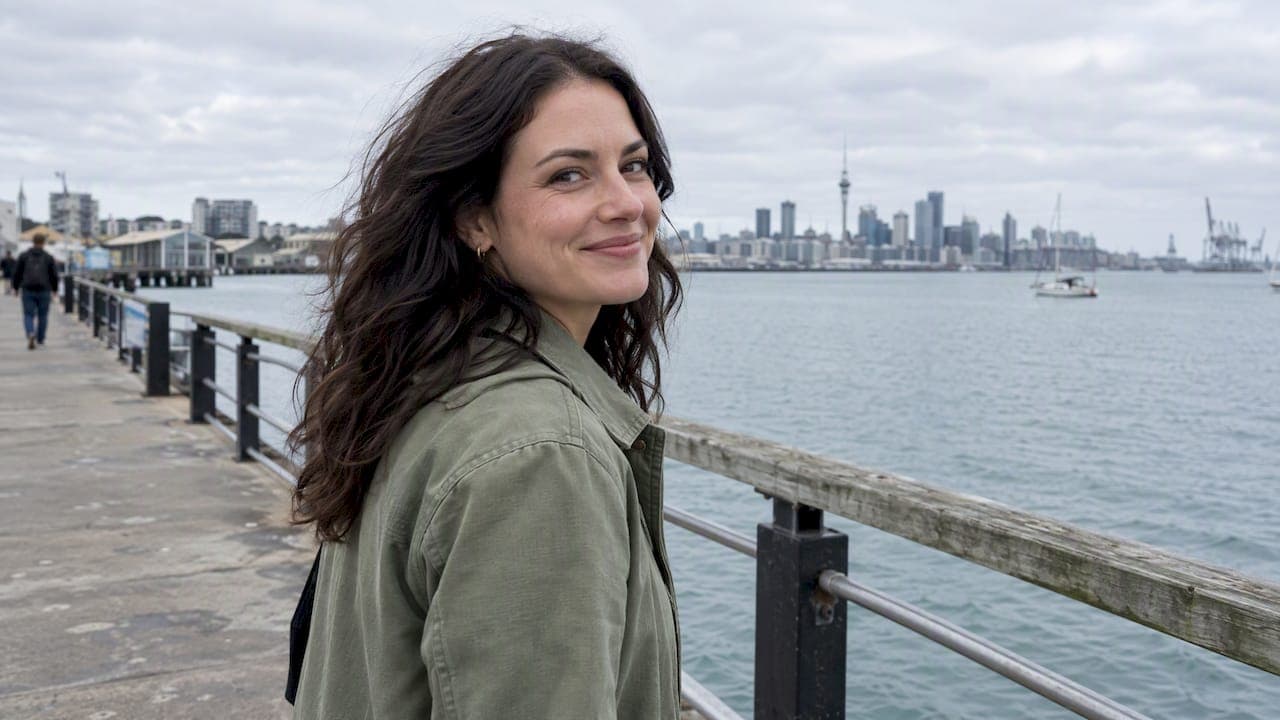
A natural smile in photos comes from feeling something, not from arranging your face. Smiles look forced when you try to produce one on command, and they look real when you are relaxed, distracted by something genuinely funny or comfortable with the person behind the camera. The good news is that you can set up the conditions for that, before and during a shoot, even if you have always thought of yourself as unphotogenic.
Below we cover why forced smiles read as fake, what you can do in the weeks and minutes before a shoot, the tricks that work in front of the lens, and when a neutral face is actually the right answer in New Zealand. We are an Auckland photographer, so we write from what happens on our shoots.
TL;DR
- A smile looks genuine when it comes from a real feeling. Viewers pick up on forced ones quickly, so the goal is to change how you feel, not to perfect your mouth.
- Skip "say cheese". Breathe out, think of something that amuses you, let a small laugh happen, and look away and back at the camera.
- Your smile is individual. There is no standard "perfect" smile to copy, so stop comparing yours with someone else's.
- Passport, visa and NZeTA photos are the exception: New Zealand requires a neutral expression with the mouth closed for those.
- The photographer matters. A relaxed, talkative shoot gives you reasons to smile that you do not have to invent.
Table of Contents
- Why forced smiles look forced
- Your smile is yours, not a template
- Before the shoot: set yourself up
- During the shoot: tricks that actually help
- Why the setting changes the smile
- Different situations, different smiles
- When you should not smile: official NZ photos
- Our perspective: you do not need to know how to pose
- If you want a shoot that makes this easy
- A short checklist for the day
- FAQ
- Sources
Why forced smiles look forced
Most people who say "I can't smile in photos" are not describing a problem with their face. They are describing the moment a camera is pointed at them, they feel watched, and their expression freezes into something they would never normally wear.
There is solid research behind why that shows up in the picture. A University of Canterbury study on posed and genuine smiles found that people are sensitive to facial expressions and can tell genuine ones from posed ones, with posed smiles often read as showing happiness without feeling it. In other words, your viewers are quick judges, even when they cannot say why a photo feels off.
The usual giveaway is the eyes. A genuine smile (often called a Duchenne smile) involves the muscles around the eyes as well as the mouth. When only the mouth moves, the face looks mismatched. Research on facial expressions and context from Massey University also notes that the eyes remain a primary cue for how authentic an expression looks, which is one reason we pay so much attention to light in the eyes when we shoot portraits.

That is why "just smile" is poor advice. Trying harder to smile usually makes the expression more rigid. What works is changing the feeling underneath it.
Your smile is yours, not a template
A lot of the worry comes from comparing yourself with a smile you have seen online. Researchers at the University of Otago, including Professor Jamin Halberstadt, have studied smile dynamics, meaning how fast, how wide and how symmetrical a smile is, and a recent paper there compares Fijians and New Zealand Europeans. A related Otago doctoral thesis on smiling looks at it in the context of orthodontic patients. The takeaway for a client is simple: smiles differ between people, and there is no single ideal one.
So if you think your smile is lopsided, too toothy, too closed or too small, the more useful question is whether it looks like you on a good day. A photograph that looks like you is the one your friends, clients and family will respond to.
A small smile that reaches the eyes will almost always beat a wide one that does not. If you prefer a closed-mouth smile, that is fine. We would rather photograph that with warmth than push you into a grin that feels wrong.
Before the shoot: set yourself up
A natural expression is mostly decided before the camera comes out. A few things help.
Choose the right kind of shoot
If you freeze in a studio, say so. An outdoor or lifestyle location with some movement, such as walking, can give you something to do besides pose. Tell your photographer what you dislike about past photos, because that tells us what to avoid.
Sleep, eat and arrive early
Tired, hungry and rushed all show on the face. Eat beforehand, avoid arriving flustered and give yourself ten minutes to settle. If you wear glasses, bring them, and wear clothes you are comfortable moving in. When you are uncomfortable in your clothes, your expression follows.
Bring the right people, or none
Some people relax with a partner, friend or colleague nearby. Others tense up with an audience. Know which one you are. For a headshot, we usually suggest coming alone so the focus stays on you and the photographer.
Practise once, lightly
A couple of minutes with your phone camera is enough to learn what your own warm face looks like. Do not mirror-practise for weeks, because then you are rehearsing the posed look. Think of something that genuinely amuses you, notice how your face feels, and remember that feeling.
During the shoot: tricks that actually help
These are the ones we use and suggest, and you can use most of them without a photographer's prompting.
- Drop "cheese". The word pulls the mouth into a fixed shape. Try breathing out slowly and letting your face soften instead.
- Add a little noise. A small chuckle, a fake laugh or a quiet hum often turns into a real laugh within seconds, because fake laughing is funny.
- Look away, then back. Look off to the side, think of something pleasant, then turn to the lens on a count of three. The expression arrives slightly fresh rather than held.
- Think of a specific person or memory. Not "happy" in general. The friend who always makes you laugh, a dog doing something silly, a good day at the beach.
- Relax the rest of the body first. Drop your shoulders, shift your weight, shake out your hands and unclench your jaw. A relaxed stance makes the smile appear more genuine.
- Smile with the eyes. Imagine you have just spotted someone you are pleased to see. The cheeks lift slightly and the eyes narrow a little, and that is the look you want.
- Talk. Answer questions, tell the photographer about your weekend, complain about Auckland traffic. Talking keeps the face moving and the expression alive between frames.
- Take the pressure off perfection. You do not need every frame to work. Most of the best images are a second or two after the "posed" one.
If you want more on posing and calming nerves, our own guides on relaxed photoshoot tips for camera-shy people and headshot posing go into the detail, and being photogenic is a skill covers the mindset side.
Why the setting changes the smile
The Massey University thesis on context effects found that recognising facial expressions is helped by congruent context, such as a relaxed setting or encouraging interaction, and hindered by incongruent context, such as a high-pressure environment. That is academic language for something every photographer sees daily: the same person looks very different in a tense room and a relaxed one.
This is why we think the photographer's job is not to say "smile". It is to make the shoot feel easy, so the smile is a by-product. A quiet, silent studio with someone saying "big smile" every few seconds works against you. A conversation, some light humour and clear, calm direction work for you.
Different situations, different smiles
What counts as natural depends on what the photo is for.
| Photo type | What a natural smile looks like | What helps most |
|---|---|---|
| Professional headshot | Warm, approachable, eyes engaged, often a soft closed or slightly open smile | A short chat before shooting and a few reset breaks |
| Personal branding | Varied: thoughtful, amused, mid-conversation, working | Doing something real, like talking, writing or laughing at a joke |
| Couples | Laughter and connection more than a posed grin | Moving, whispering, teasing each other, ignoring the camera |
| Fitness | Focused or confident, sometimes a smile after a rep | Action and music rather than holding a pose |
| Maternity and baby | Calm, soft, tender | Taking time and following your lead |
| Weddings and events | Candid and unplanned | A photographer who stays out of the way |
For a business owner, variety matters. A single beaming headshot is useful, but a library with a few different expressions, serious, warm and mid-laugh, gives you something for your website, LinkedIn and proposals. Our guide to personal branding photo ideas shows what a full set can include.
When you choose which images to publish, authenticity is what builds trust. This piece on how authenticity in branding builds trust is a useful read if you are weighing a polished shot against a more real one. In our experience, the real one wins more often than people expect.
Couples: forget the camera
Couples often tell us they feel silly. The fix is to give you something to do together: walk, whisper something ridiculous, tell the story of how you met. The laughter that follows is what you will want on the wall. If you want ideas, our post on poses for couples that look natural is a good starting point, and our couples portfolio shows how this looks in practice.

Headshots: a small smile goes a long way
For corporate or LinkedIn photos, you do not need teeth showing. A relaxed face with a slight lift at the corners and bright eyes reads as confident and friendly. You can see the range in our headshot portfolio, and our post on looking your best in professional headshots covers wardrobe and grooming.
When you should not smile: official NZ photos
A natural smile is for portraits, not identity documents. For a New Zealand passport, the Department of Internal Affairs asks for a neutral expression with your mouth closed, so a smile can get the photo rejected. Visa and NZeTA photos follow their own rules, and Immigration New Zealand requires the photo to be natural and unaltered, with no filters, beautification features or AI editing tools. Check the current requirements on those pages before you book anyone to take them.
Those rules are for those documents only. Your LinkedIn photo, website portrait and family photos are a different matter, and a genuine smile suits them well.
Our perspective: you do not need to know how to pose
We have photographed a lot of people who walked in saying they hate having their photo taken. Almost none of them were actually bad at it. What they lacked was a reason to relax.
Our approach is simple. We plan the shoot with you beforehand, explain what will happen, and give clear directions so you are never left wondering what to do with your hands. We talk a lot, we keep the mood light, and we do not expect you to know how to pose. When someone laughs at something we said, we are already photographing it.
We also do not chase a single "perfect" smile. Every person has their own way of smiling, and our job is to find yours. If you tell us you are self-conscious about your teeth, your age or the way one side lifts higher, we will work with that, not against it. Nine times out of ten, the frame you thought you would hate is the one you end up using.
The most useful thing you can do is choose a photographer whose manner you like. Look at the portfolio, notice whether the people in it look comfortable, and get in touch for a chat before you commit. That first conversation tells you a lot.
— Rowan Freeman
If you want a shoot that makes this easy
If you would like to try this with us, our Auckland sessions are built around a relaxed pace. A few places to start, all with published prices:
- Headshots: The Short one is from 345 NZD, The Standard one is 575 NZD and the Half day Office photoshoot is 2300 NZD, on the headshot photography page.
- Personal branding: Starter Brand Session at 575 NZD, Signature Brand Session at 1035 NZD and Complete Brand Session at 1495 NZD, on the personal branding page.
- Couples: Full Session at 575 NZD and Extended Session at 800 NZD, on the couples page.
You can see everything we offer on our services page, or browse the full portfolio first to see whether the expressions feel like the ones you want.
A short checklist for the day
If you remember nothing else, remember this list:
- Eat, sleep and arrive ten minutes early.
- Tell your photographer what you dislike about previous photos.
- Wear something you can move in comfortably.
- Breathe out slowly before the first frame, and drop your shoulders.
- Talk, laugh at yourself and let the pauses between frames be as natural as the frames themselves.
- Look at a selection, not one image. A full set shows you the real range of your expressions.
- Choose the photos that look like you on a good day, not the ones that look like someone else's smile.
FAQ
How do I get a natural smile in photos?
Start by relaxing your body, then change how you feel rather than how your mouth looks. Think of a specific funny memory, add a small chuckle, or look away and back at the lens. A photographer who keeps you talking will make this far easier.
What does a natural smile look like?
It usually involves the eyes as well as the mouth, with the cheeks lifting slightly and the skin around the eyes creasing a little. It also tends to be slightly asymmetrical and varies from person to person. Research from the University of Otago on smile dynamics supports the idea that there is no single standard.
Why am I attractive but not photogenic?
In person, people see your movement, voice and expressions changing constantly. A photo freezes one split second, often when you are tense. The fix is more frames, a relaxed setting and a photographer who captures the moments between poses.
Should I smile with teeth?
Only if it feels right for you. A closed-mouth smile with warm eyes looks just as natural, and many people find it more comfortable. The exception is passport, visa and NZeTA photos, where a neutral face is required.
Can a photographer really help if I hate being photographed?
Yes. A good one plans the session with you, gives clear directions and keeps the atmosphere light so you do not have to perform. If you are nervous, mention it at the start so we can adjust the pace.
Sources
- Posed and genuine smiles: an evoked response potentials study (University of Canterbury)
- Facial Expressions and Context Effects (Massey University thesis)
- Professor Jamin Halberstadt (University of Otago)
- Smiling in the context of orthodontic patients (University of Otago doctoral thesis)
- How to take a passport photo (passports.govt.nz)
- Acceptable photos for a visa or NZeTA (Immigration New Zealand)