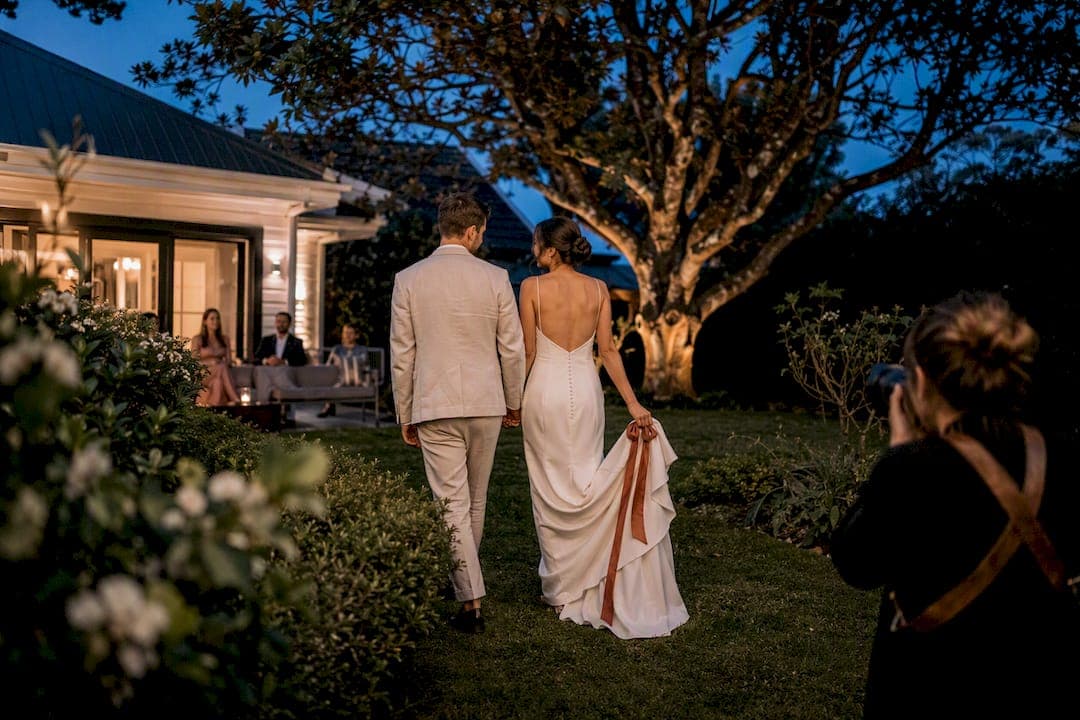
Backyard weddings produce intimate, story-driven photos, and the single biggest factor in getting great ones is planning your light and backdrops before the day, not during it. The best images come from warm, dimmable lighting, a clear sightline for the ceremony, and a wet-weather plan sorted weeks ahead. Choose a photographer who shoots true-to-life colour and a cinematic mood, and brief them early on the shots that matter most to you.
TL;DR:
- Good backyard wedding photos rely heavily on planning for optimal light and backdrops, especially during golden and blue hours.
- Key shot ideas include porch-step family portraits, festoon-lit dances, and confetti exits, with specific attention to light direction and timing.
- Site preparation should focus on clear sightlines, simple color palettes, and hiding distractions like wires or rubbish to enhance photo quality.
- Managing logistics such as power, wet-weather plans, and permission access ensures smooth photo sessions and prevents unwanted elements in images.
- True-to-life color and candid storytelling will define 2026 wedding photography trends, with drone panoramas and blue-hour portraits gaining popularity.
Table of Contents
- Backyard wedding photo ideas: what to notice in real examples
- How to stage your backyard for great photos
- Logistics that quietly decide how your photos turn out
- The shot list to hand your photographer
- Working with your photographer: briefing, timeline and guest management
- Wedding photo trends for 2026 worth briefing your photographer on
- A photographer's view on what actually matters on the day
- Posing and directing guests for shots that don't look posed
- Equipment that suits a backyard setting
- Privacy and permissions in a private backyard setting
- Editing styles suited to backyard wedding photos
- What I'd tell every couple planning this
- Booking a backyard wedding photographer through Life in Style Photography
- Sources
- FAQ
Backyard wedding photo ideas: what to notice in real examples
The photos that make people stop scrolling almost never come from an expensive setup. They come from someone noticing the light and the moment at the same time. Here's what separates a forgettable backyard wedding photo from one you'll frame.
- The porch-step group shot. Families cluster on timber steps rather than standing in a stiff line. The uneven heights created by the steps do more compositional work than any posing instruction could.
- The festoon-lit first dance. Warm string lights strung between two trees or a pergola give a glow that flatters skin tones far better than a bare bulb or a flash-lit dance floor.
- The kiss under a homemade arch. A simple frame built from foraged branches or hired greenery draws the eye to the couple without competing for attention.
- The candid toast reaction. Someone mid-laugh, someone wiping their eyes. These are almost always shot on a longer lens from the side, not front-on.
- The blue-hour couple portrait. Taken 20 to 30 minutes after sunset, when the sky turns a deep indigo and any garden lighting starts to glow properly.
- The rug-and-cushion ceremony seating. Ground-level styling with vintage rugs and mismatched cushions gives foreground texture that a row of hired chairs never will.
- The confetti exit down the driveway or side path. Shot from low and slightly behind, catching the confetti mid-air against a plain hedge or fence line.
When you show your photographer any of these as reference, mention the light direction and time of day, not just the styling. That's the detail that actually determines whether they can replicate it in your own backyard.
How to stage your backyard for great photos
Staging is not about turning your backyard into a wedding venue photo shoot. It's about removing distractions and adding the right kind of light in the right places.
- Choose the ceremony sightline first. Stand where your celebrant will stand and look at what's behind the couple. A neighbour's trampoline or the wheelie bins will end up in every single ceremony photo unless you move them or the ceremony spot.
- Plan for both golden hour and blue hour. Golden hour, the hour before sunset, gives soft, warm light for portraits. Blue hour, the short window after sunset, gives a moodier, more cinematic look. A good photo timeline reserves slots for both.
- Add festoon or fairy lighting on dimmers. Warm-toned bulbs on a dimmer switch let you adjust brightness as the evening darkens, which matters far more for photos than most couples expect. Festoon lights photograph particularly well against dusk skies, according to Auckland marquee suppliers who fit them regularly.
- Keep the colour palette simple. Two or three colours across flowers, linen and signage read as considered in photos. Five or six clashing tones read as chaotic, even if they looked fine in person.
- Hide the practical stuff. Extension cords, rubbish bins, the neighbour's washing line. A few minutes with garden stakes and some greenery before guests arrive saves a lot of editing time later.
Pro Tip: Do a test walk-through at the same time of day as your ceremony, a week or two out, with your phone camera. You'll spot harsh shadows or awkward backlighting long before it becomes a problem on the day.
Logistics that quietly decide how your photos turn out
The parts of backyard wedding planning that feel purely administrative, power, toilets, and legal paperwork, have a direct effect on your final photos. A generator running out of fuel mid-reception, or a marquee going up on uneven ground, shows up in your images whether you notice it at the time or not.
- Power. Work out early whether you need a temporary electrician-run feed or a quiet generator for lighting rigs, speakers and camera battery charging. Photographers often bring backup batteries, but festoon lighting and speaker systems draw a lot more than most households can handle off one circuit.
- Wet-weather plan. A marquee with proper flooring, sized generously and installed with buffer clearance around the footprint, gives you a genuine backup rather than a last-minute scramble. Marquee installers often need the site the day before, or two days out for larger structures, so a rushed decision on the morning rarely works.
- Ground and access. Check the ground for a marquee install well ahead of time. Level ground and extra clearance for guy ropes and service access matter more than most couples budget time for.
- Toilets. For guest counts much over 30 to 40, portable toilets are worth the hire cost, particularly if your bathroom is on the other side of the house from the ceremony area.
- Legal checklist. In New Zealand, you need to apply for your marriage licence at least three working days before the ceremony, with a $158 licence fee. Confirm your celebrant's specific requirements early, and check whether your council needs notice for anything spilling onto a public verge or street parking.
- Neighbours. A simple note through letterboxes about noise and parking on the day avoids awkward moments during your photos, and most neighbours appreciate the heads-up.
The shot list to hand your photographer
A concrete shot list saves you from vague conversations like "just capture everything." It also means nobody's grandmother ends up missing from every family photo because nobody thought to ask.
- Ceremony wide shot. Taken from the back, showing the full crowd reaction as the couple says their vows.
- Close-up during vows. A tight shot on both faces, timed for the emotional peak rather than the technical middle of the speech.
- The kiss. Obvious, but worth specifying the angle you want, straight-on or slightly to the side.
- Candid parent reactions. Often the most treasured photos years later, and easy to miss if nobody's briefed to watch for them.
- Golden-hour couple portrait. Scheduled, not squeezed in, ideally 20 to 30 minutes with a buffer either side for delays.
- Porch or step portrait. An editorial-style shot using whatever architectural feature your backyard has.
- Family group shots with natural movement. Walking, laughing, rather than lined up and staring down the lens.
- First dance under festoon lighting. This is where warm, dimmable bulbs earn their keep.
- Table styling close-ups. Detail shots of place settings, flowers and favours before the meal starts.
- Candid toasts. Reactions from the room, not just the person speaking.
- Confetti or petal exit. Coordinate with whoever's handing out the confetti so it doesn't happen before the photographer is in position.
- Drone-wide shot, if available. A panorama of the whole property at dusk gives context no ground-level shot can match.
Working with your photographer: briefing, timeline and guest management
A backyard wedding runs on a tighter, more personal schedule than a venue wedding, and that makes the briefing conversation with your photographer more important, not less.
- Build your timeline around protecting golden hour rather than treating it as a nice-to-have. A realistic photo timeline reserves a dedicated 20 to 30 minute portrait slot with a 15 to 30 minute buffer for the inevitable delays.
- Consider an unplugged ceremony. Clear signage and a short announcement asking guests to put phones away noticeably reduces the number of raised phones blocking your photographer's view.
- Agree on editing style before the day, not after you see the gallery. If you love true-to-life colour over heavy filters, say so during booking.
- Discuss whether you need a second shooter or a drone operator. A single photographer can't be at both ends of the garden for a first look and guest arrivals at the same time.
- Confirm who's managing timing on the day, whether that's a coordinator, a bridal party member, or the photographer themselves stepping in to keep things moving.
Wedding photo trends for 2026 worth briefing your photographer on
The shift for 2026 is away from heavy filters and toward true-to-life colour with consistent, cinematic grading across the gallery. Candid storytelling is overtaking formal posed sequences, and blue-hour portraits are showing up far more often as couples ask for a moodier finish to their gallery. Drone panoramas are increasingly common where budgets allow, giving backyard weddings a sense of scale that ground-level shots can't. Ask any photographer you're considering for sample edits in this style before booking, so you know the finished gallery will match what you pictured.
A photographer's view on what actually matters on the day
Rowan Freeman of Life in Style Photography treats the first ten minutes on-site the same way every time: a light check at the ceremony spot, a quick sweep for anything that'll end up in frame it shouldn't, and spare batteries within reach. None of that is glamorous, but it's the difference between a smooth afternoon and a scramble.
Familiar spaces tend to relax people faster than a formal venue does, which usually means better portraits. Guests loosen up in a garden they've had a drink in before, and couples stop performing for the camera once they're standing where they actually live. That shift, from posed to genuinely present, is what a backyard setting offers that a hired venue rarely can.
Posing and directing guests for shots that don't look posed
The goal isn't to eliminate posing, it's to hide it. Rigid, front-on poses read as stiff in photos even when everyone felt relaxed taking them. Direct movement instead of position: ask the couple to walk toward you slowly, ask a group to lean in and laugh at something genuinely funny, ask parents to simply look at their child rather than at the lens.
For couple portraits, give a physical prompt rather than a pose instruction. "Walk to that tree and talk about your first date" produces far more natural body language than "stand here and smile." For group shots, place the tallest people in the back but let everyone's weight settle naturally rather than squaring shoulders to the camera.
With guests, briefer is better. A quick word before the ceremony, something like "look toward the couple, not your phone," does more to improve candid crowd shots than any amount of direction during the moment itself. For the reception, resist herding people into forced group shots between courses. The best candid images usually happen in the five minutes either side of a toast, when everyone's attention is already in one place.
Children and pets rarely respond to instructions at all, so plan for opportunistic shots rather than posed ones. Have your photographer positioned nearby rather than calling out directions, which almost always produces a better result than a formal request for a smile.

Equipment that suits a backyard setting
Backyard weddings favour different gear choices than a large formal venue, mostly because distances are shorter and lighting is less controlled. A mid-range prime lens, something in the 50mm to 85mm range, handles portraits beautifully in tighter garden spaces where a photographer can't always step back 20 metres for a group shot.
For the ceremony and reception, a photographer working a backyard often relies more heavily on a fast zoom lens to move between wide crowd shots and tight candid moments without changing position, since repositioning around furniture, guests and garden beds takes longer than moving around an open venue floor.
Portable lighting matters more here than at most venues. A small on-camera flash with a diffuser, or an off-camera flash on a stand, fills in shadows once the sun drops, particularly under trees or a marquee where natural light disappears fast. A collapsible reflector is a low-cost addition that bounces light back into a couple's faces during a midday ceremony, softening the harsh overhead shadows that a backyard's lack of purpose-built shade can create.
None of this is about buying more gear as a couple. It's about asking your photographer what they're bringing for low light, since a garden at 8pm behaves very differently to a photo studio.

Privacy and permissions in a private backyard setting
Photographing in someone's private backyard raises a few permission questions that a public venue simply doesn't. If the ceremony is at a property you don't own, get the homeowner's clear agreement in writing, even informally by text, covering vehicle access, marquee installation and how long the crew can be on site.
Guests captured in candid backyard shots are on private property, which gives you more control over where images end up than a public location would. Still, it's worth agreeing with your photographer upfront on how gallery images will be shared or used, particularly if any commercial use, such as portfolio display, is part of the arrangement.
If neighbouring properties are visible in your backyard, especially over a low fence, a courtesy conversation beforehand avoids any awkwardness about their home appearing in your wedding photos. This is a minor point in a checklist of far bigger decisions, but it's the kind of detail an experienced backyard wedding photographer will usually raise before it becomes a problem.
Editing styles suited to backyard wedding photos
Backyard settings tend to reward a warmer, true-to-life edit over heavy stylised filters, mostly because natural garden greens and warm evening light already do a lot of the work. Over-processing a backyard wedding gallery, pushing saturation or applying a cold, moody grade across the board, often fights against the setting rather than enhancing it.
A cinematic, consistent edit across the full gallery, the kind favoured in current New Zealand wedding photography trends, still allows for mood, particularly in blue-hour portraits where deeper tones and softer contrast suit the low light. The key is consistency: a gallery that shifts wildly between warm daylight shots and cold-toned reception photos reads as disjointed, even if each individual image looks fine.
Ask your photographer for a handful of sample edited images from a similar backyard setting before booking. It's the fastest way to confirm their default editing style actually matches what you picture for your own gallery.
What I'd tell every couple planning this
Most backyard wedding advice treats styling as the main event and logistics as an afterthought. That's backwards. The couples who get the photos they actually wanted are the ones who treated power, ground surveys and wet-weather flooring as seriously as they treated flowers, because a beautiful arch photographs terribly in flat, grey light or with a generator visible in the background.
The conventional wisdom oversells posing and undersells briefing. You don't need a couple who knows how to pose. You need a photographer who knows how to prompt movement and a couple willing to walk somewhere and talk, rather than stand still and smile. That single shift produces more usable candid images than any Pinterest board of poses ever will.
If you take one thing from this guide, make it the site walk-through at the actual time of your ceremony, a week or two out. It costs nothing and it's the single most reliable predictor of whether your backyard wedding photos will look considered or accidental.
— Rowan Freeman
Booking a backyard wedding photographer through Life in Style Photography
Photographers who succeed with backyard weddings follow the same principle running through this whole guide: the best photos come from planning around light, backdrops, and a relaxed approach to guests and couples, not a rigid list of poses. A relaxed, engaging style helps put camera-shy couples and guests at ease, so the candid moments this guide keeps coming back to actually happen in front of the lens.

The Ceremony Collection, the half day collection and the full day collection cover backyard ceremonies of different lengths and complexity, each including on-the-day coverage built around a proper photo timeline rather than a rushed shot list. Couples wanting portraits ahead of the day can also look at the Full Session couples photography package to trial a style before committing.
Booking starts with an inquiry and a conversation about your backyard, followed by a site visit where useful, then package selection and a deposit to lock in your date. Get in touch through the wedding photography page to check availability and talk through what your backyard needs for the best possible photos.
Sources
Confirm your marriage licence timing with the New Zealand Government and check marquee ground requirements against a dedicated backyard wedding marquee checklist before booking suppliers.
- Get a marriage licence | New Zealand Government
- Your wedding photos are about to get so much better with these hot 2026 trends | MyWeddingGuide
- Wedding marquees in Auckland | Marquees Auckland
FAQ
How do I plan a simple backyard wedding?
Keep the guest list small, choose one clear ceremony sightline, and settle your wet-weather backup early rather than hoping for good weather. A simple colour palette and warm festoon lighting do more visual work than elaborate décor.
What are some creative photo ideas for an outdoor backyard wedding?
Porch-step family portraits, blue-hour couple shots, and a confetti exit down a side path all photograph well without needing an elaborate setup. Candid toast reactions and a first dance under festoon lighting round out a strong shot list.
What's the right dress code for a backyard wedding?
There's no single rule, but most backyard weddings lean toward smart-casual or garden-party attire that suits grass, uneven ground and warmer light rather than a strict black-tie code. Whatever you choose, let guests know on the invitation so everyone's comfortable and photos feel cohesive rather than mismatched.
What are the biggest wedding photography trends for 2026?
True-to-life colour and cinematic, consistent editing are replacing heavy filters, alongside a strong move toward candid storytelling over formal posed sequences. Blue-hour portraits and drone panoramas are increasingly popular additions to backyard wedding galleries.
How much does backyard wedding photography cost in New Zealand?
Life in Style Photography's wedding packages start at The Ceremony Collection for 1195 NZD, with the half day and full day collections available for longer coverage. Exact pricing depends on the collection and any add-ons, so check the wedding photography page for current details.