
Yes. If your photographer is working through a mealtime, you should provide a vendor meal, and most contracts expect it. A tired, hungry photography team loses focus exactly when the light and the moments matter most, which is why meal clauses over five hour events are so common. Confirm the details with your caterer early so nobody is caught out on the day.
TL;DR:
- Vendors staying on site through the reception, such as photographers, videographers, and DJs, should be provided with a proper meal, preferably hot or buffet-style.
- Confirm in advance whether your caterer offers discounted vendor meals and ensure all dietary restrictions are collected and labeled clearly for each vendor.
- Schedule vendor meal breaks during slow periods, staggering them if multiple team members are present to maintain continuous coverage.
- Most contracts require wedding clients to provide vendor meals for events longer than five hours, so clarify timing and labeling details with your caterer early.
- Tighter budgets can be accommodated with boxed or boxed-style meals, which are portable and less expensive than full guest plates, but skipping this planning risks coverage gaps.
Table of Contents
- Who counts as a vendor needing a meal?
- What should you actually feed your photographer?
- When should vendor meals be served without losing coverage?
- What to confirm in your contracts and with your caterer
- How much should vendor meals cost, and how do you keep it reasonable?
- A checklist and sample wording you can copy
- Why meals matter for coverage: a practitioner's note
- Author perspective: simple rules of thumb
- Book a photographer who plans for the details that matter
- Sources
- FAQ
Who counts as a vendor needing a meal?
Anyone working through your reception mealtime and staying on site to keep documenting or entertaining your guests belongs on the vendor meal list. That typically includes:
- Your photographer and any second shooter
- The videographer
- The DJ or band, plus their sound technician
- Your wedding planner or coordinator, if they're staying through dinner
- Photo booth attendants running an active booth
Vendors who drop off and leave, such as your florist or a ceremony musician who packs up after the vows, usually aren't included. The safest approach is to check every vendor contract for a meal clause, as The Knot's vendor guide notes photographers and videographers are almost always on that list, and ask each person about dietary needs while you're at it.
What should you actually feed your photographer?
Vendor meals don't need to match your guest menu, but they do need to be a proper meal. A hot plated dish served alongside your guests works well when your caterer can manage the timing. A vendor buffet, set up separately so your team isn't queuing behind guests, is another solid option. Boxed dinners or substantial sandwiches suit photographers who need to eat quickly between the reception and evening portraits.
- Hot plated meal: best when timing allows, keeps energy steady through a long evening
- Vendor buffet: flexible, lets your photographer eat in five minutes if a moment is coming up
- Boxed meal: portable, ideal if your photographer is stepping outside for golden hour shots straight after eating
- Cold sandwiches: acceptable only for shorter days; not enough fuel for an eight or nine hour wedding
Label every vendor meal clearly, especially if there are allergies in the mix, and confirm this with your caterer rather than assuming they already know. Brides' guide to vendor meals points out that many caterers prefer to serve vendors just before guest entrees go out, which keeps your team fed without pulling focus from table service.
Pro Tip: Ask your caterer for a meal that can be eaten one-handed if your photographer is likely to be called back mid-course. A wrap or slider option travels better than a plate of pasta.
When should vendor meals be served without losing coverage?
Getting the timing right matters as much as the food itself. Most caterers serve guests first, then bring vendor meals through in a short window once entrees are out. That's standard, but it only works if your photography team plans around it.
- Build a 20 to 30 minute meal break into your day-of timeline, ideally right after speeches or during a lull between formalities.
- If you've booked a second shooter, stagger the breaks so one person keeps shooting candids while the other eats.
- Ask your MC or coordinator to give the photography team a two-minute warning before the first dance or cake cutting, so nobody's mid-bite when the key moment happens.
- Set up a nearby vendor area, out of guest sightlines, where your team can eat and store camera bags safely between courses.
A wedding timeline built around these breaks keeps coverage continuous rather than leaving gaps where nobody's holding a camera. The venue itself can help too. Some venues, including partners like Mountain View Menagerie, set aside a curtained-off service area specifically for vendor meals and kit storage, which speeds up how fast your team gets back on the floor.
What to confirm in your contracts and with your caterer
Most modern photography contracts include a meal clause for any event running longer than five hours. The wording is usually simple: the client provides a vendor meal, and the photographer may take a short break to eat without being penalised for lost coverage time. Wedy Pro's photography contract template is a good example of how concise this clause can be, usually just two sentences covering meal provision and break timing.
Before your final headcount goes to catering, run through this checklist:
- Does your caterer offer a discounted supplier meal, or will vendors be charged full guest price?
- How and when will vendor meals be served relative to guest service?
- Are meals portioned the same as guest meals, or is there a smaller "vendor" version?
- Will meals be clearly labelled for dietary requirements?
- Have you collected allergy and dietary information from every vendor, not just the photographer?
Get answers in writing where you can, and pass the final vendor count to your caterer at least two weeks out.
How much should vendor meals cost, and how do you keep it reasonable?
Three main approaches exist, and each suits a different budget. Full guest-price meals are simplest administratively but cost the most. Discounted supplier meals, which many caterers offer specifically for vendors, are usually the best value. Buffet or boxed meals work well for tighter budgets while still giving your team a proper hot meal.
- Full guest meal: same cost as a guest plate, simplest to add to your order
- Supplier/vendor meal: often discounted, check with your caterer directly
- Buffet or boxed option: typically the cheapest per head while still being a real meal
Ask your caterer directly whether they offer a supplier meal rate. According to The Knot, many catering teams already have a vendor-specific pricing structure built into their packages, so confirming this before you finalise numbers can shave a noticeable amount off your final catering bill. Add the vendor count to your catering contract early rather than as a late addition.
A checklist and sample wording you can copy
Use this before your final vendor meeting:
- Confirm which vendors are staying through your mealtime and need feeding.
- Ask your caterer about supplier meal pricing and format (hot, buffet, boxed).
- Collect dietary and allergy information from every vendor by name.
- Add the final vendor count to your catering order in writing.
- Confirm break timing with your photographer against your wedding day timeline.
Sample contract wording: "Client agrees to provide a vendor meal for Photographer and any assisting shooters for events exceeding five hours in duration. Photographer may take a break of up to 30 minutes to eat without penalty to contracted coverage hours."
Sample caterer email: "Hi [caterer name], could you confirm supplier meal pricing and timing for our wedding on [date]? We need to feed [number] vendors, including our photographer and [second shooter/DJ/planner]. Dietary needs: [list]. Thanks."
Why meals matter for coverage: a practitioner's note
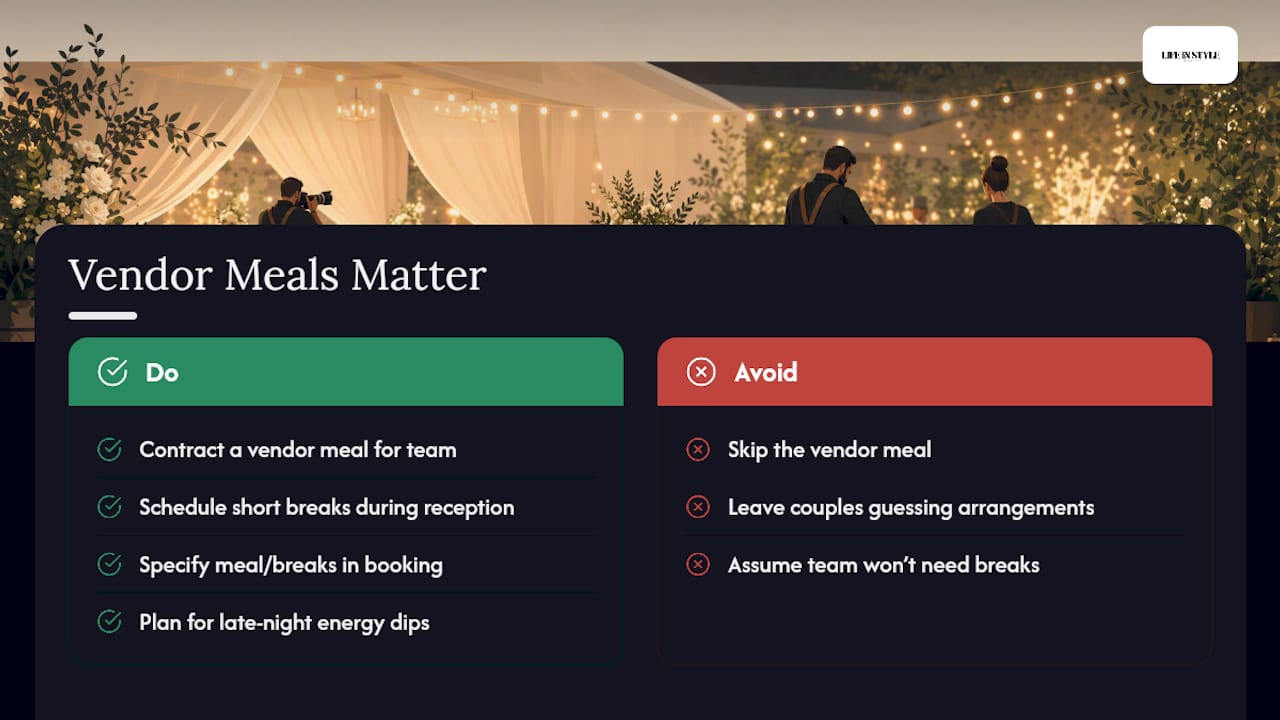
A fed photography team holds focus through the parts of the day that matter most, including golden hour portraits and the last dances of the night, when energy naturally dips. Skipping the vendor meal risks missed reactions, slower reflexes behind the camera, and in longer summer weddings, real fatigue by 9pm.
At Life in Style Photography, we build meal and break expectations into our wedding photography bookings from the start, so couples aren't guessing what to arrange. Planning this properly protects the shots you're paying for.
Author perspective: simple rules of thumb
Three things stick with me after looking at how this plays out across weddings: feed your vendors on any day running past five or six hours, get the meal clause confirmed with your caterer in writing, and stagger breaks if you've booked a second shooter so coverage never actually stops.
If budget's tight, a boxed meal beats a snack, and a discounted supplier rate beats skipping the question entirely.
— Rowan Freeman
Book a photographer who plans for the details that matter
Vendor meal and break planning should be treated as a normal part of every wedding booking, not an afterthought raised the week before the big day. Clear expectations are set upfront around timing, breaks, and coverage continuity, so there's no scrambling with your caterer at the last minute.

That kind of planning protects the moments you're actually paying for, from your ceremony through to the last dance. If you're building your wedding day around a team that thinks through logistics as carefully as they think through light and composition, have a look at our wedding photography packages, including the Ceremony Collection and full day coverage, and get in touch to check availability for your date.
Sources
- A guide to serving wedding vendor meals | Brides
- All Your Questions About Wedding Vendor Meals Answered by Pros | The Knot
- Free Wedding Photography Contract (2026) | Wedy Pro AI
FAQ
Do you have to feed a wedding photographer?
Most couples do, and most photography contracts for events over five hours include a meal clause requiring it. Skipping the meal risks fatigue and lost focus during the parts of the evening your photographer is still meant to be covering, as outlined in Brides' vendor meal guide.
Are photographers considered wedding vendors?
Yes, photographers are classed as wedding vendors alongside videographers, DJs, bands, and planners. This is why they're typically included in the vendor meal headcount you give your caterer, according to The Knot.
What foods work best for photographers during a shoot?
Portable, one-handed foods like wraps, sliders, or boxed meals work best because they let a photographer eat quickly and get back to shooting without missing a moment. Hot plated meals are fine when the timing allows a proper sit-down break between key events.
What's a typical cost to feed vendors at a wedding?
Costs vary by caterer and meal type, so ask directly about supplier meal pricing rather than assuming guest-price rates apply. Many caterers offer a discounted supplier meal specifically for vendors, which is usually cheaper than paying full guest price for each vendor plate.
Does Life in Style Photography plan for meal breaks in bookings?
Yes, Life in Style Photography builds meal and break expectations into wedding bookings so couples know what to arrange with their caterer in advance. Pricing for wedding packages, including the Ceremony Collection and full day coverage, is listed on the wedding photography page.