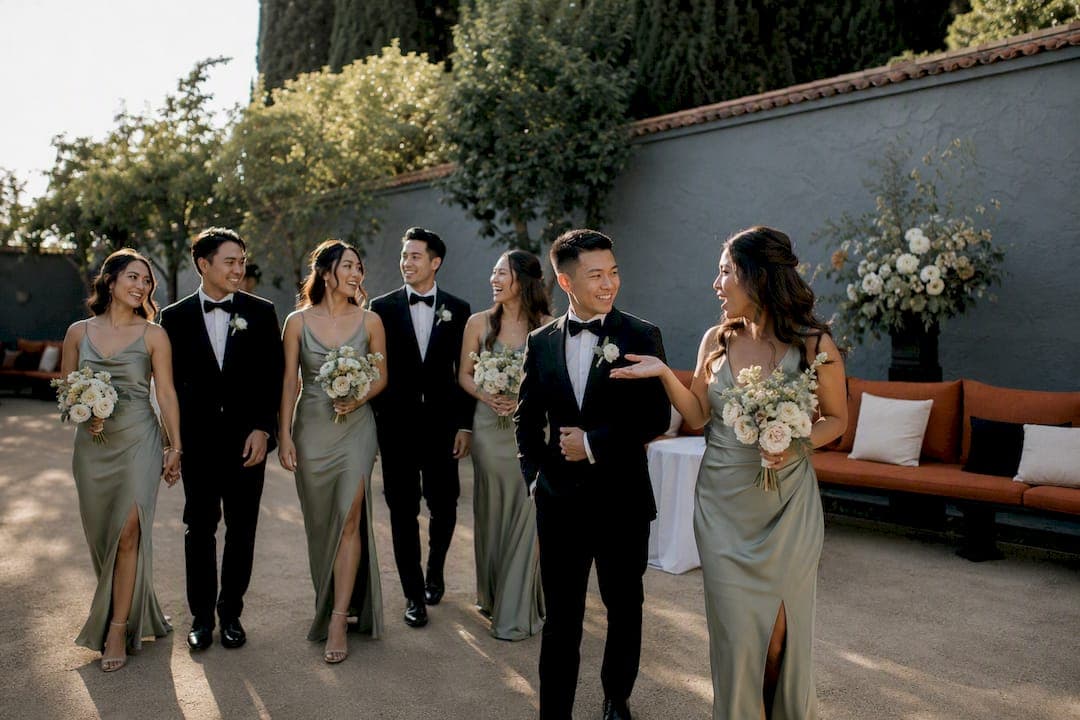
Three approaches cover almost every great wedding party photo you have ever admired: the formal lineup, movement shots where the group walks or talks, and candid prompts that catch real laughter. The single biggest time saver is building a short shot order before the day and locking in a 20 to 40 minute window with your photographer.
TL;DR:
- Prioritize quick, well-planned shots like full group lineup, couple with attendants, and levels formation to cover essential photos efficiently within 20 to 40 minutes.
- Use triangle clusters, stairs, and shoulder angles to create dynamic, natural-looking group compositions, especially for larger parties.
- Opt for prompts and micro-interactions over stiff poses to capture genuine expressions, with a focus on task-based directions for a lively feel.
- Prepare your group beforehand by organizing outfits, giving clear instructions, and packing a small kit to reduce on-site stress and improve photo quality.
- Share a detailed shot list and appoint a timeline captain to ensure smooth execution and maximize time, especially for medium and large wedding parties.
Table of Contents
- Bridal party photo ideas: the 12 shots worth prioritising
- Choosing a pose style: formal, candid, and playful prompts
- How long to allocate and what order to shoot in
- Posing groups: depth, levels, and the triangle method
- Technical basics for sharper, better lit group photos
- Getting your bridal party ready before the camera comes out
- Sample shot lists by bridal party size
- A note from Life in style Photography
- What the conventional advice on bridal party photos gets wrong
- Ready to hand your shot list to a photographer
- Sources
Bridal party photo ideas: the 12 shots worth prioritising
If your timeline is tight, this is the shortlist. Work through it roughly in order and you will cover every angle your album needs without wasting daylight.
- Full wedding party lineup — everyone shoulder to shoulder, symmetrical, couple centred.
- Couple with all attendants — the couple stays the focal point while the group frames them.
- Walking toward camera — loose conversation, arms linked, captured mid-stride.
- Staircase or levels formation — height variation using stairs, benches, or garden walls.
- Huddle shot — everyone leans in close for a tight, warm, candid frame.
- Champagne pop or cheer — a genuine celebratory burst, best shot on continuous drive.
- Individual attendant with the couple — one on one moments that matter for the album.
- Bridesmaids only, groomsmen only — split groups for cleaner backgrounds and easier posing.
- Seated editorial portraits — a bench, steps, or grass, styled like a magazine spread.
- Confetti or cheering tunnel — the whole party either side, couple walking through.
- Shoe or accessory detail shot — boutonnières, bouquets, shoes lined up together.
- Night time sparklers or lantern shot — a creative closer once the light drops.
None of these need elaborate equipment. What they need is a plan, decent light, and a group that knows what is coming next.
Choosing a pose style: formal, candid, and playful prompts
Every bridal party photo idea sits somewhere on a scale from formal to loose, and picking a lane before the day makes posing far faster.
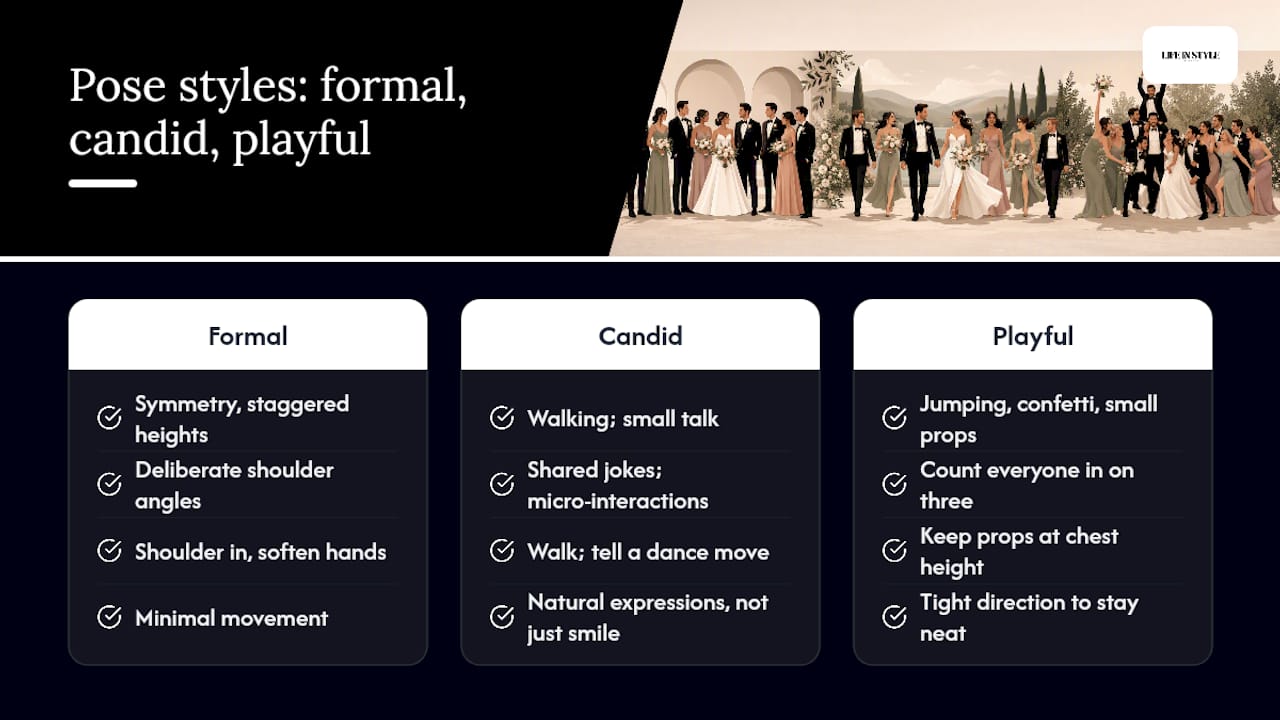
Formal and editorial poses rely on symmetry, staggered heights, and deliberate shoulder angles. A simple prompt like "shoulder in, soften your hands" fixes stiff arms in seconds.
Movement and candid shots come from walking, small talk, and shared jokes rather than a held pose. Try "walk toward me and tell the person next to you your favourite dance move" or "look at the bride and tell her something you're grateful for." Photographers consistently find that prompts and micro-interactions generate more natural expressions than a plain request to smile.
Playful and fun shots use jumping, confetti, or small props, but keep direction tight so it stays neat: count everyone in on three, keep props at chest height, and shoot in bursts.
Pro Tip: Give each attendant a one line task rather than an instruction to "look natural" — a task gives their face something real to react to.
How long to allocate and what order to shoot in
Most planning guides recommend 20 to 40 minutes for wedding party portraits, with larger groups needing the longer end of that window.
- Full wedding party first, while everyone is fresh and still dressed correctly.
- Subgroups next: bridesmaids only, then groomsmen only.
- Couple with individual attendants, working through pairings quickly.
- Candid movement shots, walking or talking, once the formal poses are done.
- Detail shots last, once the group can disperse to drinks or photos of their own.
Build this into a single page shot list and hand a copy to your photographer and whoever is running your timeline. A full wedding shot list gives you a template to adapt for your own group size and venue.
Posing groups: depth, levels, and the triangle method
Flat lineups read as stiff because everyone stands at the same height and distance from the lens. The fix is treating your group like an architectural composition rather than a row of people.
- Use the triangle method: cluster smaller groups into loose triangles rather than a straight line.
- Put people on stairs, benches, or a slope to create tiers instead of one flat row.
- Angle every set of shoulders slightly, shift weight onto the back foot, and close any gaps between people to avoid the stiff "waiting for the bus" look.
- Place the couple first, then build outward by importance, letting shoulders overlap slightly to show real connection.
Photography journals note that staggered head heights and triangular clusters are what separate an editorial group portrait from a school photo. For parties beyond 12 people, breaking into two or three of these clusters rather than one long line makes the whole composition read as intentional.
Technical basics for sharper, better lit group photos
You don't need a technical background to get this right, just a few defaults.
- Favour open shade or golden hour light; if you are stuck in harsh midday sun, backlight the group and fill with a reflector or flash.
- Shoot from a slight distance using a 35mm to 70mm lens, and set your aperture to roughly f/5.6 to f/8 for multi row groups so faces stay sharp front to back.
- Meter for the darkest skin tone in the group, not the brightest, so exposure is fair across every face.
- Shoot five to eight frames per pose. With a dozen or more people blinking at random, multiple frames dramatically increase the odds of everyone having open eyes in at least one shot.
Getting your bridal party ready before the camera comes out
A prepared group photographs faster and looks better, which is worth organising well before the ceremony.
- Nominate one person as timeline captain and send them a simple written schedule, not just a verbal plan.
- Steam or hang outfits the night before, pack backup shoes, and pin boutonnières before anyone stands in front of the lens.
- Check in on comfort: plan a seat or a shorter standing spell for anyone who needs it, especially in heels or warm weather.
Preparation checklists genuinely reduce on-the-day stress and improve overall photo quality because nobody is fixing a hem or hunting for a boutonniere mid-shoot.
Pro Tip: Pack a small kit with safety pins, tissues, and a stain wipe. Handing it to your timeline captain rather than carrying it yourself keeps your hands free for photos.
Sample shot lists by bridal party size
Adjust the depth of your list to match your group size rather than using one template for everyone.
- Small party (up to 4 attendants): full group, couple with each attendant individually, two candid moments.
- Medium party (5 to 8 attendants): add a bridesmaids only and groomsmen only shot, plus a walking sequence and one detail shot.
- Large party (9 or more attendants): shoot in subgroups first, use elevated positions like steps for levels, and prioritise the pairings that matter most since working subgroup by subgroup rather than rebuilding the full group each time saves real time.
A note from Life in style Photography
Rowan Freeman leads editorial direction at Life in style Photography, an Auckland based studio working across weddings, portraits, and personal branding. On set, the team leans on the timeline captain method and simple verbal prompts rather than stiff, held poses, drawing on a working couples and wedding portfolio built from real ceremonies rather than staged setups.
What the conventional advice on bridal party photos gets wrong
Most guides treat posing as a list of shapes to hold. That misses the actual variable that decides whether a photo looks alive or wooden: what the group is doing with their attention in the split second the shutter fires.
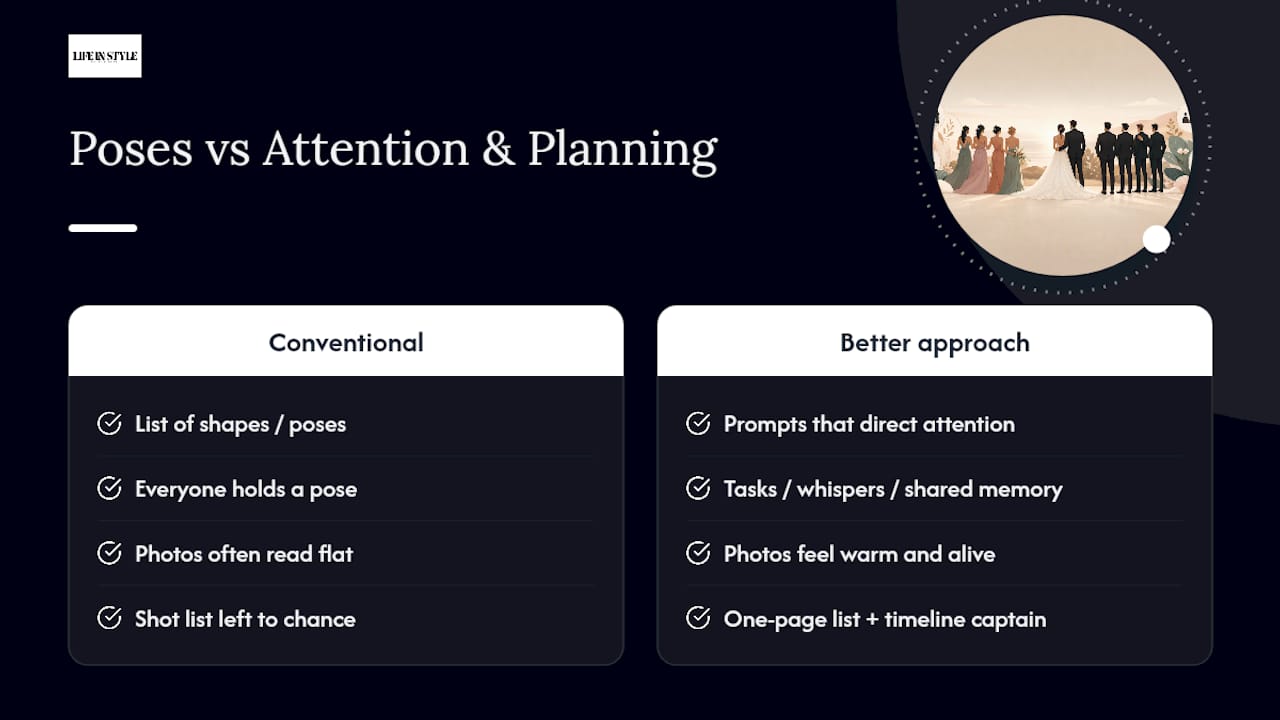
A perfectly staggered lineup with everyone thinking about nothing still reads flat. A slightly imperfect triangle where someone just laughed at a genuine joke reads warm. Prioritise the prompt over the pose. Composition sets the frame, but a task, a whisper, or a shared memory is what puts something real on the faces inside it.
The other thing conventional advice underplays is planning discipline. Couples spend hours choosing venues and flowers, then leave the shot list to chance on the day itself. A one page list, shared in advance with a nominated timeline captain, does more for your final gallery than any single pose idea in this article. Get the plan right first. The creativity works far better once the logistics stop fighting you.
— Rowan Freeman
Ready to hand your shot list to a photographer
Life in style Photography turns exactly the ideas above into a working plan on the day, so you are not the one directing your own bridal party between ceremony and reception. Wedding clients get a shot list built around their venue and numbers, on-the-day direction using the same prompt-based approach covered here, and a relaxed, editorial aesthetic that photographs real reactions rather than forced smiles.
Every wedding package includes planning support before the day, so your timeline captain and photographer are working from the same page rather than guessing. If you are getting married in Auckland and want someone else carrying the shot list on the day, view the wedding photography packages and get in touch for a quote.
Sources
For deeper shot list templates, see Sortra's planning guide and BGF Photography's prioritised checklist, both useful alongside your own timeline.
- How to Plan Wedding Party Photos: A Practical Guide for a Smooth, Stylish Shot List
- 18 Pictures of the Wedding Party You Need to Take
- Photograph a Large Wedding Party Like a Pro | ShutterReview
- Posing large wedding groups: the professional’s guide to architectural composition in 2026