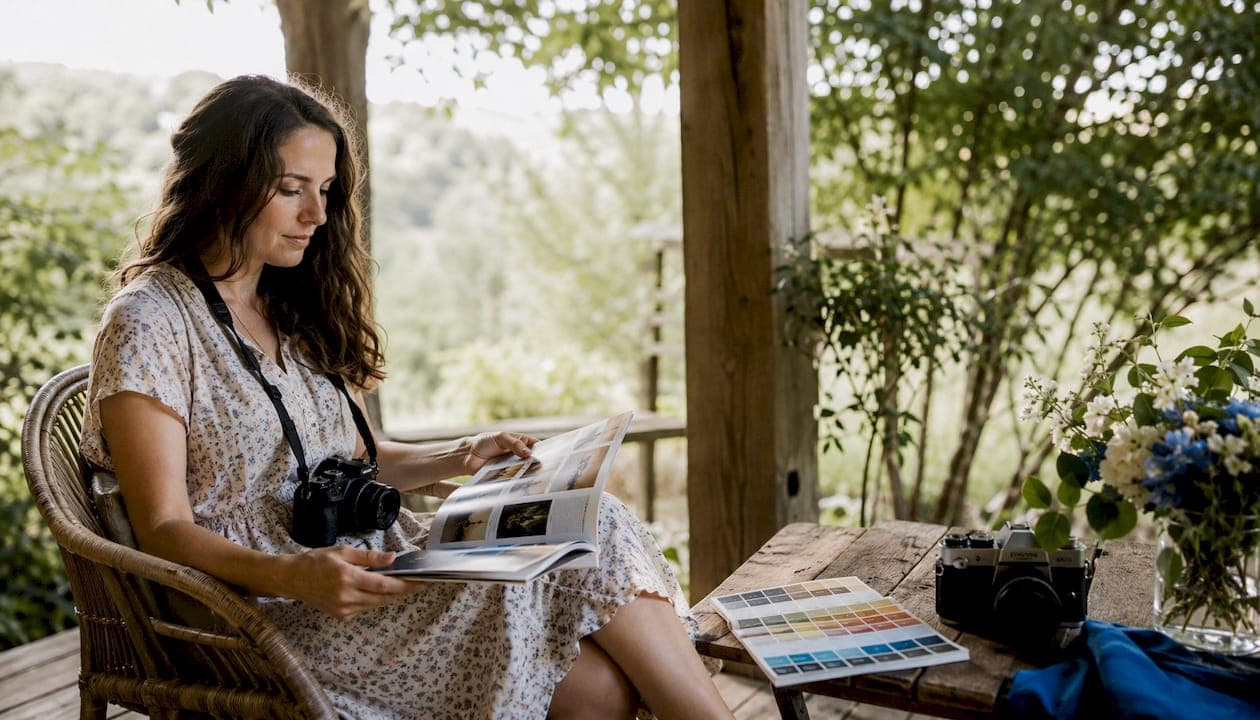
Wedding photography styles fall into a handful of recognizable categories — documentary/photojournalistic, editorial (fashion-forward), traditional (posed), fine art, dark and moody, film/vintage, lifestyle/boho, black and white, flash/high-contrast, blurred/artistic, and aerial/drone — and your best choice depends on how you want to remember the day. If you want to relive the feeling of your wedding, documentary is your anchor. If you want images that look like they belong in a magazine, editorial is the direction to go. Most couples end up somewhere in between, and that’s completely fine.
Before you read further, here are three immediate next steps:
-
Build a mood board of 10–15 saved images from photographers’ full galleries (not just highlight reels) and notice which ones you keep returning to.
-
Book consultations with two or three photographers whose complete wedding galleries match your mood board.
-
Ask each one: “How much of the day is active portrait time versus observation?” That single question tells you more than any style label.
Table of Contents
1. The main wedding photography styles, explained
Below is a practical catalog of every major approach. For each style, you’ll find what it looks like, what kind of wedding it suits, and a one-line brief you can copy when contacting a photographer.
Traditional
Visual hallmarks: Formal compositions, even lighting (often flash-assisted), symmetrical groupings. Colors are accurate and neutral. Backgrounds are clean and uncluttered.
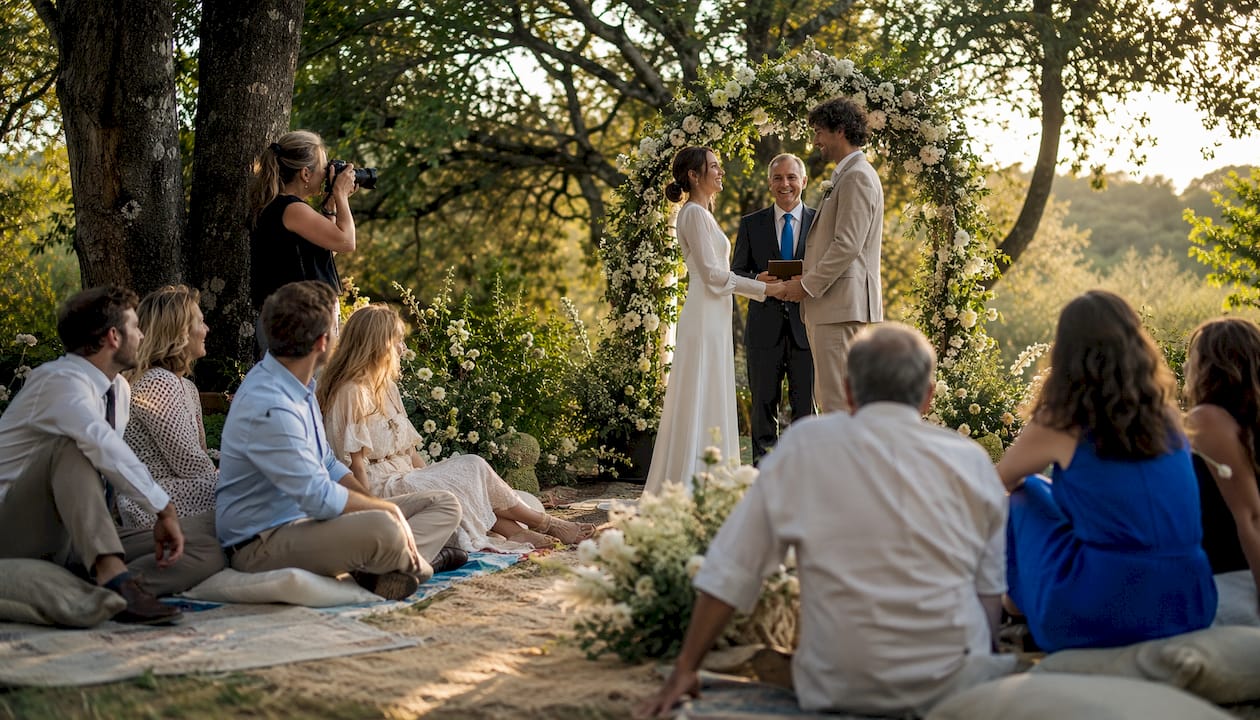
Example shots: Staged family portraits, posed couple portraits at the altar, bridal party lineup.
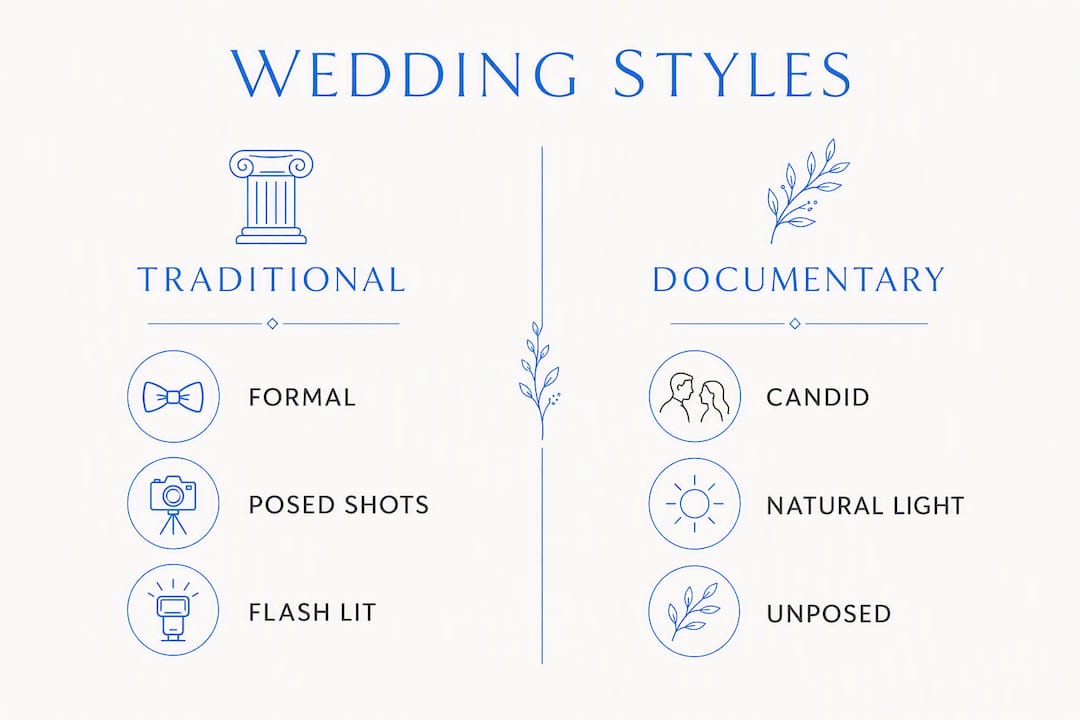
Best for: Couples with large families who need organized group shots, or those with cultural traditions that call for formal documentation. Works well in ballrooms and churches.
Pro: Efficient. Group shots get done quickly and completely.
Con: Less spontaneous; the day can feel like a series of photo calls.
Sample brief: “We need thorough family formals and posed couple portraits at key moments — please plan for organized group shots after the ceremony.”
Documentary (photojournalistic)
Documentary wedding photography prioritizes authentic, fleeting moments with minimal direction. The photographer acts as an observer, building a narrative from bridal prep through the final dance. This approach goes by several names — wedding photojournalism, reportage, and candid wedding photography — and what they share is a commitment to honesty.
Visual hallmarks: Real expressions, natural light, imperfect-but-true compositions. Images feel like they were stolen from the moment rather than arranged.
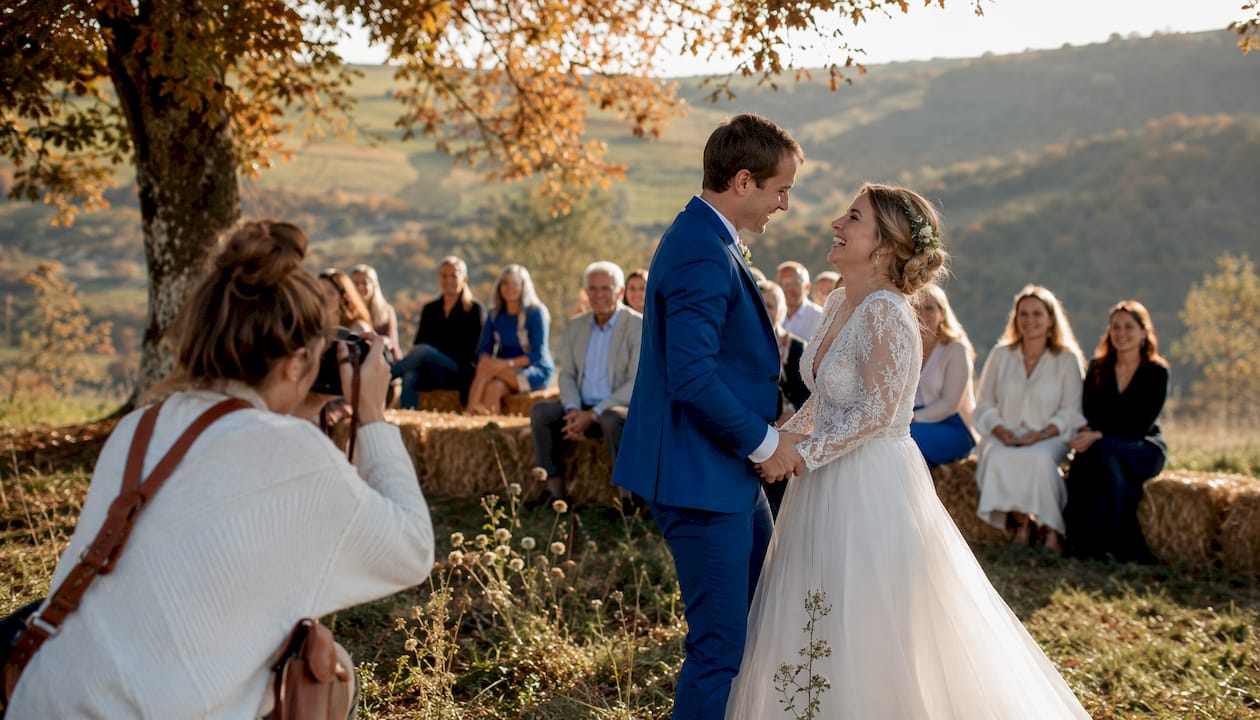
Example shots: A first-look candid, tears during vows, guests laughing at the reception periphery.
Best for: Couples who want to be present rather than perform. Suits intimate ceremonies, outdoor weddings, and anyone who dislikes posing.
Pro: Produces emotionally resonant images that genuinely reflect the day.
Con: Requires trust; you won’t always know what the photographer is capturing.
Sample brief: “We want you to observe and document the day as it unfolds — minimal posing, maximum authenticity.”
Editorial
Editorial style is fashion-forward and highly directed. Think magazine-quality posing, dramatic lighting, and intentional compositions. The photographer takes an active role in shaping each image.
Visual hallmarks: Strong directional light, deliberate poses, cinematic framing. Color grading is often bold or high-contrast.
Example shots: A wide landscape couple shot with dramatic sky, a close-up portrait with off-camera flash, a styled detail flat-lay.
Best for: Couples who love fashion photography and want images that feel curated and aspirational. Suits luxury venues, dramatic landscapes, and styled shoots.
Pro: Consistently striking images with a high-end aesthetic.
Con: Requires more portrait time and active direction, which can feel less natural for camera-shy couples.
Sample brief: “We love fashion-forward, magazine-style portraits — please plan for directed portrait sessions at key locations.”
Fine art (bright and airy)
Fine art photography favors natural light, soft pastels, and painterly compositions. Bright and airy images pair well with garden ceremonies and daylight venues where light is abundant and soft.
Visual hallmarks: Overexposed highlights, muted greens, warm beige or blush tones. Feels light, romantic, and timeless.
Example shots: Backlit couple portrait in a garden, soft-focus floral detail, wide shot in a sunlit field.
Best for: Outdoor daytime weddings, garden venues, bohemian or romantic aesthetics.
Pro: Universally flattering; ages well.
Con: Depends heavily on natural light — overcast or indoor venues can limit the look.
Sample brief: “We love soft, bright, airy images with natural light — think romantic and painterly rather than dark or dramatic.”
Dark and moody
Dark and moody is primarily an editing-driven look. Deeper shadows, rich contrast, and desaturated or cool tones create a dramatic, cinematic mood. Low-light venues and evening receptions suit this style particularly well.
Visual hallmarks: Crushed blacks, muted highlights, strong shadow detail. Colors lean cool or earthy.
Example shots: Candlelit reception portrait, dramatic silhouette at sunset, moody indoor ceremony.
Best for: Evening weddings, industrial or dramatic indoor venues, couples who love a cinematic feel.
Pro: Incredibly atmospheric and distinctive.
Con: Can look inconsistent if the venue doesn’t cooperate with the lighting requirements.
Sample brief: “We want rich, dramatic, moody images — deep shadows, cinematic tones, and a dark, atmospheric feel.”
Film and vintage
Many photographers emulate a film look digitally, though some still shoot on actual 35mm or medium-format film. The result is warm tones, gentle grain, slightly faded highlights, and a nostalgic quality that feels timeless.
Visual hallmarks: Warm or slightly faded color palette, visible grain, soft contrast. Skin tones lean golden.
Example shots: Ceremony candid with grain overlay, couple portrait with warm vintage cast, detail shot with faded edges.
Best for: Couples drawn to a nostalgic, romantic aesthetic. Works beautifully at rustic, barn, or heritage venues.
Pro: Timeless and distinctive; ages gracefully.
Con: True film photography adds cost and longer turnaround; digital emulation varies in quality.
Sample brief: “We love the warm, grainy, nostalgic look of film photography — whether shot on film or edited to match that aesthetic.”
Lifestyle and boho
Lifestyle photography sits between documentary and editorial. The photographer gives gentle prompts (“walk toward me,” “hold hands and keep talking”) but doesn’t fully direct. The result feels natural but is subtly guided.
Visual hallmarks: Relaxed, movement-filled images; natural light; earthy or warm tones. Couples look at ease rather than posed.
Example shots: Couple walking through a field, laughing during a first look, candid embrace at golden hour.
Best for: Couples who want natural-looking images but feel nervous about being completely unposed. Suits outdoor and bohemian weddings.
Pro: Accessible for camera-shy couples; results feel genuine.
Con: Requires a photographer skilled at subtle direction — the prompts need to feel invisible.
Sample brief: “We want relaxed, natural-looking images with gentle guidance — not stiff poses, but not purely candid either.”
Black and white emphasis
Black and white isn’t a standalone shooting style so much as an editing and curation choice. Many documentary and fine art photographers deliver a mix of color and monochrome, selecting black and white for emotionally charged moments where color would distract. Monochrome frequently brings out emotion that color masks — the tones, the grain, the contrast focus the eye on the people and the moment.
Visual hallmarks: High contrast or soft gray tones, strong shadow detail, emphasis on expression and texture.
Example shots: Tear during vows, first dance silhouette, candid laugh at the reception.
Best for: Couples who value emotional storytelling over color palette. Works across all venue types.
Pro: Timeless; removes distracting color casts from mixed lighting.
Con: You lose the color story of your wedding — flowers, dress details, and décor read differently.
Sample brief: “We’d love a strong selection of black-and-white images, especially for emotional ceremony moments.”
Flash and high-contrast
Flash photography uses off-camera or on-camera strobe to create bold, high-contrast images. Popular for receptions and night portraits, it produces a graphic, editorial look that stands apart from natural-light styles.
Visual hallmarks: Sharp shadows, bright subjects against dark backgrounds, punchy color or high-contrast black and white.
Example shots: Reception dance floor portrait, night outdoor couple shot, dramatic indoor ceremony image.
Best for: Evening receptions, dark venues, couples who want bold and graphic images.
Pro: Works in any lighting condition; produces a distinctive, high-energy look.
Con: Can feel less intimate than natural-light styles; requires a photographer experienced with flash.
Sample brief: “We love bold, flash-lit portraits for the reception — graphic, high-contrast, and full of energy.”
Blurred and artistic
This approach uses intentional camera movement, long exposures, or selective focus to create abstract, impressionistic images. It’s rarely a couple’s primary style but works beautifully as a creative accent.
Visual hallmarks: Motion blur, dreamy bokeh, painterly abstraction. Often used for dance floor or reception coverage.
Example shots: Long-exposure first dance, bokeh-heavy reception detail, intentional blur during ceremony exit.
Best for: Couples who want a few artistic, non-literal images to complement their main gallery.
Pro: Adds creative variety and a unique artistic dimension.
Con: Works best as a complement, not a primary approach — a full gallery of blurred images loses narrative clarity.
Sample brief: “We’d love a few creative, artistic images mixed into our gallery — motion blur or impressionistic shots for the reception.”
Aerial and drone
Drone photography adds a wide, landscape-scale perspective that no ground-level shot can replicate. It’s particularly powerful for outdoor venues with dramatic surroundings.
Visual hallmarks: Bird’s-eye compositions, sweeping landscapes, geometric patterns from above.
Example shots: Wide aerial of the ceremony site, couple portrait from above in a field, venue establishing shot.
Best for: Outdoor weddings at scenic venues — vineyards, coastal cliffs, mountain estates.
Pro: Produces genuinely unique images that contextualize the venue.
Con: Requires FAA authorization in many U.S. locations; weather-dependent; adds cost.
Sample brief: “We’d love aerial shots of the venue and a couple of wide landscape portraits if drone use is permitted at our location.”
How to choose your style and brief your photographer
Choosing a style isn’t about picking a label — it’s about understanding how you want to feel during the day and what you want to see when you look back at the images years from now.
Step-by-step decision checklist:
-
Identify your emotional priority. Do you want to relive the feeling of the day (documentary), or do you want images that look intentionally beautiful (editorial/fine art)?
-
Consider your venue and light. A dark indoor ballroom limits bright-and-airy options; a coastal outdoor ceremony opens up almost every style.
-
Assess your comfort with posing. If being directed feels unnatural, lean documentary or lifestyle. If you enjoy it, editorial is worth exploring.
-
List your non-negotiable shots. Family formals? A wide landscape portrait? Candid reception moments? Your must-haves will point toward a style.
-
Account for cultural or traditional requirements. Many cultural weddings require specific formal portraits; confirm the photographer is experienced with those traditions.
Questions to ask in every consultation:
-
“How much of the day is active portrait time versus observation?” This is the most revealing consultation question you can ask.
-
“Can I see a full wedding gallery from a wedding shot in a similar style and venue?”
-
“How do you balance documentary coverage with directed portraits?”
-
“Do you work with a second shooter, and how does that affect coverage?”
-
“What is your approach when lighting conditions don’t cooperate?”
Many modern photographers use a hybrid approach — documentary during the ceremony and reception, editorial for portraits — and it’s more useful to ask how they balance styles across the day than to ask which single style they “are.”
Sample inquiry email:
Timeline and budget factors to keep in mind:
-
Documentary coverage requires less directed time but more total hours to capture the full narrative.
-
Editorial shoots need dedicated portrait blocks, which affects your wedding-day schedule.
-
Traditional group formals take organized time immediately after the ceremony — plan for it.
-
Film photography adds cost (materials, lab processing) and typically extends delivery time.
-
A second shooter adds coverage and cost; documentary and large-wedding editorial shoots benefit most.
-
Album design, print packages, and RAW file delivery all affect final pricing.
What editing and delivery actually mean for your gallery
Editing consistency is the most reliable indicator of whether a photographer can deliver the look you want. A single stunning image tells you very little; a full gallery tells you everything.
Common deliverables to confirm before booking:
-
High-resolution digital files (standard in most packages)
-
Web-optimized files for sharing
-
Online gallery access (with download and sharing options)
-
Print credits or album design services
-
Turnaround time (digital galleries typically range from 6–12 weeks; film can take longer)
-
Whether RAW files are available (most photographers do not include them by default)
Film vs. digital: True film photography produces organic grain, gentle color shifts, and a tonal quality that’s difficult to replicate precisely in post-processing. Many “film-look” galleries are actually digital images edited to emulate film. Both can look beautiful — but if you’re paying a premium for actual film, confirm the photographer shoots on film and delivers scanned negatives or prints. Ask to see the lab they use.
Editing styles like bright and airy, dark and moody, high-contrast, and desaturated are applied in post-production and affect every image in your gallery. Stylistic labels like “dark and moody” or “fine art” are frequently editing-driven looks rather than shooting techniques, so the delivered gallery’s color grading matters more than any single image you see in a highlight reel.
Pro Tip: Request a complete gallery from a recent wedding shot under similar lighting conditions to your venue. Consistency across 400–600 images is far more telling than 20 curated highlights.
How your chosen style shapes the day itself
A photography style is also a service experience. Documentary shoots require trust and minimal interruption; editorial shoots require more time for direction. Understanding that difference before the wedding prevents frustration on the day.
| Style | Direction level | Portrait time needed | Second shooter benefit | Flash use |
|---|---|---|---|---|
| Documentary | Low | Minimal | High (wider coverage) | Rare |
| Lifestyle/Boho | Low to moderate | Moderate | Moderate | Occasional |
| Traditional | High | High (group formals) | High (crowd management) | Common |
| Editorial | High | High (styled portraits) | Moderate | Common |
| Fine Art/Bright & Airy | Moderate | Moderate | Moderate | Rare |
| Dark & Moody | Moderate | Moderate | Low | Occasional |
| Flash/High-Contrast | Moderate to high | Moderate | Moderate | Always |
What to expect from your photographer on the day:
-
Documentary photographers scout locations in advance, anticipate light, and use subtle prompts during portraits to produce natural-looking images. The best documentary photographers blend observation with gentle guidance — they are not purely passive observers.
-
Editorial photographers will set up specific shots, direct your posing, and may use off-camera flash or reflectors.
-
Traditional photographers typically work from a shot list and coordinate family groups efficiently.
-
Hybrid photographers shift between modes across the day, which is now industry standard rather than the exception.
“A documentary-first approach focuses on bearing witness and is suited to couples who want to be present rather than perform for the camera. Documentary-first couples often value honest images and emotional storytelling over posed perfection.” — Honey & Bloom Photography
When choosing a photographer, assess their ability to create a calm, comfortable environment. A photographer who puts you at ease will produce natural expressions regardless of the style they’re working in — and that comfort level matters as much as their portfolio.
Key Takeaways
Choosing the right photography style comes down to three things: how you want to feel during the day, what your venue allows, and whether you’ve verified a photographer’s consistency across a full gallery.
| Point | Details |
|---|---|
| Pick mood before style label | Decide whether you want emotional truth (documentary) or controlled aesthetics (editorial) before comparing photographers. |
| Review full galleries, not highlights | Editing consistency only shows across a complete wedding gallery — request one before booking. |
| Ask the direction question | “How much of the day is portrait time versus observation?” is the single most revealing consultation question. |
| Most photographers are hybrid | Documentary during ceremony and reception, editorial for portraits is the industry norm — ask how they balance it. |
| Lifeinstyle suits couples who want both | Lifeinstyle’s documentary-first, hybrid approach balances authentic candids with gently directed portraits for a complete gallery. |
What I’d recommend for most couples
Most couples I speak with want the same thing: images that feel real, but also look intentional. That’s not a contradiction — it’s exactly what a well-executed hybrid approach delivers.
The mistake I see most often is choosing a style based on a single image rather than a full gallery. A dark and moody image can look extraordinary in isolation and inconsistent across 500 images if the photographer hasn’t mastered the editing workflow. The same is true for bright and airy, film, and editorial. The style is only as good as its consistency.
My honest recommendation for most couples is to start documentary-first. Let the day unfold naturally, capture the genuine moments, and carve out one or two dedicated portrait sessions for directed images you’ll want to frame. That combination gives you emotional truth and a few polished portraits without turning your wedding into a photoshoot.
If you’re drawn to a specific aesthetic — film grain, dark and moody tones, editorial drama — that’s a conversation about editing and post-processing as much as shooting style. Find a photographer whose full galleries consistently reflect that look, not just their best 20 images.
And if you’re camera-shy, don’t let that steer you away from portraits entirely. A photographer who creates a relaxed, comfortable environment will get natural expressions from you regardless of the approach. The right person behind the camera matters more than the style label on their website. You can find some practical tips on feeling comfortable on camera that apply no matter which style you choose.
How Lifeinstyle approaches your wedding photography
Lifeinstyle’s wedding photography is built around one core idea: your day should feel like your day, not a photoshoot. Rowan leads every wedding with a documentary-first mindset, spending the majority of the day observing and capturing genuine moments, then shifting into gentle direction for portrait sessions that feel relaxed rather than rigid.
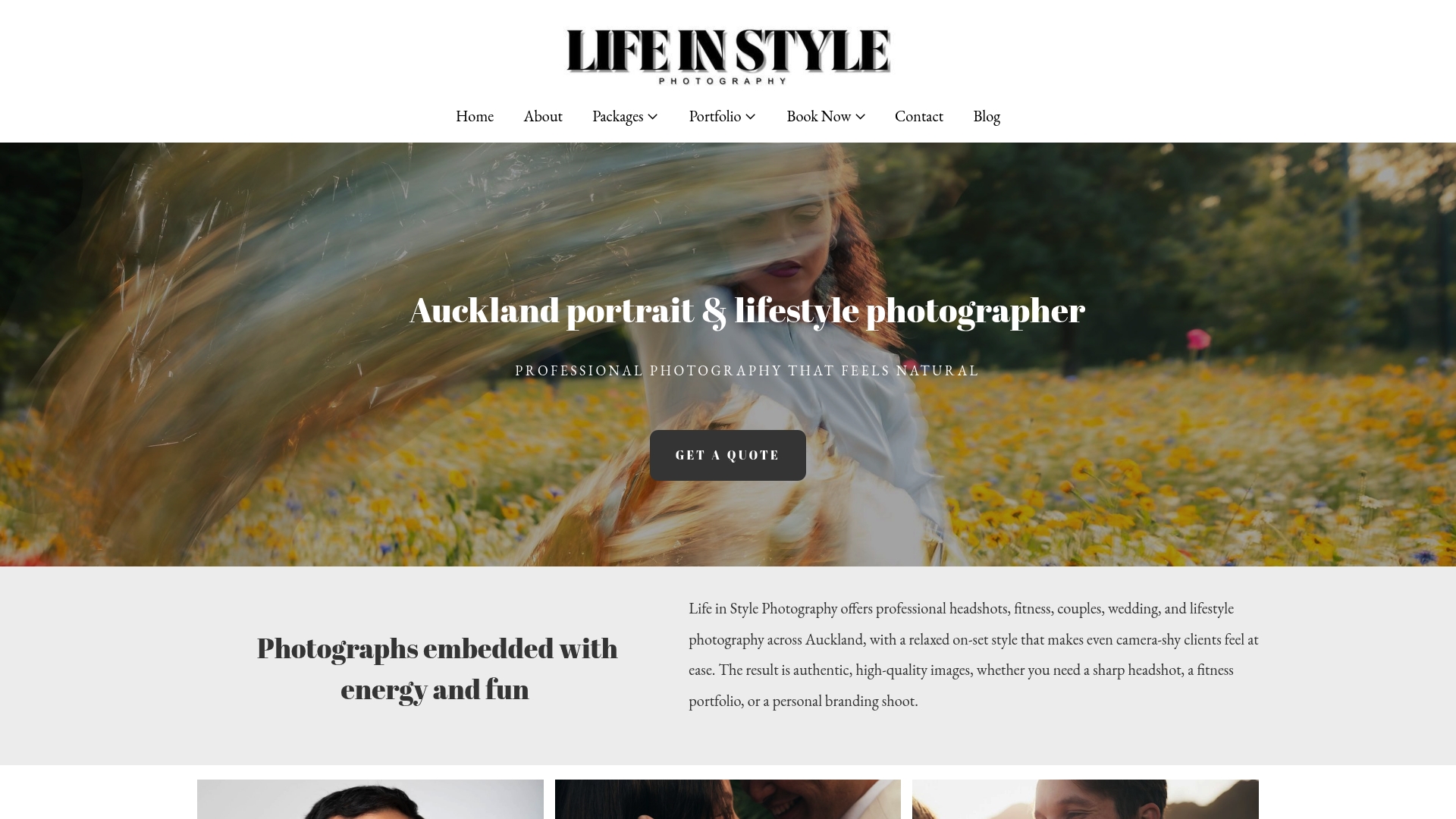
A typical wedding package includes full-day coverage, a dedicated portrait session, high-resolution digital delivery, and album options — with a process that moves from initial inquiry through a style consultation, mood board review, and a day-of plan tailored to your venue and timeline. The goal is a gallery that covers the complete story: bridal prep, ceremony, reception, and every candid moment in between.
If you’re ready to see what this approach looks like in practice, browse the couples portfolio and then reach out to check availability for your date.
Useful sources and how to build your mood board
The most useful research you can do before contacting any photographer is studying full wedding galleries, not curated highlight posts. Here’s what to look for and where to look.
What to look for in a full gallery:
-
Consistent editing tone across the entire day (not just the golden-hour portraits)
-
Coverage of all phases: bridal prep, ceremony, cocktail hour, reception
-
In-the-moment candids that clearly weren’t staged
-
How the photographer handles low-light or mixed-light situations
-
Whether the images tell a coherent story from start to finish
How to build a mood board:
-
Save 10–15 images from full galleries (not Instagram grids) that genuinely resonate with you.
-
Label each saved image with the quality you love: “light,” “emotion,” “composition,” “color.”
-
Look for patterns — if most of your saved images are backlit and warm, you’re drawn to fine art or film. If they’re raw and unposed, documentary is your direction.
-
Share the mood board with your photographer before the consultation so they can respond to specific images rather than abstract style labels.
Authoritative resources worth reviewing:
-
Vogue’s wedding photography style guide covers editorial and traditional approaches with strong visual context.
-
The Knot’s style overview is a practical starting point for understanding editing-driven looks.
-
Lifeinstyle’s wedding and couples portfolio shows the hybrid documentary-lifestyle approach in real wedding contexts.
-
The Lifeinstyle photography blog includes behind-the-scenes posts and practical guidance on the session experience.
When you’re ready to choose the right photographer for your wedding, the mood board you’ve built will make every consultation more productive — and help you recognize immediately whether a photographer’s full gallery matches what you actually want.