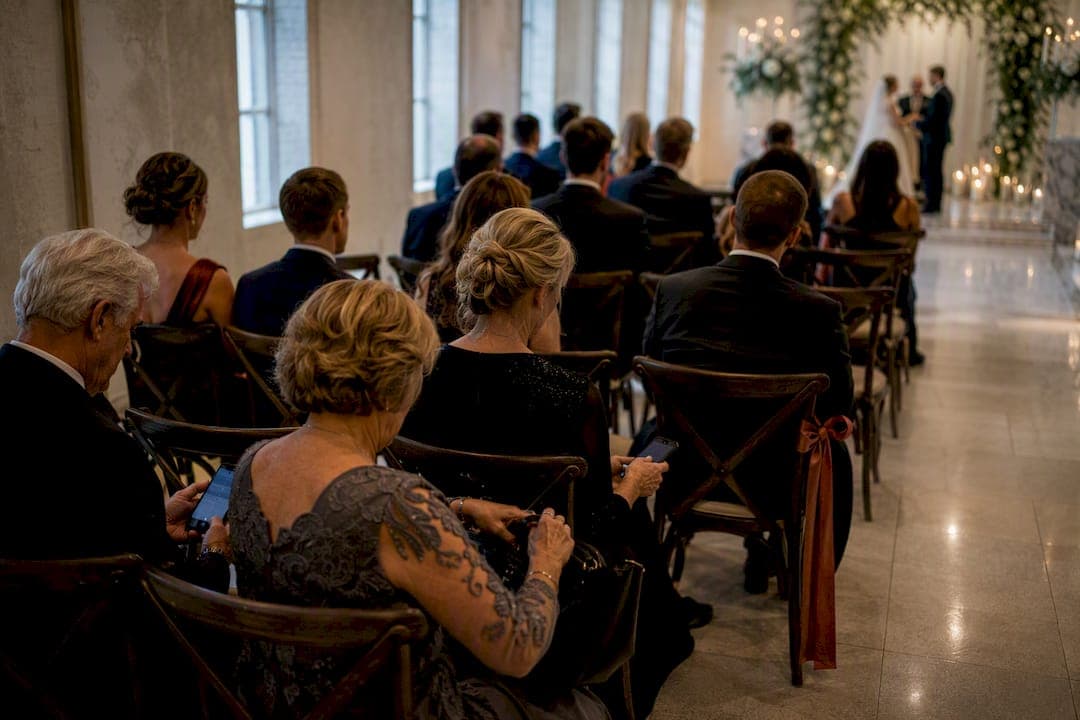
Yes. An unplugged ceremony almost always produces cleaner, more emotional wedding photography because guests aren't holding phones up over the aisle. The single most useful step is telling guests early, on your invitations or wedding website, then having your celebrant announce it before you walk down the aisle. Photographers consistently point to that announcement as the moment guest behaviour actually changes.
TL;DR:
- Guests who comply with early announcements are more likely to remain phone-free during the ceremony, improving photo composition and emotional impact.
- Signage placed at eye level and a celebrant's verbal reminder are the most effective tools for securing guest compliance, especially when scheduled before the processional.
- Partial or one-photo window compromises can be effective but are harder to enforce, so coordinating closely with vendors helps ensure key moments remain clear.
- Non-compliant guests often shift angles or drop phones when reminded, but lighting and timing influence how well photographers can work around them.
- Couples should clarify privacy preferences with their photographer in advance to prevent unflattering or unwanted images of certain guests.
Table of Contents
- What an unplugged ceremony actually means
- How unplugged ceremonies change your photos, according to a photographer
- Weighing the pros and cons for you and your guests
- How to ask guests and actually get compliance
- Photographer-tested tips and realistic compromises
- Common challenges photographers face and how they solve them
- Legal and privacy considerations couples should know
- How unplugged rules affect your videographer too
- How Life in Style Photography handles unplugged ceremonies
- Wedding packages built around unplugged ceremonies
- Sources
- FAQ
What an unplugged ceremony actually means
An unplugged ceremony asks guests to put phones and cameras away during part or all of the service, so the only person photographing is your hired photographer. Couples usually choose one of three approaches: fully unplugged (no devices from the first note of music to the final kiss), partial unplugged (devices away for the vows but fine during recessional or reception), or a hybrid where guests get one quick moment to snap a photo before ceremony start.
Most couples land here for three reasons. They want guests genuinely watching rather than filming through a screen, they want privacy before photos go public on social media, and they've paid for a professional photographer whose sightlines get blocked by raised arms and phone flashes.
Guests sometimes push back, and the objections are predictable:
- They worry they'll have no personal photos of the ceremony at all
- Some feel like they're being "managed" or scolded on someone else's big day
- A few genuinely don't realise the request applies to them until it's too late
Every one of these is manageable with clear wording and a promise of photo access afterwards, which we'll cover below.
How unplugged ceremonies change your photos, according to a photographer
The difference shows up first in composition. Without forests of raised phones down the aisle, a photographer can shoot the processional clean, without a sea of screens between the lens and your face. Photographers report that phone-free ceremonies produce more genuine guest reactions and tighter framing, which lifts the emotional quality of the final gallery, according to Vogue's reporting on phone-free ceremonies.
The moments that benefit most are the ones you'll actually want to remember:
- The processional, where guests' faces turn to watch you rather than to frame a shot
- The vows, where a raised phone from the front row can block the officiant's face entirely
- The first kiss, where phone flashes routinely wreck low-light exposure
- The recessional, when guests who've been asked to stay unplugged often erupt into genuine, unfiltered joy
Even when a few guests ignore the request, photographers adapt. That usually means shifting angles to shoot around known "problem" guests, timing key frames for the split second a phone drops, and leaning harder on candid shots during the exit when compliance typically slips anyway. It isn't a guarantee of a phone-free frame every time, but it measurably reduces how often you'll spot a stranger's phone in your favourite photo.
Weighing the pros and cons for you and your guests
Unplugging the ceremony is a trade, not a free win. Here's what you're weighing up:
- You gain presence. Guests watch you get married instead of watching you through a lock screen.
- You gain cleaner images. Fewer obstructions, better light, more visible faces in every row.
- You gain control over the first reveal. No risk of a blurry phone photo hitting group chats before your photographer has even delivered a single edited shot.
- You lose some guest-sourced candids. Grandma's slightly wonky phone photo from her seat has its own charm, and some couples genuinely miss those.
- You risk friction. A small number of guests always resent being told what to do, however politely you phrase it.
The fix for most of this friction is simple: promise guests they'll get to see professional images quickly, or offer a short window before the ceremony for personal photos. Both defuse the most common objection almost entirely.
— Rowan Freeman
How to ask guests and actually get compliance
Getting an unplugged ceremony to work isn't about one clever sign. It's a sequence, and skipping steps is why some couples end up with phones in frame anyway. Announcing the request early, on your wedding website and invitations, then backing it up with entrance signage and a celebrant announcement on the day, is the combination most likely to succeed, according to The Knot's guide to unplugged weddings.
Here's the sequence that works, in order:
- Weeks before: Add a line to your wedding website and, if you're printing invites, a small note on the RSVP card.
- On arrival: Place a clear, friendly sign at the ceremony entrance, ideally at eye height where guests naturally pause.
- In the programme: Include one short line reminding guests why you've made the choice.
- Right before you walk down the aisle: Have your celebrant say it out loud. Guests are conditioned to listen at that exact moment, more than at any other point in the day.
- Optional: Set up a small basket or attendant near the entrance for guests who want to hand over their phone entirely.
Sample sign wording: "We invite you to be fully present with us today. Please keep phones and cameras away during the ceremony, our photographer will capture every moment for you to enjoy." That kind of warm, positive phrasing works better than anything that sounds like a rule, as explained in guidance for unspoken moments in an Indian wedding and respectful communication to guests.
Pro Tip: Put your sign at the exact spot guests slow down to be seated, not at the car park or gate. A sign nobody walks past slowly is a sign nobody reads.
Photographer-tested tips and realistic compromises
Across most weddings, the celebrant's announcement is the single most reliable enforcement tool available, more effective than signage alone because guests treat it as an authoritative, socially accepted cue delivered in the moment they're already listening. Signage sets expectations early. The spoken reminder is what actually changes behaviour right before it matters.
If a full unplugged ceremony feels too strict for your family, workable compromises exist:
- Partial unplugged: Phones away for the vows and kiss, fine again from the recessional onward.
- One-photo moment: A brief window before the processional where guests can grab a single shot, then phones go away for the ceremony itself.
- Front-rows-only rule: Ask just the first two or three rows to go phone-free, since they're the ones most likely to end up in your photographer's key frames.
Every compromise is slightly harder to enforce than a full unplugged request, simply because there's more nuance for guests to misremember. Coordinating with your celebrant, planner, and photographer beforehand on exactly which version you're running removes most of the confusion on the day. Offering a quick set of preview images within a day or two of the wedding also does a lot of the heavy lifting, since it removes the guest's biggest worry before it even becomes a complaint.
Common challenges photographers face and how they solve them
The biggest practical problem isn't hostile guests, it's inconsistent compliance. One row goes phone-free, the next doesn't, and a photographer has to shoot around that unevenness in real time. The usual fix is positioning: shooting from an angle where the non-compliant guest is out of frame, or timing the shutter for the second their arm drops.
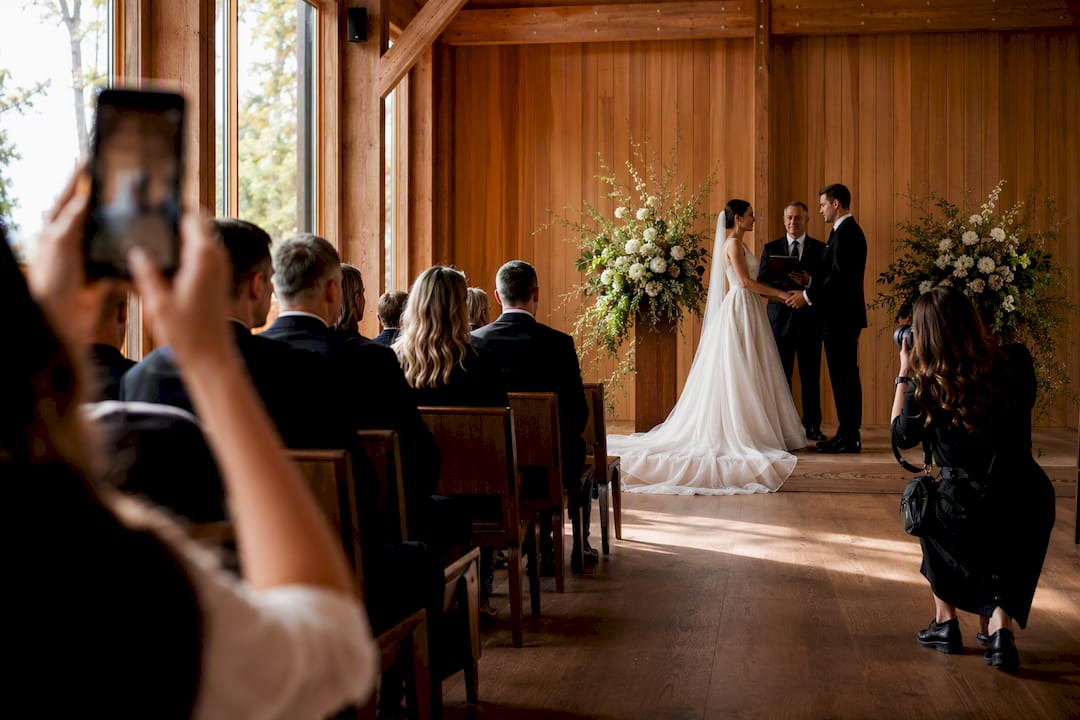
Late arrivals are another recurring issue. A guest who missed the celebrant's announcement because they were parking the car will often lift a phone without realising anyone asked otherwise. Photographers handle this by asking one usher or family member to quietly repeat the request to stragglers, rather than relying on the sign alone.
Lighting is a smaller but real complication. Outdoor ceremonies at golden hour or dim indoor chapels are exactly where a stray phone flash does the most damage to exposure, so photographers often pre-scout the ceremony space and choose a shooting position that keeps flash-prone guests out of the frame regardless of compliance.
Finally, there's the emotional challenge of enforcement itself. Photographers generally avoid confronting guests directly, since it can create tension the couple then has to smooth over. Instead, most lean on the planner or a nominated family member to have that conversation, keeping the photographer focused entirely on capturing the day rather than policing it.
Legal and privacy considerations couples should know
Unplugged requests are a matter of etiquette, not law, so there's no requirement in New Zealand forcing guests to comply. What you're setting is a house rule for your own event, similar to a dress code, and most guests will respect it simply because you've asked politely.
Privacy cuts the other way too. If your ceremony includes guests who'd rather not appear in photos at all, whether for personal, cultural, or safety reasons, it's worth flagging that to your photographer ahead of time so those individuals can be avoided in wider shots or excluded from any images shared publicly. This matters more once photos start circulating: if you plan to post ceremony images or share a gallery link with extended family, a quick check with anyone who's asked not to be tagged or shown avoids an awkward conversation later.
There's also a practical privacy upside to going unplugged that's easy to overlook. When guests aren't taking their own photos, you retain far more control over what gets posted, when, and by whom, rather than having unedited, unflattering shots of your ceremony appear on someone's social media before your own photographer has delivered a single image.
How unplugged rules affect your videographer too
Everything that applies to still photography applies just as strongly, arguably more so, to video. A single raised phone in a guest's row doesn't just spoil one frame, it can spoil several continuous seconds of footage, and unlike a photo, that footage usually can't be reshot or cropped around after the fact.
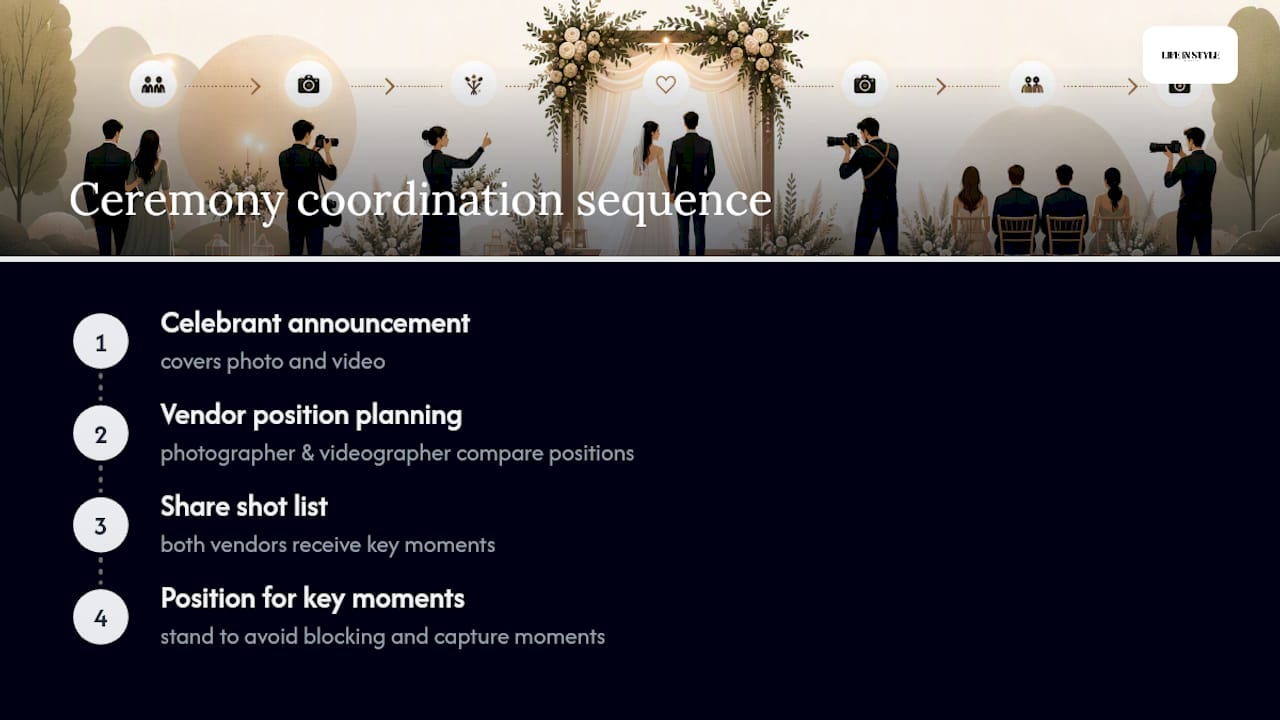
The fix is coordination, not a separate set of rules. Your celebrant's announcement should cover both photography and video in one breath, and your photographer and videographer benefit from comparing notes beforehand on where each of them will be standing, so they're not blocking each other's shots while also managing guest compliance. If you're using a wedding shot list to plan key moments, share it with both vendors so they know which instants matter most and can position themselves accordingly without guesswork on the day.
One extra consideration for video specifically: audio. A phone-free ceremony doesn't just clean up the visual frame, it also reduces the chance of camera shutter sounds, ringtones, or whispered commentary bleeding into your vow audio, which matters far more for a videographer than a photographer.
How Life in Style Photography handles unplugged ceremonies
The unplugged conversation is built into planning from the first shot list discussion, not as an afterthought the week before the wedding. This includes agreeing on signage wording, drafting a short celebrant script, and mapping out exactly where key moments will happen so photographers can position themselves for clean frames whether or not every guest complies perfectly.
On delivery, photographers prioritise a small batch of preview images within days of the wedding, well ahead of the full gallery. That single step removes most of the resistance seen from guests before the day even starts. Every couple's family dynamic is different, and photographers prefer to talk through specific concerns directly rather than provide a generic script that might not fit the celebrant or venue.
Wedding packages built around unplugged ceremonies
If you're already planning to ask guests to put phones away, the next question is who's capturing everything instead. Life in Style Photography's Wedding Photography packages are built for exactly this, with The Ceremony Collection at $1,195 NZD covering focused ceremony capture, right through to the full day collection at $2,995 NZD for couples who want coverage from getting-ready through to the reception. The half day collection sits between the two at $1,895 NZD.

Every wedding booking includes discussion of the day-of communication plan as part of the process, not as an extra. The photographer discusses signage wording, helps draft what the celebrant will say, and agrees on positioning so key moments get captured cleanly, phones or no phones. If you're still deciding which level of coverage suits your ceremony, browse the wedding photography styles guide for a sense of what each approach looks like in practice, or head straight to the Wedding Photography page to check available dates and request a quote.
Sources
A few sources shaped the practical advice in this guide:
FAQ
What are the cons of an unplugged ceremony?
The main downside is losing some guest-sourced candid shots, the kind only a relative sitting in a specific seat could capture. A smaller number of guests may also feel micromanaged, though positive, clear wording on signage and in your celebrant's script largely prevents that reaction.
How do you tell guests it's an unplugged ceremony?
Announce it early on your wedding website or invitations, then reinforce it with entrance signage and a celebrant announcement right before the processional. That sequence, outlined by The Knot, gets the highest compliance because guests hear it at the exact moment they're paying attention.
What is the 30-minute rule for weddings?
There's no universal "30-minute rule" tied specifically to unplugged ceremonies. If you've seen the term used elsewhere, it typically refers to general wedding-day timing buffers rather than a photography or phone policy, so treat any specific version of it as venue or vendor-specific rather than a fixed standard.
Who walks mum down the aisle?
Traditionally the father walks the bride down the aisle, but plenty of couples now choose whoever fits their family, including having mum walk one or both partners down. It's entirely your call, and worth flagging to your celebrant and photographer in advance so the moment gets captured the way you want it.
Does Life in Style Photography offer packages for unplugged ceremonies?
Yes, ceremony coverage is included across the Wedding Photography range, starting with The Ceremony Collection at $1,195 NZD. Day-of communication planning, including signage and celebrant wording, is discussed as part of every wedding booking.