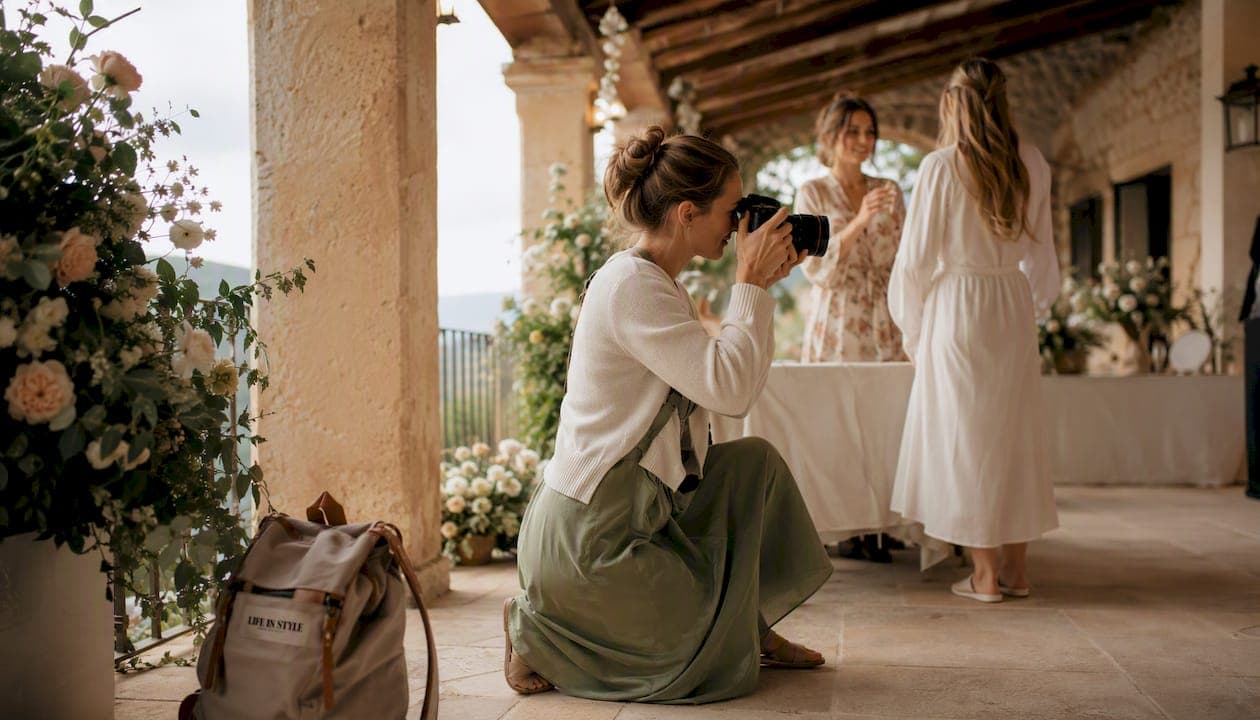
Documentary wedding photography is a photojournalistic approach that captures your day as it actually unfolds, with minimal direction and no staged moments. Also called reportage or photojournalistic wedding photography, it is built around observation, anticipation, and storytelling rather than posing. If you want to stay fully present on your wedding day and come home to images that feel genuinely yours, this style is likely the right fit.
Here is what you can expect:
- Full-day coverage from getting-ready moments through the last dance
- Mostly candid images captured without direction or interruption
- A short family-formals window of limited duration, covering multiple portrait groups
- A handful of guided couple portraits, usually during golden hour or a natural break
- A cohesive narrative gallery that tells the whole story of the day, not just the highlights
Table of Contents
- What documentary wedding photography actually means
- How documentary differs from traditional and editorial approaches
- Why couples choose this approach, and what to weigh carefully
- What your photographer will do throughout the day
- The skills that separate great reportage photographers from average ones
- How to choose a documentary wedding photographer
- How to read a portfolio and spot genuine storytelling
- Practical tips for couples on the wedding day
- What research and experienced photographers agree you should expect
- Key Takeaways
- Why documentary weddings matter more than most couples realize
- Life in style Photography for your wedding story
- Further reading and resources
What documentary wedding photography actually means
The philosophy behind this style comes directly from photojournalism. Henri Cartier-Bresson's concept of the "decisive moment" is central to it: the precise fraction of a second when emotion, action, and light converge into a single frame. Documentary wedding photographers train themselves to anticipate that moment rather than manufacture it.
What separates genuine reportage from a collection of random candid snapshots is narrative sequencing. A skilled documentary photographer builds a visual story across the full day, from the quiet nervousness of getting ready to the uninhibited energy of the dance floor. The images work together to recreate the experience of the day, not just document isolated moments.
Coverage typically runs from preparations through the reception's final hour. The deliverable is a cohesive gallery, not a folder of unrelated frames.
How documentary differs from traditional and editorial approaches
Understanding the differences helps you decide whether a pure documentary approach, a hybrid, or something more traditional suits your priorities.
| Dimension | Documentary / Reportage | Traditional / Posed | Editorial / Fashion |
|---|---|---|---|
| Direction level | Minimal to none | High | High |
| Portrait time | a short period (formals + couple) | — | — |
| Editing style | Natural, true-to-life tones | Polished, often retouched | High-contrast or stylized |
| Guest experience | Uninterrupted, relaxed | Frequently paused for shots | Heavily choreographed |
| Primary output | Narrative story gallery | Portrait collection | Magazine-style images |
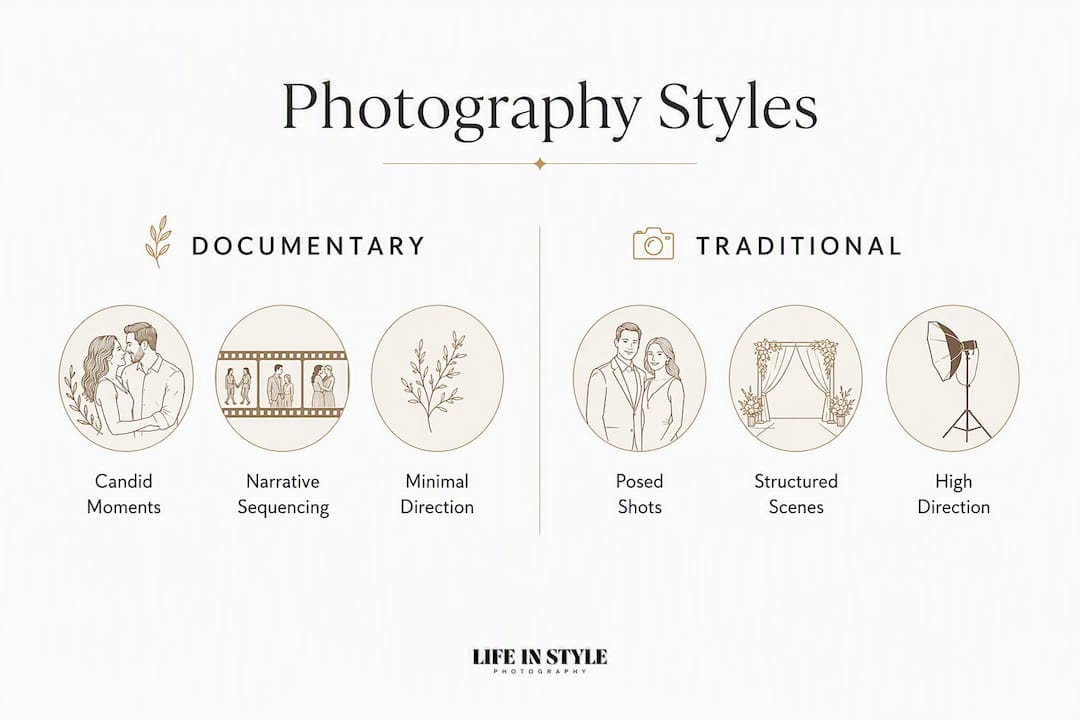
A hybrid approach makes sense when you want the emotional authenticity of candid coverage but also value a few composed, magazine-quality portraits. If you go that route, be specific with your photographer: agree on an exact number of portrait minutes, which groups to include, and how much direction is acceptable. Without those boundaries, a "hybrid" session can drift toward a traditional shoot.
Why couples choose this approach, and what to weigh carefully
The benefits are real and practical. Candid wedding photography lets you stay present. You are not pulled away from your guests for extended portrait sessions, and your reactions, tears, and laughter are captured because they actually happened, not because someone asked you to recreate them. Camera-shy couples especially benefit, since there is no pressure to perform for the lens.
The emotional payoff is significant. Natural wedding photography tends to produce the images couples return to most often, because those frames hold genuine feeling rather than a rehearsed expression.
The trade-offs deserve honest consideration:
- Fewer posed or formal portraits, which matters if extended family expects traditional group shots
- Results depend heavily on the photographer's anticipation and technical skill, particularly in low-light venues
- Poor scheduling or a chaotic family-formals window can create gaps in the story
- Venues with restricted access or very dark interiors require a photographer with strong available-light technique
Lighting and schedule are the two biggest variables. A venue with beautiful natural light and a relaxed timeline gives a documentary photographer room to work. A dark ballroom with a rushed schedule demands more technical experience and, occasionally, subtle supplemental lighting.
What your photographer will do throughout the day
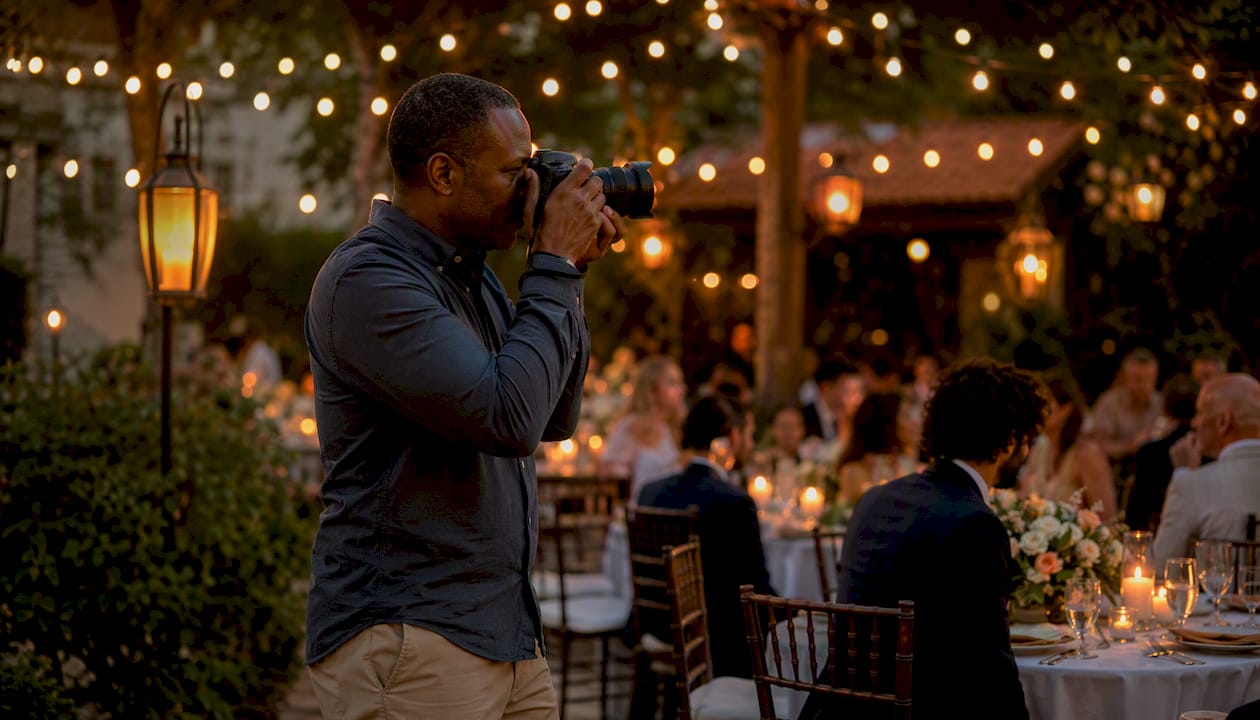
Full-day coverage means the photographer arrives during preparations and stays through the reception, acting as an observer rather than a director. Here is how a typical timeline looks:
| Phase | Typical Duration | Photographer's Role |
|---|---|---|
| Getting ready | — | Observes quietly, captures candid prep moments and details |
| Pre-ceremony | 15–20 minutes | Documents arrivals, guest interactions, venue atmosphere |
| Ceremony | — | Discreet coverage from multiple angles, no interruptions |
| Family formals | a short period | Efficient, list-driven; several groups maximum |
| Couple portraits | a brief period | Light guidance only; natural interaction encouraged |
| Reception | several hours | Observational coverage of speeches, toasts, dancing |
During the ceremony, a good documentary photographer stays invisible. They move quietly, shoot from a distance when needed, and never interrupt a moment to reposition someone. The family-formals window is the one structured exception: a defined list of groups, moved through efficiently so the rest of the day stays natural and candid.
Pro Tip: Designate a trusted family member as your "wrangler" for the formals window. They know who needs to be in each shot and can gather people quickly, keeping the 10–20 minute window realistic.
The skills that separate great reportage photographers from average ones
Anticipation is the core skill. A documentary photographer reads the room constantly: watching for the father who is about to tear up, the flower girl who is about to bolt, the couple who is about to share a private laugh. Positioning for that moment before it happens is what produces a decisive-moment image rather than a blurry reaction shot.
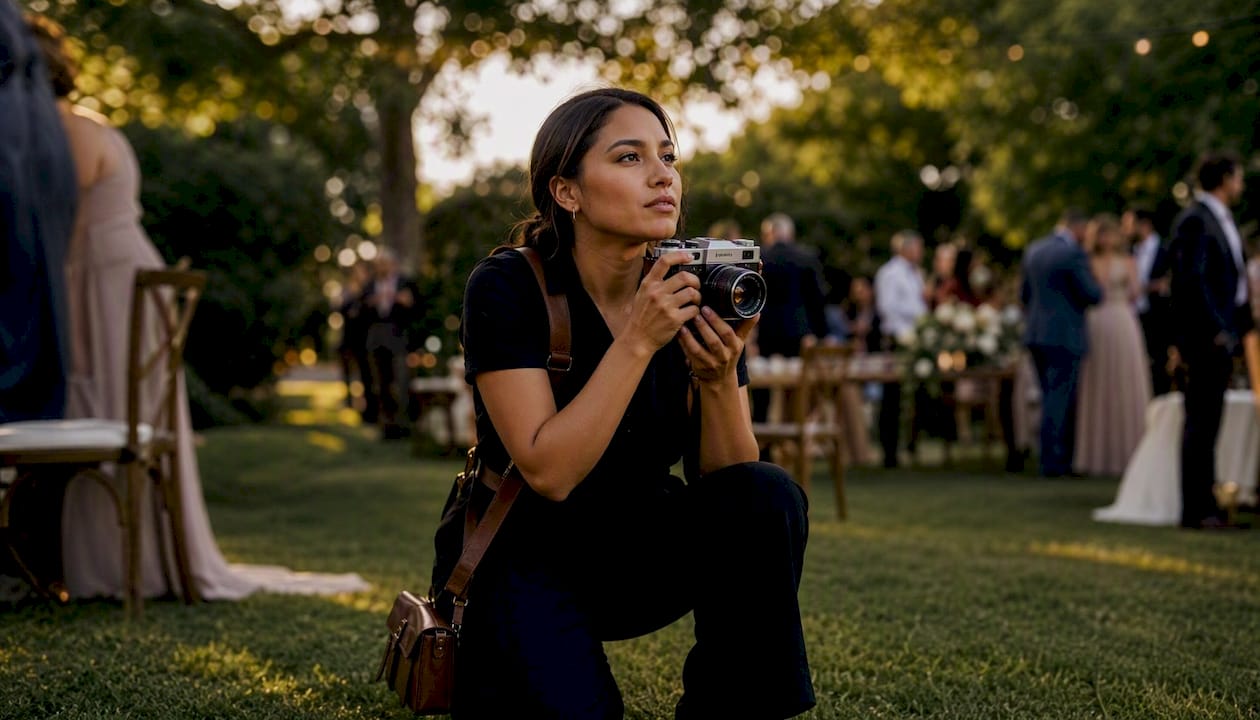
Composition and layering matter just as much. Strong reportage images often include foreground, subject, and background working together to give context to an emotion. A tight close-up of clasped hands means more when the ceremony backdrop is visible behind it.
Low-light technique is where experience shows most clearly. Technical mastery of available light is non-negotiable in venues like candlelit barns or dimly lit reception halls. The best photographers handle this with high-ISO capability and fast lenses rather than flash, preserving the ambient mood. When supplemental lighting is necessary, it is used subtly so it does not disrupt the candid feel.
Finally, sequencing. A skilled photographer does not just capture individual frames; they build a narrative across hundreds of images that, when edited together, recreate the emotional arc of the day.
How to choose a documentary wedding photographer
Build your checklist
- Review full wedding galleries, not just highlights. A curated highlight reel can look documentary even when the full day was heavily posed. Ask to see two or three complete galleries from start to finish.
- Check for narrative variety. Strong reportage galleries show getting-ready moments, ceremony candids, reception energy, and quiet in-between moments. If every image is a posed portrait, the photographer is not working documentarily.
- Look for credentials in reportage organizations. This Is Reportage and the Wedding Photojournalist Association (WPJA) judge photographers on technical and storytelling excellence. Membership is a meaningful vetting signal.
- Ask about their second shooter policy. A second photographer covers angles the lead cannot, especially during the ceremony and reception simultaneously.
- Confirm their low-light approach. Ask specifically how they handle dark venues. The answer should reference fast lenses, high ISO, and minimal flash.
- Discuss the family-formals plan. A good documentary photographer will have a clear, efficient process for this window and will ask you for a prioritized list in advance.
- Request their typical delivery timeline. Industry practice for edited wedding galleries generally runs four to eight weeks after the wedding date.
Questions to ask in the interview
- "Can I see a full gallery from a wedding with a similar venue or lighting situation to mine?"
- "How do you handle the family-formal window without it taking over the day?"
- "What is your approach when the light is poor or the schedule runs late?"
- "Do you work with a second shooter, and what do they cover?"
Pricing considerations
Documentary wedding photography in the United States typically varies widely in price depending on experience and services included. Full-day coverage, a second shooter, and a high-resolution edited gallery are standard inclusions at the mid-to-upper range. Always confirm what is included in writing before signing.
Red flags to watch for: portfolios that are entirely posed despite a "documentary" label; photographers who market themselves as candid but whose galleries are heavily staged; vague answers about low-light technique; no clear contract terms around delivery timeline or image count.
Pro Tip: When comparing quotes, ask each photographer to define what "full-day coverage" means in hours. Some start at the ceremony; others arrive during preparations. That difference can be two to three hours of your story.
How to read a portfolio and spot genuine storytelling
A genuine documentary portfolio tells you something about the people in it. You should be able to follow the emotional arc of the day through the images, even without knowing the couple.
Look for these signals in any gallery you review:
- Getting-ready moments that feel private and unposed, not arranged
- Ceremony frames that capture reactions from guests, not just the couple at the altar
- In-between moments: a quiet conversation, a child wandering, a grandparent watching
- Reception candids that show real movement and energy, not everyone posed for the camera
- Consistent quality across the full day, not just during golden-hour portraits
Staged galleries masquerading as documentary tend to show repeated poses across different weddings, over-curated settings with no environmental context, and very few images from the less photogenic parts of the day (getting ready in a small hotel room, a dark reception hall). If the portfolio only shows beautiful light and beautiful settings, ask to see the rest.
You can also browse This Is Reportage to see what award-winning documentary storytelling actually looks like. It sets a useful benchmark when evaluating photographers you are considering.
For a broader comparison of photography styles, the wedding photography styles guide from Life in style Photography is a practical starting point.
Practical tips for couples on the wedding day
Small scheduling decisions have an outsized effect on what your photographer can capture.
Do:
- Build 15–20 minute buffers between major transitions (ceremony end to cocktail hour, for example)
- Give your photographer a prioritized family-formals list of no more than 5–7 groups before the day
- Designate a family wrangler who knows the list and can gather people quickly
- Let your photographer know about any private moments you want documented (a letter exchange, a first look)
- Choose a venue with good natural light if possible, or confirm your photographer's low-light approach
Avoid:
- Scheduling family formals immediately after the ceremony when emotions are still high and guests are dispersing
- Asking guests to re-enact moments the photographer missed
- Overscheduling the day so tightly that there is no room for spontaneous moments
- Blocking sightlines during the ceremony with a large videography rig
Pro Tip: Ask your guests to keep phones down during the ceremony. A sea of screens blocks sightlines and pulls people out of the moment, both of which affect what your photographer can capture.
What research and experienced photographers agree you should expect
Documentary photographers consistently emphasize that this style is a practiced skill built on anticipation, composition, and timing, not a passive approach to shooting. The results depend on experience, not luck.
On deliverables, industry practice points to full-day observational coverage from preparations through the reception, with 10–15 portraits completed in roughly 15–20 minutes. Edited gallery delivery typically runs four to eight weeks post-wedding, with final image counts varying by photographer and package, though full-day coverage commonly yields several hundred edited images.
The photojournalistic approach produces cohesive story sequences rather than unconnected single frames. That distinction is what separates a true documentary gallery from a folder of candid snapshots, and it is the main thing to look for when evaluating any photographer's work.
Key Takeaways
Documentary wedding photography is the right choice when you want a cohesive, emotionally honest story of your day, captured with minimal direction and maximum authenticity.
| Point | Details |
|---|---|
| Coverage scope | Full-day observational coverage runs from preparations through the last dance. |
| Family formals | Keep the formals window to 10–20 minutes and limit groups to 5–7 for best results. |
| Portfolio vetting | Always request full wedding galleries; highlight reels can hide a heavily posed approach. |
| Credentials matter | Membership in This Is Reportage or WPJA is a reliable signal of genuine reportage skill. |
| Life in style Photography | Life in style Photography brings a relaxed, observational approach to wedding coverage, helping couples stay present while capturing the real story of their day. |
Why documentary weddings matter more than most couples realize
There is a tendency to treat documentary wedding photography as the "relaxed" option, the style you choose when you do not want to fuss with posing. That framing undersells it considerably.
What a skilled reportage photographer actually delivers is harder to produce than a traditional portrait session. Posing someone in good light is a learnable, repeatable process. Anticipating the exact moment a father sees his daughter walk down the aisle, being in the right position, with the right exposure, before the moment peaks — that requires a different order of skill entirely. It demands patience, people-reading, technical fluency, and the confidence to stay still when every instinct says to move.
Couples who choose this approach and then look back at their galleries years later consistently describe the same thing: the images feel like memory, not documentation. That is the real value of the style, and it is why the photographer's experience level matters so much more here than in almost any other genre.
If you are weighing styles, do not choose documentary because it sounds low-maintenance. Choose it because you want images that hold the actual feeling of your day, and then invest in finding a photographer with the skill to deliver that.
Life in style Photography for your wedding story
If you want your wedding day captured with warmth, honesty, and a genuine eye for the moments that matter, Life in style Photography offers exactly that kind of coverage. The approach is observational and relaxed, designed to keep you fully present while building a complete visual story from the first quiet moments of the morning through the energy of the reception.
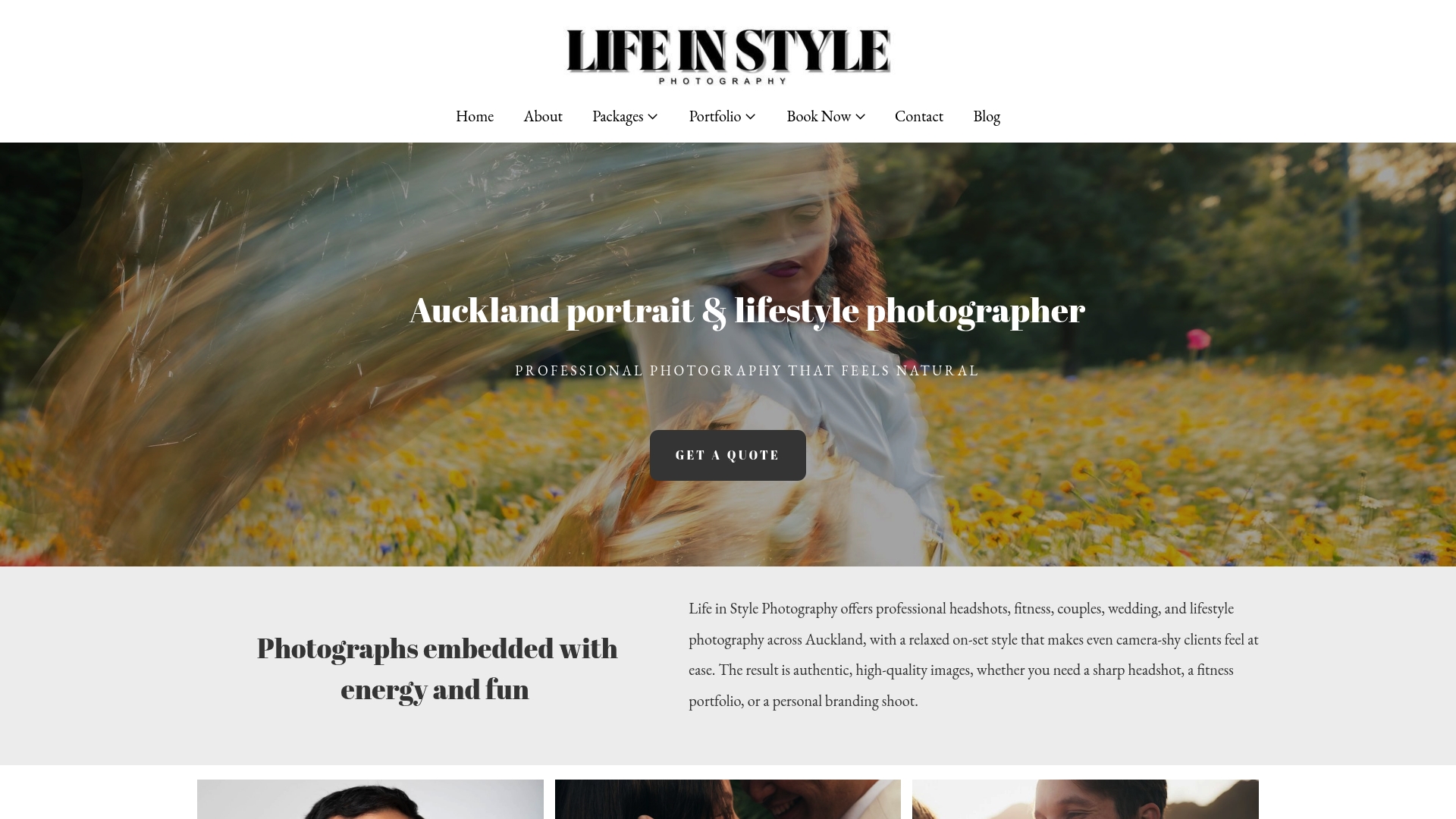
What sets Life in style Photography apart is the on-set style: calm, unobtrusive, and genuinely engaging, so even the most camera-shy couples feel at ease rather than watched. You get the candid emotional moments and the essential family portraits, handled efficiently within a defined window so the rest of your day flows naturally.
Browse the couples and engagement portfolio to see how natural interaction translates into images that feel real, then visit the wedding photography page to review packages and reach out with your date.
Further reading and resources
These sources are worth reviewing as you research photographers and refine what you are looking for:
- This Is Reportage — An authoritative directory and awards body for documentary wedding photographers worldwide. Browsing the award winners gives you a clear benchmark for what genuine reportage storytelling looks like.
- Wedding Photography Styles Guide | Life in style Photography — A comparison of major wedding photography styles to help you decide which approach fits your priorities.
When you contact any photographer on your shortlist, ask for two or three full wedding galleries before committing. That single step will tell you more than any highlight reel or Instagram feed.
Recommended
- Wedding Photography Styles: A Complete Guide for Couples
- Auckland Engagement photography - Auckland Portrait, Branding & Wedding Photographer | Life in Style Photography
- Micro Wedding Photography: A Complete Guide for Couples
- Auckland Wedding and engagement photographer - Auckland Portrait, Branding & Wedding Photographer | Life in Style Photography