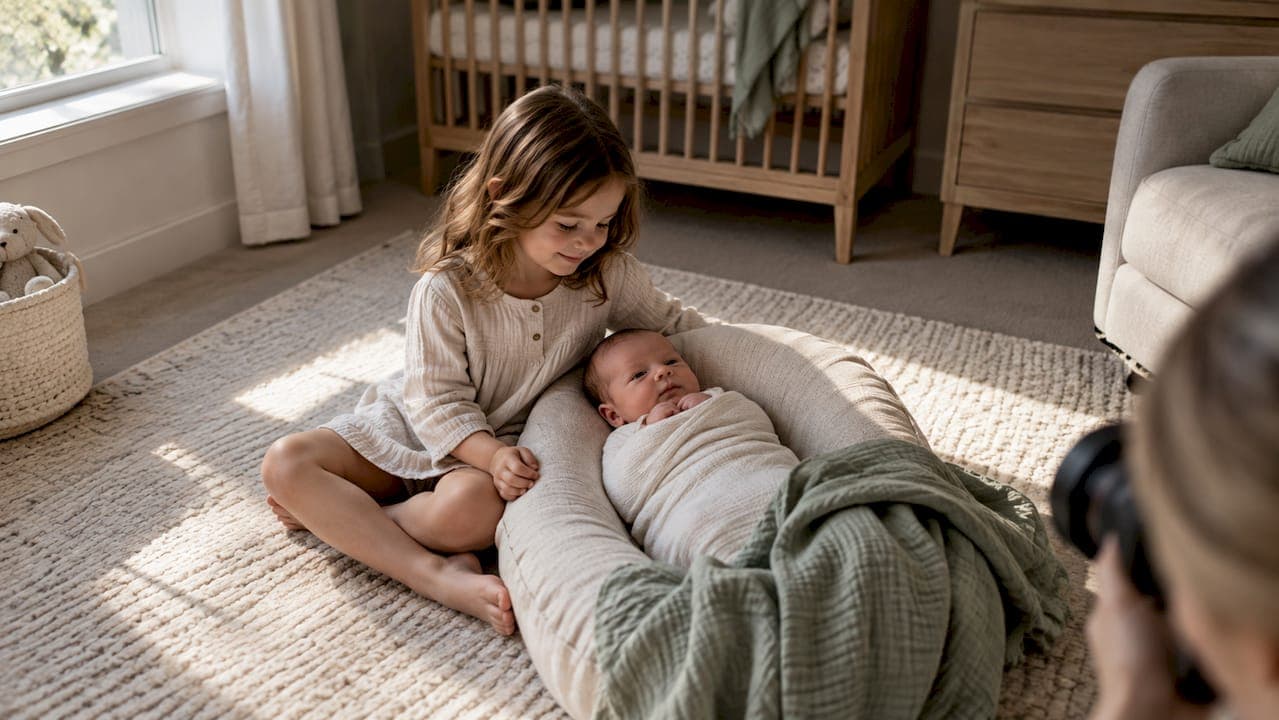
Include siblings in newborn photos when a spotter is on hand, sessions stay short, and the focus is connection rather than a perfect pose. Arrange for a second adult to support the older child, plan two or three simple sibling shots rather than a whole gallery, and run a brief rehearsal beforehand so nobody feels caught off guard. The steps below cover the safety rules, poses, and preparation that make this work in practice.
TL;DR:
- Sibling shots should include a spotter, be brief, and focus on connection rather than perfection to capture genuine moments.
- Simple poses like blanket cuddles or hand touches work best, with adults supporting the baby at all times and safety always prioritized.
- Preparing older siblings with practice and assigning small jobs can help improve cooperation and reduce stress during the session.
- Coordinating neutral outfits and meaningful props promote natural, timeless photos that age well over time.
- Flexibility, quick bursts of interaction, and accepting a little mess often produce the most memorable and authentic sibling images.
Table of Contents
- Copyable poses that work for sibling shots
- Safety checklist for sibling poses
- Preparing older siblings before the shoot
- What to wear and which props actually help
- What actually happens during the session
- Photographer-tested techniques that make sibling shots work
- Fast fixes when things go off-script
- Why we'd rather you enjoy the session than chase a perfect shot
- How Life in Style Photography can help
- Useful resources for parents
- Sources
- FAQ
Copyable poses that work for sibling shots
You don't need a studio to get sibling shots that feel genuine. A handful of simple set-ups, done with the right support, will carry most of the session.
- Neutral-blanket cuddle: Sit the sibling on a couch or bed with a rolled blanket across their lap, then place the baby on top with an adult's hand always under the baby's head and back.
- Parent-assisted lap hold: Have the parent sit directly behind the sibling, arms wrapped around both children, so the sibling gets the credit in the photo while the parent does the actual supporting.
- Forehead kiss: Hold the baby up to the sibling's height (an adult does the lifting) and capture the moment just before or after the kiss, when expressions are most relaxed.
- Hands and feet detail: Let the sibling gently touch the baby's hand or foot while seated well back from the baby's face, which keeps the shot safe and still feels intimate.
- Toy prompt: Give the sibling a soft toy to "introduce" to the baby, which naturally draws out curiosity and a real reaction instead of a forced smile.
For each pose, an adult's hands stay within reach of the baby at all times, either supporting directly or ready to step in. If you're shooting on a phone, use natural window light rather than flash, shoot slightly above eye level for the sibling, and switch to burst or continuous mode so you can pick the one genuine expression out of a dozen frames.
Pro Tip: Shoot from slightly behind and above the sibling's shoulder so the baby's face stays visible even if the sibling shifts mid-shot.
Safety checklist for sibling poses
Newborn safety comes first, and every pose above depends on it. Plunket's guidance on bonding with a second baby notes that reactions to a new sibling vary widely by age and temperament, which is exactly why supervision matters more than the pose itself.
- Never leave a baby alone with a sibling, even for a few seconds, no matter how gentle the older child usually is.
- Keep one adult within arm's reach at all times, ready to take the baby's weight if needed.
- Use a firm cushion or rolled towel under the sibling's arms for lap holds rather than relying on the child's grip.
- Watch for restlessness, sudden movements, or grabbing at the baby's face: these are cues to end the pose immediately.
- Wash hands before handling the baby and skip small props like beads or clips that could end up near little fingers.
Pro Tip: Keep posed holds under thirty seconds each. Babies tend to settle better in short bursts than in one long, held pose.
Preparing older siblings before the shoot
A little rehearsal goes a long way. Parenting Place recommends short, playful practice runs before anything unfamiliar, and a photoshoot with a new baby qualifies.
- Practise "gentle hands" on a doll or stuffed toy a day or two beforehand, so the movement feels familiar rather than instructed on the spot.
- Explain the shoot in plain terms: "We're going to take a few photos of you and the baby, then you can go and play."
- Give the sibling a small job, such as choosing which toy to bring, so they feel included rather than sidelined.
- Schedule the sibling portion for their best time of day, not naptime or right before a meal, since mood matters more than timing convenience.
A small reward afterwards, even just a sticker or a favourite snack, reinforces that the session was a positive experience worth repeating.
What to wear and which props actually help
Simple, coordinating outfits photograph better than matching ones, and they're far easier to get everyone into without a fight.
- Choose neutral tones such as soft white, sage, or warm beige, and avoid busy patterns that pull focus from faces.
- Pick soft, breathable fabrics the sibling can move freely in, since a scratchy collar will show up in every expression.
- Bring a spare outfit for the sibling in case of spills or an unexpected mess before the session starts.
- Use props that encourage genuine interaction, such as a small gift for the sibling to give the baby or a familiar soft blanket, and skip anything with small or loose parts.
Coordinating rather than matching also means everyone still looks like themselves, which tends to age better in photos than a fully colour-matched outfit ever does.
What actually happens during the session
Most newborn sessions run for a couple of hours in total, but the sibling portion itself is usually short. Auckland studio workflows, including one described by Hannah Webb Photography, typically photograph the baby alone first, then bring siblings in for a focused burst rather than the whole shoot.
- Baby-only shots come first, while the baby is generally calmest and most likely to sleep through posing.
- Siblings are brought in for a short, focused block, often ten to fifteen minutes, rather than being expected to sit through everything.
- One adult manages the baby while a second entertains or supervises the sibling, swapping in only when it's their turn in frame.
- Pack snacks, a spare outfit, a familiar toy, and hand sanitiser, since a hungry or bored toddler rarely photographs well.
Good photographers build in flexibility, letting siblings pop in and out rather than holding a rigid running order, which keeps everyone's stress levels down.
Photographer-tested techniques that make sibling shots work
A technique many photographers use is the "sibling lock": one adult's hand stays hooked under the sibling's supporting arm throughout a pose, invisible in the final crop but doing all the real work. Quick candid prompts, like asking a toddler to "tell the baby a secret," tend to outperform any posed instruction because the resulting expression is real.
Connection, not perfection, is what makes a sibling photo worth keeping.
At Life in Style Photography, our relaxed, engaging approach comes from years of working with camera-shy clients and young children who don't yet understand what a camera is for. We favour soft, even light and short bursts of interaction over long, held poses, because that's where genuine moments actually happen. For a quick, one-off shot at home, DIY works fine. For a session you want to keep for decades, a photographer used to managing both a newborn and an unpredictable toddler is worth the booking.
Fast fixes when things go off-script
- If the toddler won't cooperate, switch to play-based prompts, shoot in short bursts, and save any remaining posed shots for later in the session.
- If the baby is unsettled, pause for a feed or cuddle and shoot detail shots (hands, feet, sleeping face) while things settle.
- If the sibling seems jealous, hand them an immediate special job, praise them for it, and offer a short one-on-one mini-session of their own.
- If nothing is working after a genuine effort, it's fine to reschedule the sibling portion for another day rather than forcing it.
Why we'd rather you enjoy the session than chase a perfect shot
The photos we treasure most from sibling sessions are rarely the tidiest ones. A toddler mid-giggle at a newborn's tiny sneeze, or a reluctant hug that turns real halfway through, tends to outlast the posed version in every parent's memory. Let the session be a little messy. That's usually where the good stuff is.
— Rowan Freeman
How Life in Style Photography can help

If you'd rather hand the safety planning and sibling wrangling to someone who does it every week, our Maternity and Baby photography packages are built around exactly this. Sessions are relaxed by design, with plenty of time built in for siblings to warm up rather than perform on cue.
- Tiny Moments - Baby shoot is priced at 345 NZD one-off, a good fit for a shorter session focused on the newborn with brief sibling moments.
- Quick Maternity shoot (460 NZD one-off) and Extended Maternity shoot (690 NZD one-off) suit families wanting to capture the lead-up to the baby's arrival with the sibling included.
Get in touch through our Maternity and Baby photography page to check availability and talk through what your family needs on the day.
Useful resources for parents

For more on sibling adjustment, Plunket's page on connecting with your child and Parenting Place's guide to soothing sibling squabbles are worth a read. Our own guide to newborn session outfits covers wardrobe choices in more depth.
Sources
- Baby number two » Whānau Āwhina Plunket
- Let's rehearse — Parenting Place
- What does an Auckland newborn photoshoot look like on the day? — Hannah Webb Photography
FAQ
Should siblings be in newborn photos?
Yes, when a spotter supervises every hold and the sibling portion stays brief. Plunket notes reactions to a new baby vary by age and temperament, so genuine responses, not forced smiles, make the best photos.
What should siblings wear for newborn photos?
Soft, neutral tones in comfortable fabrics work best, avoiding busy patterns that distract from faces. Coordinating outfits rather than matching ones tend to look more natural and age better over time.
When should you take family pictures with a newborn?
Most photographers schedule baby-only shots first, then bring siblings in for a short, focused block once the baby is settled. Studio workflows described by Hannah Webb Photography show this order reduces stress for everyone.
How do siblings typically react to a newborn?
Reactions range widely, from immediate affection to jealousy or indifference, and that's normal. Plunket advises against expecting instant closeness, since bonding with a new sibling often takes time to develop.