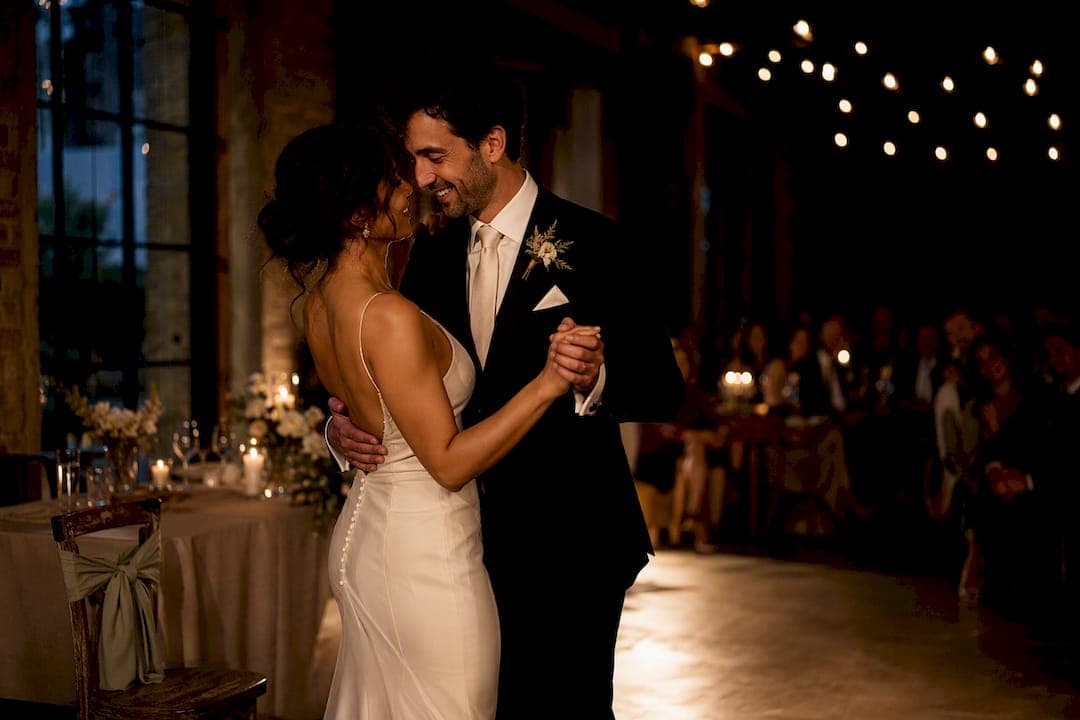
Great first dance photos come from planning two or three key moments, sorting lighting and camera angles with your photographer beforehand, and letting the two of you move naturally instead of rehearsing a routine. A good photographer leans on venue lighting rather than fighting it, and the sections below walk through exactly how to set that up.
TL;DR:
- Most couples underexpose ambient light by one to two stops during the dance to maintain mood while avoiding silhouettes caused by backlighting.
- Using two rim lights and a trigger flash with low power settings creates polished images without flattening the venue's atmosphere.
- Planning key moments and lighting positions beforehand, including a floor plan and specific song cues, ensures seamless coverage and reduces stress.
- Stiff choreography or overly rehearsed routines tend to look staged; natural moments like spins or candid laughs produce more genuine photos.
- Avoid standing with bright lights or windows behind you, as backlighting often results in unwanted silhouettes instead of desired romantic poses.
Table of Contents
- First dance photo ideas worth showing your photographer
- Coordinating with your photographer before the reception
- Lighting and camera settings that keep the mood without losing sharpness
- Wardrobe and choreography choices that photograph well
- A shot list you can copy and send
- Your day-of timeline and checklist
- Why this relaxed, planned approach works
- Talking through your vision before the big day
- Common first dance photography problems and simple fixes
- What actually matters most in first dance photography
- Book a wedding photographer who makes the dance floor feel easy
- Sources
- FAQ
First dance photo ideas worth showing your photographer
Bring a shortlist to your planning chat rather than a vague "just capture the moment" brief. These are compositions that work across most venues and lighting setups.
- Silhouette under fairy lights — moody and cinematic; stand so the string lights sit behind you both, camera low.
- Slow spin with the veil or dress catching air — romantic and full of motion; needs a wide shot to show the fabric.
- Close-up on foreheads touching — intimate and quiet; works best with a longer lens from a few metres back.
- Rim-lit dip — dramatic and a little theatrical; needs a light source (uplight or off-camera flash) angled from behind.
- Shoot-through the crowd's shoulders — natural and candid; photographer shoots from the guest line, not the dance floor edge.
- Bubbles or confetti drifting through frame — dreamy and playful, especially with backlight catching the particles.
- Hand on the small of the back, mid-turn — natural and connected; a medium shot that reads well in albums.
- Laughing at a lyric or a fumbled step — genuinely candid; impossible to pose, so tell your photographer to watch for it.
- Wide shot showing the whole reception glowing around you — establishes scale and venue character.
- Detail shot of hands intertwined — quiet and tender; usually grabbed in the first thirty seconds.
- Uplighting wash across the dance floor — turns a plain function room into something with colour and depth.
For each idea, ask for a wide, a medium, and one close-up frame. That trio covers you if one composition doesn't land.
Coordinating with your photographer before the reception
The dance floor is not the place to improvise camera settings. Sort the details in advance.
- Send photos or a floor plan of the reception space, including where decorative lights sit.
- Pick a few key moments in the song (such as the chorus, a beat change, or a planned dip) you actually want captured well.
- Decide whether a second shooter is worth booking to grab crowd reactions and close-ups while the lead photographer covers you both.
- Agree on exact standing positions for the photographer and, if needed, any off-camera light stands.
- Confirm the dancefloor test happens at least fifteen minutes before guests are called in.
Pro Tip: Send your photographer a floor plan photo from your final venue walkthrough, not a photo from the venue's website. Lighting rigs and furniture placement change between the brochure shot and your actual reception night.
If you're weighing up whether a pre-wedding shoot would help you both feel more at ease in front of a camera before the big night, it's worth raising with your photographer during this planning stage too.
Lighting and camera settings that keep the mood without losing sharpness
Most photographers underexpose the ambient light by one to two stops, then add a low-power off-camera flash or rim light to shape you both without flattening the room's atmosphere. This is the technique behind most polished reception photography you've probably admired without knowing why it worked.
A common, reliable setup among wedding photographers is:
- Two off-camera flashes on stands, positioned to rim-light the couple from either side.
- One on-camera flash used mainly as a trigger and gentle fill, not the main light source.
- Low power settings on all three, so the room's own lighting still reads as the dominant mood.
This three-flash arrangement recycles faster than a single high-power flash, which matters when you're trying to catch a spin or a dip without missing the moment while the flash recharges.
A small aperture also helps create pleasing starbursts from any point-light sources in the room, like fairy lights or candles, and lets your photographer zone-focus rather than constantly hunting for focus in low light. The biggest mistake couples make is positioning themselves with a bright window or doorway behind them. That backlight competes with your photographer's lighting and turns you both into silhouettes when that's not the shot you asked for. Decorative lights, uplighting, and fairy light strings should be treated as part of the composition, not obstacles to work around.
For low-light receptions generally, our guide to winter wedding photo ideas covers more of this same reasoning if your wedding falls in the darker months.

Wardrobe and choreography choices that photograph well
Flowing fabrics move beautifully in photos; stiff, structured pieces don't. Test how your dress bustles and how your hemline sits during a rehearsal spin, not for the first time on the night.
- Choose sensible footwear you can actually turn and dip in, not just stand in.
- Rehearse a slow spin, one dip, and a forehead touch, nothing more elaborate.
- Skip the full routine. Couples who focus on being in the moment rather than memorising complex steps consistently get more natural-looking photos.
- Leave room for a genuine laugh at a lyric or a missed step. That's usually the frame everyone loves most.
A shot list you can copy and send
Give your photographer a realistic sense of what you want captured across the three or four minutes of your song.
- Wide (establishing): the whole dance floor and room, one or two frames early in the song.
- Medium (full body): shows movement, posture, and connection, several frames throughout.
- Close-up (faces): captures expression and emotion, especially during quieter lyrics.
- Detail shots: hands, rings, dress fabric mid-motion.
- Crowd reaction: guests watching, especially parents or the bridal party.
- Shoot-through frames: taken past guests' shoulders for a candid, in-the-room feel.
Balance a few posed anchor shots (the dip, the spin) with candid coverage in between. Too many posed moments back to back reads as staged in the final gallery.
Your day-of timeline and checklist
Ten minutes of preparation prevents most first-dance photo problems.
- T minus 15 minutes: confirm your song cue with the DJ or band, and test lights and sound levels.
- T minus 10 minutes: set your dress bustle, check hemlines, and clear the dance floor edges of chairs or cables.
- T minus 5 minutes: your photographer confirms their position and any off-camera lights are secured on stable stands, well clear of foot traffic.
- T minus 1 minute: the announcement happens, guests gather.
- The dance begins: photographer shoots your planned key moments plus candid coverage.
- T plus 1 to 2 minutes: crowd reaction shots as the dance wraps and guests start clapping or joining in.
If you're using a bubble machine or fairy light feature, have it tested and positioned well before guests arrive, not fumbled with during the announcement.
Why this relaxed, planned approach works
A relaxed, engaging on-set style that puts camera-shy couples at ease is important, especially on the dance floor during a wedding day. A couple who feels watched and judged tenses up, and that tension shows in every frame. Our couples portfolio reflects sessions where planning happened well ahead of time, so the actual shooting felt like documentation, not direction. That's the whole point of pairing minimal choreography with maximum technical preparation: the couple gets to actually dance, and the photography does the rest of the work quietly, in the background.
Talking through your vision before the big day
Most couples underestimate how much a fifteen-minute planning conversation changes the final gallery. Rather than describing a vague feeling ("romantic", "fun", "candid"), bring reference photos. Screenshot two or three images from Pinterest or Instagram that show the mood you actually want, whether that's a moody, dim-lit silhouette or a bright, laughing embrace. Vague language leaves your photographer guessing; specific references remove the guesswork entirely.
Talk through timing too. If you want your photographer capturing your parents' reactions or your wedding party's expressions during the dance, say so explicitly, because a solo shooter physically can't be in two places, and this is exactly when a second shooter earns their fee. Mention any moments you specifically don't want photographed (a stumble, a wardrobe adjustment) so your photographer knows where the line sits. Finally, confirm delivery expectations: how many first-dance images you'll receive, and roughly how long after the wedding your gallery arrives. Clear communication here removes almost every source of post-wedding disappointment.
Common first dance photography problems and simple fixes
The most frequent issue is backlighting. Couples often unknowingly stand with a bright exit sign, window, or DJ booth light directly behind them, and this turns a planned romantic shot into a silhouette nobody wanted. The fix is simple: your photographer checks the standing position during the pre-dance lighting test, not during the dance itself.
The second common problem is motion blur from slow shutter speeds in dim rooms. This is largely solved by the underexposed-ambient-plus-flash technique already discussed, since the flash freezes movement while the ambient exposure keeps the room's mood intact.
Crowded dance floors create a third challenge: guests drifting into frame or blocking sightlines. A second shooter or a clearly agreed photographer position solves most of this, along with a quick request to the MC to ask guests to keep the floor edges clear during the song.
Finally, over-rehearsed choreography often backfires. Stiff, memorised routines read as performance rather than connection in photos. Couples get better results focusing on two or three natural moments and letting the rest of the dance simply happen.

What actually matters most in first dance photography
The conventional wedding advice treats the first dance like a performance to be choreographed and lit like a stage show. That's backwards. The couples who get the photos they actually love spent their planning energy on communication, not rehearsal. They told their photographer which two moments mattered, agreed on where the light would come from, and then let go of trying to control the rest.
Where most guides fall short is treating lighting as a technical afterthought rather than the actual mood-maker it is. Fairy lights, uplighting, and candles aren't obstacles your photographer works around, they're often the entire reason a photo feels romantic instead of flat. Prioritise that conversation about venue lighting over any conversation about dance steps. A couple standing still in beautiful light, genuinely looking at each other, will always outperform a technically perfect spin under a bare fluorescent tube.
— Rowan Freeman
Book a wedding photographer who makes the dance floor feel easy
A relaxed, engaging approach that helps even camera-shy couples look natural in front of a lens matters most in the thirty seconds everyone's watching you dance. A typical wedding booking process starts with a planning conversation covering key moments and venue lighting, moves through full day-of coverage, and finishes with a delivered gallery.

Whether you're after The Ceremony Collection, a half-day package, or full-day coverage, the planning process is the same: we talk through your vision, sort the lighting and positioning ahead of time, and let the two of you actually enjoy your first dance instead of performing it. Check availability and see the full wedding photography options on the Wedding Photography page.
Sources
- A simple and stress-free approach to your first dance
- Tips to nailing the first dance
- Wedding photography lighting tips | Canon New Zealand
- First dance flash — how I light wedding receptions like a movie
FAQ
Should we rehearse our first dance or keep it natural?
Rehearsing a full routine often makes photos look stiff and staged. A more natural, in-the-moment approach with just two or three planned highlights, like a spin or a dip, tends to produce more genuine, photogenic results.
How many photos should we expect from our first dance?
This varies by photographer and package, but most couples receive a mix of wide, medium, close-up, and detail shots covering the full song. Ask your photographer directly what's included in your specific package, since coverage differs between collections.
What lighting setup gives the best first dance photos?
Many photographers underexpose the room's ambient light slightly, then use low-power off-camera flash or rim lighting to shape you both while keeping the venue's mood intact. Avoid standing with bright light sources directly behind you, as backlighting creates unwanted silhouettes.
Does Life in Style Photography offer wedding packages that include first dance coverage?
Yes, first dance coverage is part of Life in Style Photography's wedding packages, including The Ceremony Collection, the half-day collection, and the full-day collection, all listed on the Wedding Photography page. Current pricing and package details are available directly on that page.
What should we send our photographer before the wedding to help with first dance shots?
Share a floor plan or photos of your reception space, including where decorative lighting sits, along with two or three key song moments you want captured well. This lets your photographer pre-plan positioning and lighting instead of improvising on the night.