
Pick the photographer whose full wedding galleries you consistently prefer and who feels easy to spend 8–10 hours with on your wedding day. That's the core of how to choose a wedding photographer, and everything else in this guide helps you verify that choice with confidence.
Before you book anyone, run three quick checks: review 2–3 complete wedding galleries (not just the highlights reel), confirm they have experience in venues or lighting similar to yours, and schedule a 20-minute video call to test the chemistry in person. Life in Style Photography, for example, makes both the gallery review and the consultation easy to arrange, so you can assess style and personality before committing. Ask your top candidate for two full wedding galleries and book that video call this week.
- Review multiple full wedding galleries per candidate
- Confirm venue and lighting experience
- Meet via video or in person before signing anything
- Check the contract for a substitution clause and clear delivery dates
Table of Contents
- The six must-check criteria when selecting a wedding photographer
- How to evaluate a photographer's portfolio beyond the highlights
- What to ask at the consult — questions that reveal reliability and fit
- How pricing and packages work in New Zealand
- When to start looking and how far ahead to book
- Why chemistry matters and how to test it before you book
- Contract red flags and must-have clauses
- A simple method to choose between two finalists
- Your action plan for the next 48 hours
- How to find and source potential wedding photographers
- How to read reviews and testimonials effectively
- How to assess photographer professionalism before the wedding day
- Budgeting tips and total cost considerations
- How to avoid pressure tactics during the consultation
- How to handle the final decision and booking steps
- Key Takeaways
- What actually makes a great wedding photographer
- Life in style Photography is ready to help you get this right
The six must-check criteria when selecting a wedding photographer
Not every photographer who looks great on Instagram will deliver consistently across a full wedding day. These six criteria cut through the noise quickly.
1. Style and editing approach. Pull up the mood board or Pinterest images you've saved and hold them next to the photographer's work. Look for tonal consistency, color grading, and how they treat skin tones in mixed or low light. If their natural-light outdoor portraits look beautiful but their indoor reception shots look muddy, that matters.
2. Full-gallery consistency. Portfolios are curated sales tools; insist on reviewing 2–3 complete, full-day wedding galleries (400–800 images) to check consistency across changing light and family formals. A refusal to share full galleries is a strong red flag.
3. Experience and venue fit. Has this photographer shot at your venue before, or in similar lighting conditions? A dim heritage hall and a golden-hour beach ceremony require very different technical skills.
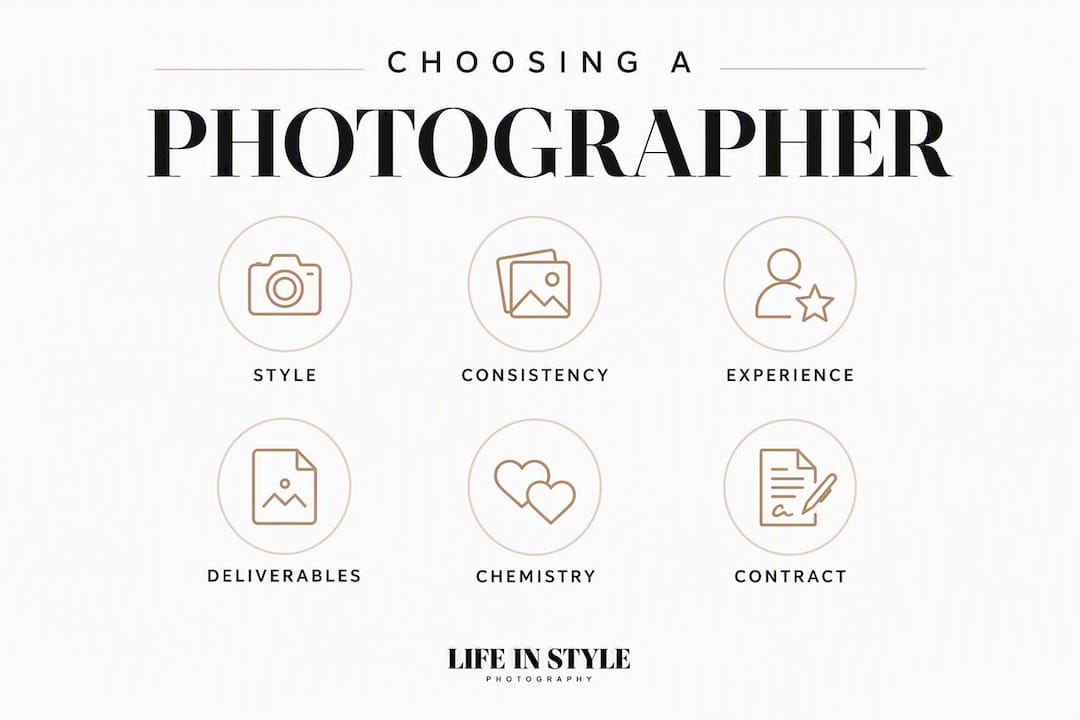
4. Deliverables and timeline. Confirm the expected image count, file formats, album options, and the exact delivery date in weeks, not vague phrases like "as soon as possible."
5. Personality and communication. You'll spend 8–10 hours with your photographer on the wedding day. How quickly do they reply to your initial inquiry? Do their emails feel warm and thoughtful, or transactional?
6. Contract and backup plans. Every contract should include a substitution clause, proof of liability insurance, a written equipment backup policy, and delivery deadlines stated as firm dates or week ranges.
Stat to know: Industry guides consistently recommend requesting full-day galleries of 400–800 images to judge real-world consistency, since highlight reels can mask weak performance in challenging light.
How to evaluate a photographer's portfolio beyond the highlights
A highlight reel is a marketing tool. What you actually need to see is how a photographer performs from the bridal prep at 9 AM through the last dance at 10 PM.
Request multiple full-day wedding galleries from each candidate and set aside uninterrupted time to view them properly. You're looking for how the images hold up across the whole day, not just the golden-hour portraits.
What to scan for in every gallery:
- Ceremony and reception shots in low or mixed light (candles, DJ lighting, dim interiors)
- Candid moments alongside posed family formals
- Detail shots: rings, florals, table settings, shoes
- Consistency in color grading from morning to evening
- How real people (not models) look in the images
Compare like-for-like where you can. If your venue is a dim barn, look for galleries shot indoors. If you're getting married on a beach at sunset, find galleries with similar golden-hour conditions. A photographer who excels outdoors may struggle in a low-light reception hall, and vice versa.
Pro Tip: Pick your 3–5 favorite images from each full gallery, not from the photographer's curated highlights. Then compare your personal selections side-by-side. The gallery that produces more images you'd hang on your wall is usually the clearer answer.
Reviews can reinforce what you see in the galleries. Look for patterns in testimonials, specifically repeated comments about late delivery, missing images, or poor communication. A single glowing headline tells you little; five reviews all mentioning "delivered on time and exceeded expectations" tells you a lot.
What to ask at the consult — questions that reveal reliability and fit
A 20-minute call can surface more than hours of online research. Go in with specific questions and listen for specific answers.
- Availability and personnel: "Will you personally be the lead shooter on our date, or will you send an associate?" Follow up with: who is the second shooter, and can you see their work?
- Image count and format: How many edited images should we expect? What file formats do you deliver, and do we receive high-resolution files for printing?
- Delivery timeline: What is your turnaround time, stated in weeks? When will we receive a sneak peek, and when will the full gallery be ready?
- Album options: Do you offer album design and print services? What are the costs, and are they included or add-ons?
- Backup equipment: What happens if your primary camera fails mid-ceremony? Do you carry backup bodies and lenses?
- Liability insurance: Do you carry public liability insurance? Some venues in New Zealand require proof before allowing vendors on-site.
- Travel and overtime: Are there travel fees for our venue? What is your overtime hourly rate if the day runs long?
- Cancellation and refund policy: What happens if we need to postpone or cancel? Is the retainer refundable under any conditions?
- Contract specifics: Does the contract include a substitution clause naming who can replace you, a firm delivery date range, and explicit printing rights for personal use?
Red-flag answers to watch for: vague delivery windows ("I'll get them to you when they're ready"), no written backup plan for equipment failure, or any hesitation to share complete wedding galleries from past clients.
How pricing and packages work in New Zealand
Wedding photography pricing in New Zealand varies by experience level, coverage hours, and what's bundled into the package. Understanding the tiers helps you compare value rather than just price.

| Package Tier | Typical NZD Range | What's Usually Included |
|---|---|---|
| Budget | NZ$800–NZ$2,500 | 4–6 hours, one shooter, digital gallery |
| Mid-range | NZ$3,000–NZ$6,000 | 8–10 hours, second shooter, engagement session, digital gallery |
| Premium | NZ$6,000+ | Full day, second shooter, engagement session, album design, prints |
Note: These ranges reflect general New Zealand market expectations. Auckland rates often sit at the higher end of each tier. Always confirm current pricing directly with your photographer.
Line items and extras to watch for:
- Travel and accommodation fees for destination or out-of-Auckland venues
- Overtime rates (typically charged per hour beyond the contracted end time)
- Album design and printing costs (often NZ$800–NZ$2,500 extra if not bundled)
- Rush delivery fees if you need images faster than the standard turnaround
- Second shooter fees when not included in the base package
Common pricing traps: A low headline price that excludes travel, overtime, and album design can end up costing more than a mid-range package that bundles everything. Always ask for a total cost estimate, not just the base rate.
Key pricing terms defined:
- Retainer/deposit: A non-refundable payment (usually 20–30% of the total) that secures your date on the photographer's calendar.
- Overtime: An hourly rate charged when coverage extends beyond the contracted end time.
- Second shooter: A second photographer who covers different angles simultaneously, particularly useful for large weddings.
- Licensing vs. copyright: Copyright typically stays with the photographer; licensing grants you personal printing rights. Confirm what you're receiving in writing.
- Sneak peek: A small selection of lightly edited images delivered within days of the wedding, before the full gallery is ready.
- Proof gallery: An online gallery of all edited images, usually delivered via a platform like Pixieset or Pic-Time, from which you select prints or downloads.
When to start looking and how far ahead to book
Start searching 12–18 months before your wedding date, especially for peak-season Saturday weddings in Auckland and other major New Zealand cities. Popular photographers at the mid-range and premium tiers fill their calendars quickly, and the best ones rarely have last-minute availability.
Booking timeline at a glance:
- 12–18 months out: Begin shortlisting photographers, review full galleries, and schedule consultations.
- 10–12 months out: Narrow to two or three finalists, complete your consultations, and request contracts.
- 9–12 months out: Sign with your chosen photographer and pay the retainer to lock in your date.
- 6–8 months out: Confirm logistics, share your venue details, and discuss a shot list or timeline.
- 1–2 months out: Final check-in to confirm start times, family formals list, and any venue-specific requirements.
If you're fewer than six months from your wedding date, shift your approach. Availability becomes the first filter, and you may need to consider a Friday or Sunday wedding to access your preferred photographer. Some photographers do hold cancellation spots, so it's worth inquiring directly even if their calendar appears full.
New Zealand's peak wedding season runs from October through April, with summer Saturdays in December and January booking fastest. Autumn weekends in March and April are popular for their softer light and cooler temperatures, and they often book nearly as quickly as midsummer dates.
Why chemistry matters and how to test it before you book
The images your photographer produces are shaped partly by how comfortable you feel in front of them. A photographer who puts you at ease will capture more natural, relaxed expressions than one who makes you feel stiff or self-conscious.
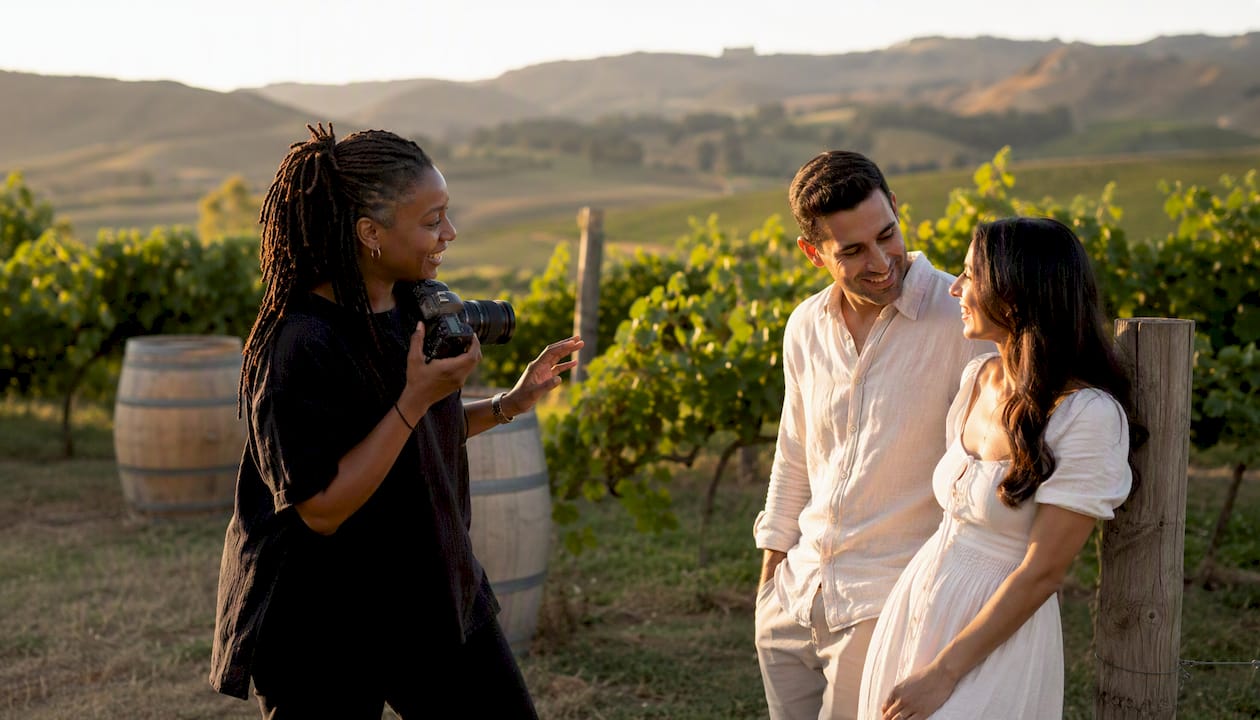
Personality fit is as crucial as artistic skill. Spending 8–10 hours with someone who communicates well and reads the room makes a real difference to how the day flows. During your consultation call, pay attention to whether they ask thoughtful questions about your wedding or simply recite a package rundown. A photographer who asks about your venue, your family dynamics, and what moments matter most to you is already thinking like a storyteller.
Ask directly: "How do you work with couples who feel camera-shy?" The answer reveals a lot. A thoughtful response might describe specific posing techniques, conversation-based direction, or how they use movement to create natural expressions. A vague answer ("I just make it fun!") is less reassuring.
Pro Tip: Notice the tone of their first email response to your inquiry. Warmth, specific questions, and a genuine interest in your wedding before any money changes hands are reliable early signals of how they'll behave on the day itself.
An engagement session is the most practical way to test chemistry before committing to a full wedding package. A 60–90 minute couples session gives you real experience of their posing style, communication, and how they handle the unexpected. It also produces images you can use for save-the-dates. Life in Style Photography offers couples engagement sessions that work well as a low-pressure trial before booking a full wedding package.
Contract red flags and must-have clauses
A well-written contract protects both you and your photographer. Read it carefully before signing, and allow at least 24 hours to review it rather than signing on the spot.
Must-have clauses:
- Exact wedding date, names, venue, and contracted start and end times
- Expected image count (or a clear range, such as 50–80 edited images per hour of coverage)
- Delivery deadline stated as a firm date range (e.g., within 8–12 weeks of the wedding)
- Substitution clause: who can be sent as a replacement if your photographer is unable to attend, and whether you have approval rights over that substitute
- Usage and printing rights: confirmation that you can print images for personal use
- Cancellation and refund policy, including what happens to the retainer if you postpone
Insurance and equipment:
- Proof of public liability insurance (required by many Auckland venues)
- Written equipment backup policy confirming backup camera bodies and lenses are carried
A contract without a substitution clause is a risk you shouldn't accept. If your photographer is ill or injured on your wedding day and the contract doesn't name a replacement process, you have little recourse. Contracts should include a substitution clause, delivery deadlines, and explicit usage rights — and you should never sign less than 24 hours after receiving the agreement.
Red flags to walk away from:
- Delivery promised "as soon as possible" with no firm date range
- No written backup plan for equipment failure or photographer illness
- Missing substitution clause
- Gallery download links that expire in 30 days or less with no archive option
- Refusal to share full wedding galleries from past clients
If you want to request changes to contract wording, do so in writing before signing. Ask for delivery timelines stated in weeks, a named backup photographer or an approval clause for substitutes, and confirmation of your printing rights.
A simple method to choose between two finalists
When two photographers both meet your must-have criteria, the decision often stalls. This method cuts through it cleanly.
Step-by-step:
- Collect the same number of full-gallery images from each finalist (aim for at least one complete wedding gallery each).
- Each partner independently picks their 3–5 favorite images from each gallery, without discussing choices first.
- Lay the chosen images side-by-side and count which photographer won more picks between you.
- Score the remaining factors using a simple weighting: style (40%), personality/chemistry (30%), value and package (20%), logistics and contract (10%).
When you're down to two strong candidates, pick the 3–4 images you love from each of their full galleries and lay them out side-by-side — your personal selections usually point clearly to the best fit. The method works because it removes the influence of price anchoring and marketing copy and puts the actual images at the center of the decision.
If the scores land within a narrow margin and both photographers meet your contract and backup requirements, pick the one whose personality felt warmer during the consultation and commit. Post-booking second-guessing rarely changes the outcome and adds unnecessary stress to your planning.
Pro Tip: The side-by-side selection exercise surfaces the photographer whose work you instinctively prefer when you stop over-analyzing. Trust the images your gut kept returning to.
Stat to know: Industry guides recommend requesting 2–3 full-day wedding galleries (400–800 images) before applying any scoring method, since a decision based on highlight reels alone can lead to regret when the full gallery arrives.
Your action plan for the next 48 hours
You don't need to have everything figured out before you take the first step. Here's what to do right now.
- Request two full wedding galleries from each photographer on your shortlist and set aside time to view them properly.
- Confirm they'll be the lead shooter on your date, not an associate.
- Ask for a written substitution clause before signing anything.
- Get the delivery timeline in weeks, not a vague promise.
- Pay the retainer only after you've reviewed the contract for at least 24 hours.
- If you're still undecided, ask Life in Style Photography about a couples engagement session to test chemistry before committing to a full wedding package.
Don't sign under pressure during or immediately after a consultation. A photographer who pushes for an on-the-spot signature is a yellow flag worth noting.
How to find and source potential wedding photographers
The best starting points are your venue coordinator and recently married friends. Venue coordinators see dozens of photographers work their space each year and know who performs well under their specific lighting conditions. A personal referral from a couple whose images you admire carries more weight than any directory listing.
Online, wedding vendor directories let you filter by location, style, and price range while viewing portfolios and reviews in one place. Instagram is useful for discovering photographers whose aesthetic matches your vision, but always move from social media to a full gallery review before shortlisting anyone. A feed of 30 beautiful images tells you very little about how a photographer performs across a full wedding day.
Local photography associations and wedding expos in Auckland are worth attending if you're early in your search. Meeting photographers in person at an expo gives you a quick read on personality before you've invested time in a formal consultation.
How to read reviews and testimonials effectively
A five-star rating on its own is almost meaningless. What matters is the pattern across multiple reviews and the specific details reviewers mention.
Look for repeated references to punctuality, communication during the planning process, turnaround time, and how the photographer handled unexpected moments (rain, a late ceremony, a difficult family dynamic). Reviewer patterns reveal more about reliability than isolated positive reviews, and a cluster of reviews all mentioning "delivered exactly when promised" is a stronger signal than a single effusive headline.
Pay attention to how the photographer responds to any negative reviews. A measured, professional response suggests maturity and accountability. Defensiveness or silence suggests the opposite.
How to assess photographer professionalism before the wedding day
Professionalism shows up long before the wedding day. The clearest signals appear in how a photographer handles the inquiry and booking process.
Response time is the first indicator. A photographer who replies to your initial inquiry within 24–48 hours and follows up with thoughtful questions is demonstrating the same attentiveness you'll want on the wedding day. Slow or vague responses during the sales process rarely improve once money has changed hands.
Ask to see a sample timeline or shot list from a previous wedding. An experienced photographer will have a clear workflow for the day, including buffer time for travel between locations, family formals, and couple portraits. A photographer who can't articulate how they structure a wedding day is likely less experienced than their portfolio suggests.
Check whether they carry professional-grade equipment and whether they can name their backup gear. This isn't about brand snobbery; it's about knowing they've invested in reliability. You can also review their photography portfolio to assess the breadth and consistency of their work across different venues and lighting conditions.
Budgeting tips and total cost considerations
Wedding photography is one of the few vendor categories where the final cost often exceeds the initial quote. Build your budget around the total cost, not the headline package price.
Start with the base package and add the likely extras: travel fees if your venue is outside central Auckland, overtime if your reception runs late, album design and printing if not bundled, and any rush delivery fees. A mid-range package at NZ$4,000 with NZ$800 in album costs and NZ$300 in travel fees is a NZ$5,100 investment, not a NZ$4,000 one. (Mid-range packages in New Zealand generally sit between NZ$3,000 and NZ$6,000 for an experienced professional.)
Tipping is not standard practice in New Zealand the way it is in some other markets, but it's a genuine and appreciated gesture if your photographer goes above and beyond. A tip of NZ$100–NZ$200 for exceptional service is a reasonable benchmark if you feel moved to offer one.
GST (15%) is included in most New Zealand photography quotes, but confirm this when comparing packages. Some photographers quote GST-exclusive prices, which can make their rates appear lower than they are. Always ask: "Is GST included in this price?"
How to avoid pressure tactics during the consultation
Some photographers use scarcity language to push for a quick decision: "I have another couple interested in your date" or "This price is only available if you book today." These tactics are common and worth recognizing for what they are.
A reputable photographer will hold your date for 48–72 hours while you review the contract. If a photographer refuses to give you time to review the agreement or applies pressure to sign immediately, that behavior is a signal about how disputes or delivery delays will be handled later.
Go into every consultation with your must-have checklist ready. If a photographer can't answer your questions about backup plans, substitution clauses, and delivery timelines with specific, confident answers, no amount of beautiful portfolio work changes that gap. The consultation is your opportunity to assess reliability, not just aesthetics.
How to handle the final decision and booking steps
Once you've chosen your photographer, the booking process is straightforward. Confirm the contract covers all the must-have clauses covered earlier in this guide, then sign and pay the retainer to secure your date.
Most New Zealand photographers require a retainer of 20–30% of the total package price at booking, with the balance due one to four weeks before the wedding. Get the payment schedule in writing as part of the contract, not as a verbal agreement.
After signing, send a confirmation email summarizing the key details: your wedding date, venue, contracted start and end times, and the expected delivery timeline. This creates a paper trail that protects both parties and reduces the chance of miscommunication as the date approaches.
Keep a copy of the signed contract somewhere accessible, and note the delivery deadline in your calendar. If the deadline passes without communication from your photographer, follow up promptly in writing.
Key Takeaways
Choosing the right wedding photographer comes down to reviewing full galleries, testing chemistry in person, and confirming your contract protections before paying a single dollar.
| Point | Details |
|---|---|
| Always request full galleries | Ask for 2–3 complete wedding galleries (400–800 images) to assess real consistency, not just highlights. |
| Book 12–18 months ahead | Peak Auckland weekends fill fast; popular photographers often close their calendars well in advance. Start your search 12–18 months before your wedding date, especially for high-demand photographers and summer weekends. |
| Test chemistry before committing | A 20-minute video call or engagement session reveals a personality fit that no portfolio can show. |
| Protect yourself with a solid contract | Confirm a substitution clause, firm delivery dates, and explicit printing rights before signing. |
| Life in style Photography | Offers Auckland wedding and engagement packages with a relaxed, editorial approach and a clear booking process. |
What actually makes a great wedding photographer
The conventional wisdom says to find someone whose style you love. That's true, but it's only half the answer. The photographers who consistently produce exceptional wedding galleries are the ones who combine technical skill with genuine people skills, and those two things don't always travel together.
What gets underestimated is how much the photographer's behavior shapes the images. A calm, confident presence during a chaotic family formals session produces relaxed, natural expressions. A photographer who rushes, gives unclear direction, or seems stressed transfers that energy to the people in front of the lens. You can see it in the images, even if you can't always name what you're looking at.
The other thing worth saying plainly: a beautiful Instagram feed is not a portfolio. It's a selection of the best 30 images from potentially hundreds of weddings. Full galleries are where the real story lives, and any photographer worth booking will share them without hesitation.
For New Zealand couples, the local market has its own rhythms. Auckland's mix of indoor heritage venues, coastal locations, and garden settings demands a photographer who can adapt quickly between very different lighting conditions. That adaptability shows up in full galleries, not in hero shots.
Life in style Photography is ready to help you get this right
If you've worked through this guide and you're ready to see what a relaxed, editorial approach looks like in practice, Life in style Photography is a strong next step. Based in Auckland, the team works across a wide range of venues and lighting conditions, from intimate garden ceremonies to larger indoor receptions, with a style that prioritizes genuine moments over stiff posing.
The Auckland wedding photography portfolio gives you a clear picture of the full-day work, not just the highlights. If you'd like to test the chemistry before committing to a full wedding package, a couples engagement session is an easy, low-pressure way to experience the on-set style firsthand. To inquire about availability for your date or to ask about package options, reach out directly through the website and expect a response within 24 hours.
Recommended
- Shapo Widget
- What to Look for in a Good Photographer: A Complete Guide - Auckland Portrait, Branding & Wedding Photographer | Life in Style Photography
- Auckland Wedding and engagement photographer - Auckland Portrait, Branding & Wedding Photographer | Life in Style Photography
- Auckland Event Photographer Portfolio - Auckland Portrait, Branding & Wedding Photographer | Life in Style Photography