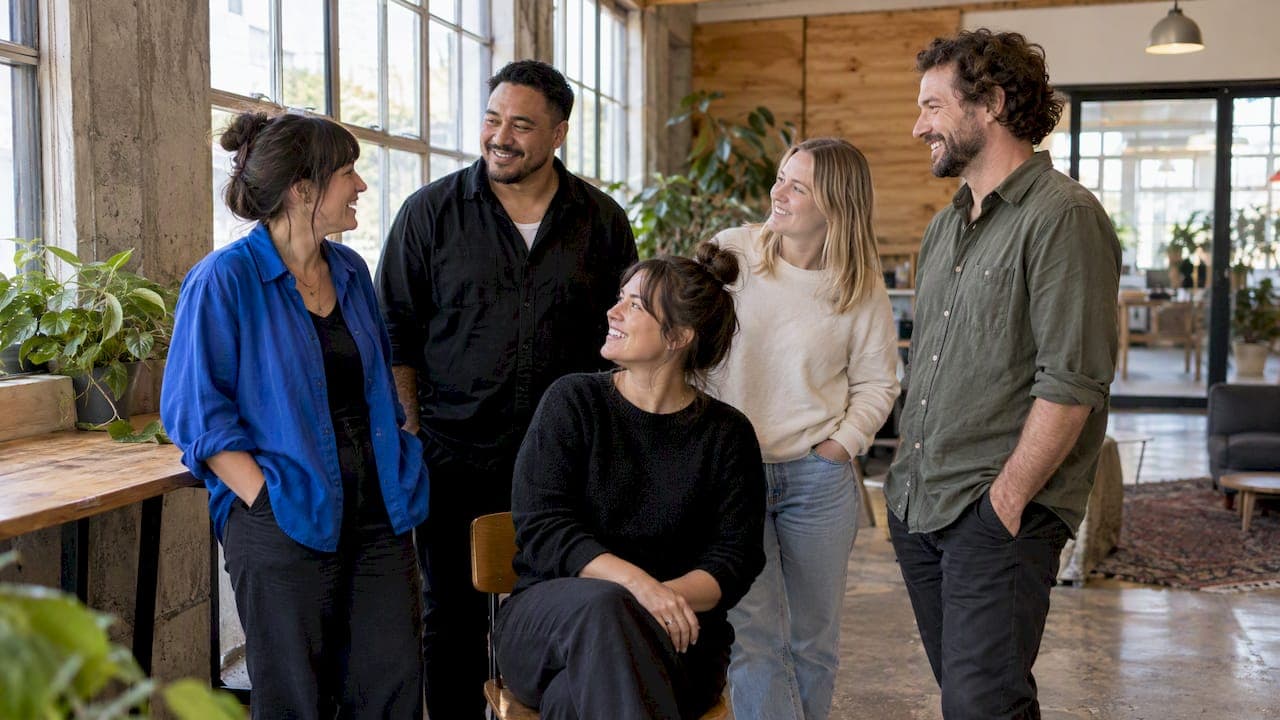
The quickest way to get great team photos is to pair one polished hero portrait with a handful of relaxed candid shots, settle on a simple wardrobe palette beforehand, and put one person in charge of wrangling the group. We've shaped this guide around that approach, drawing on practical experience from professional photography, so the images you end up with work just as well on your website as they do on social media.
TL;DR:
- Use a simple color palette and a designated person to coordinate positions, ensuring the group looks cohesive and relaxed.
- Pose arrangements should build from the back with staggered heights and avoid hidden faces for every individual to read well.
- Shoot with a moderate telephoto lens at eye level using soft lighting, and check camera framing on faces before capturing the final images.
- For large groups, plan a short, structured shot list starting with a hero image and ending with candid shots to maintain energy.
- For critical or complex photos, hiring a professional photographer provides better control over lighting, direction, and post-production quality.
Table of Contents
- 1. Creative team photo ideas for every group size
- 2. Posing fundamentals: arranging people so every face reads well
- 3. Composition and camera basics for professional-looking group shots
- 4. Wardrobe and styling for a cohesive look
- 5. Shoot-day organisation: shot list, timing and roles
- 6. How Life in Style Photography applies these techniques in practice
- When hiring a photographer beats a DIY approach
- Book a team photoshoot with us
- FAQ
- Sources
1. Creative team photo ideas for every group size
A strong shot list mixes posed structure with movement and personality, and it flexes depending on how many people you're working with. Use this pool of ideas as a starting point and adapt it to your space, your group size and how formal the occasion needs to be.
- Classic tiered group shot: rows at different heights, suited to large groups, indoor or outdoor, formal or casual.
- Walking towards camera: candid energy for medium to large teams, the best outdoors.
- Huddle from above: an overhead shot looking down on linked arms or hands, great for medium groups.
- Desk or workstation candids: people doing real tasks, ideal for office environments and small teams.
- Laughing at a shared joke: genuine reaction shot, works for any group size.
- Jump shot: energetic and fun for smaller, mobile groups; offer a seated alternative for mixed-mobility teams.
- Confetti toss: celebratory, best outdoors for easy clean-up, small to medium groups.
- Spinning fabric or flags: adds movement and colour, suited to open outdoor spaces.
- Back-to-camera, looking over shoulders: moody and modern, small groups work best.
- Coffee break candid: relaxed, naturalistic, any size.
- Whiteboard brainstorm: shows collaboration, ideal for small teams.
- Stair or tiered seating shot: uses existing architecture for natural height variation.
- Hands-in shot: close-up of joined hands or a stacked high five, works for any size.
- Walking and talking: candid movement through a corridor or outdoor path.
- Formal line-up with one quirky element: one person breaks pose for personality.
- Silhouette against a window or sunset: dramatic, best for small to medium groups.
- Props tied to the brand: branded mugs, tools or signage held naturally.
- Pet-friendly team shot: office dogs included where appropriate.
- Group huddle with laptop or tablet: shows a shared project.
- Outdoor picnic or lunch shot: casual, works well for team-building events.
- Mirror or reflection shot: creative framing for smaller groups.
- Diagonal line formation: visually dynamic alternative to straight rows.
- Seated and standing mix on steps: practical for larger groups with less space.
- Candid clapping or cheering: captures genuine celebration.
- Rooftop or skyline backdrop: suits brand-forward or corporate teams.
- Close crop on just faces: works well for social media squares.
- Behind-the-scenes candid: someone adjusting a tie or laughing before the pose.
- Themed costume shot: for culture-focused teams, use sparingly.
- Action shot of a task in progress: baking, building, presenting.
- Quiet one-on-one moment within the group: two colleagues chatting while others blur in the background.
Pro Tip: Save pyramids, lifts and jumps for smaller, able-bodied groups, and always offer a seated or standing alternative so nobody feels left out.
2. Posing fundamentals: arranging people so every face reads well
Good group posing comes down to structure and connection, not luck. Effective group posing relies on creating connection and balance using eye contact, close spacing and tiered height levels so every face is visible rather than hidden behind a shoulder.
- Build rows from the back: tallest at the rear, shortest at the front, with a slight diagonal rather than a flat line.
- Stagger heads so no face is directly behind another, then check the frame edge to edge before shooting.
- Encourage light touch, a hand on a shoulder or linked arms, to soften stiff postures.
- Avoid hands in pockets, crossed arms or hunched shoulders, which read as closed off and unapproachable.
- Give everyone a shared focus point, whether that's the camera, a joke, or each other, so eyelines match.
Appoint a wrangler whose only job is moving people into position, calling out height order and keeping energy up between frames, so your photographer can stay focused on lighting and timing.
3. Composition and camera basics for professional-looking group shots
The technical choices behind the camera matter as much as how people stand. A moderate telephoto lens, something in the 50 to 85mm range on a full-frame camera, keeps faces looking natural and avoids the stretching that wide-angle lenses cause at the edges of a large group.
- Leave headroom above the tallest person and check the background for clutter or distracting signage.
- Shoot from eye level for a connected, approachable feel, or slightly elevated for very large groups so rows don't overlap.
- Use soft, even light and a touch of fill flash or a reflector to lift shadows under eyes and chins.
- Take a test shot and zoom in on faces before the full sequence, checking for closed eyes or awkward expressions.
- For groups too large to fit in one clean frame, consider a composited multi-row image stitched together afterwards.
4. Wardrobe and styling for a cohesive look
Clothing choices can make or break a group photo faster than posing ever will. Picking two to four complementary colours across the team avoids the visual chaos of everyone wearing something different, while patterns and logos should stay minimal so faces stay the focus rather than busy prints.
- Balance one or two branded items, like a jacket or lanyard, with neutral trousers or dresses elsewhere.
- For formal shoots, lean on navy, charcoal and white; for smart-casual, add muted greens or soft blues; for casual outdoor shoots, warmer earth tones photograph well.
- Pack an iron or steamer, a lint roller and a few safety pins on the day to fix last-minute wrinkles or loose hems.
- Ask everyone to avoid logos from other brands and overly bright colours that compete with skin tones.
For a deeper breakdown of palettes and lighting interactions, our guide on outfit colours for photos covers this in more detail.
5. Shoot-day organisation: shot list, timing and roles
A short, ordered shot list keeps everyone relaxed and on schedule.
- Start with the hero shot, the formal, on-brand image you'll use everywhere, since leading with the primary image first means it's captured even if time runs short.
- Move to two or three posed variations, then finish with candid and action shots while energy is still high.
- Allow roughly ten to fifteen minutes per setup for larger groups, with less time needed for smaller teams.
- Assign a photographer, a wrangler and a wardrobe lead, and bring a simple kit: reflector, spare batteries, a step stool for tiering.
- Have a backup indoor location or diffuser ready in case of wind, rain or harsh midday sun.
6. How Life in Style Photography applies these techniques in practice
Our on-set style stays relaxed and conversational, which helps even camera-shy team members settle into natural expressions rather than forced smiles.
Careful planning, clear guidance and attention to client comfort run through every session, without expecting anyone to know how to pose.
The photographer draws on this same approach across portrait, branding and event shoots. If you'd like to see it applied to real teams, our personal branding portfolio and guide to personal branding photo ideas are worth a look.
When hiring a photographer beats a DIY approach
For brand-critical images, very large groups or tricky lighting, a professional earns their fee through direction, lighting control and post-production polish. Smaller, informal teams can do well with natural light, a steady hand and a smartphone.
— Rowan Freeman
Book a team photoshoot with us
We offer small-team and office photography through The Short one, The Standard one and Half day Office photoshoot, covering everything from a quick portrait session to a full half-day shoot at your workplace. Workshop sessions run by the Photographic Society of New Zealand cover techniques like fabric movement and compositing that we draw on for creative group portraits.
If your team needs images that work across your website and social channels without the guesswork, get in touch with CROWD Company and we'll put together a quote suited to your group size and timing.
FAQ
How do you pose a group for a photo?
Arrange people in tiered rows by height, stagger heads so no face is hidden, and encourage light touch like a hand on a shoulder. Give everyone a shared point to look at and avoid closed poses like crossed arms or hands in pockets.
What is the 20 60 20 rule in photography?
This isn't a standard, widely documented photography principle, and definitions vary depending on the source. In group photo contexts, some photographers use it loosely to describe splitting attention between background, subject and foreground, but there's no single agreed meaning.
What are the 7 posing points people mention for photos?
There's no single official list, but commonly referenced points include head angle, shoulder position, hand placement, weight distribution, chin height, spacing between subjects and eyeline direction. Applying even a few of these consistently across a group makes the biggest visible difference.
What are some basic tips for taking good group photographs?
Use soft, even light, keep the background simple, and shoot at eye level or slightly elevated for larger groups. Take a test shot to check for closed eyes, use a moderate telephoto lens to avoid distortion, and keep wardrobe colours coordinated.
Sources
- Styling headshots (eloise design co)
- Highlight your team and products through captivating photography (Media Giant)
- Workshop 1 – Photographic Society of New Zealand