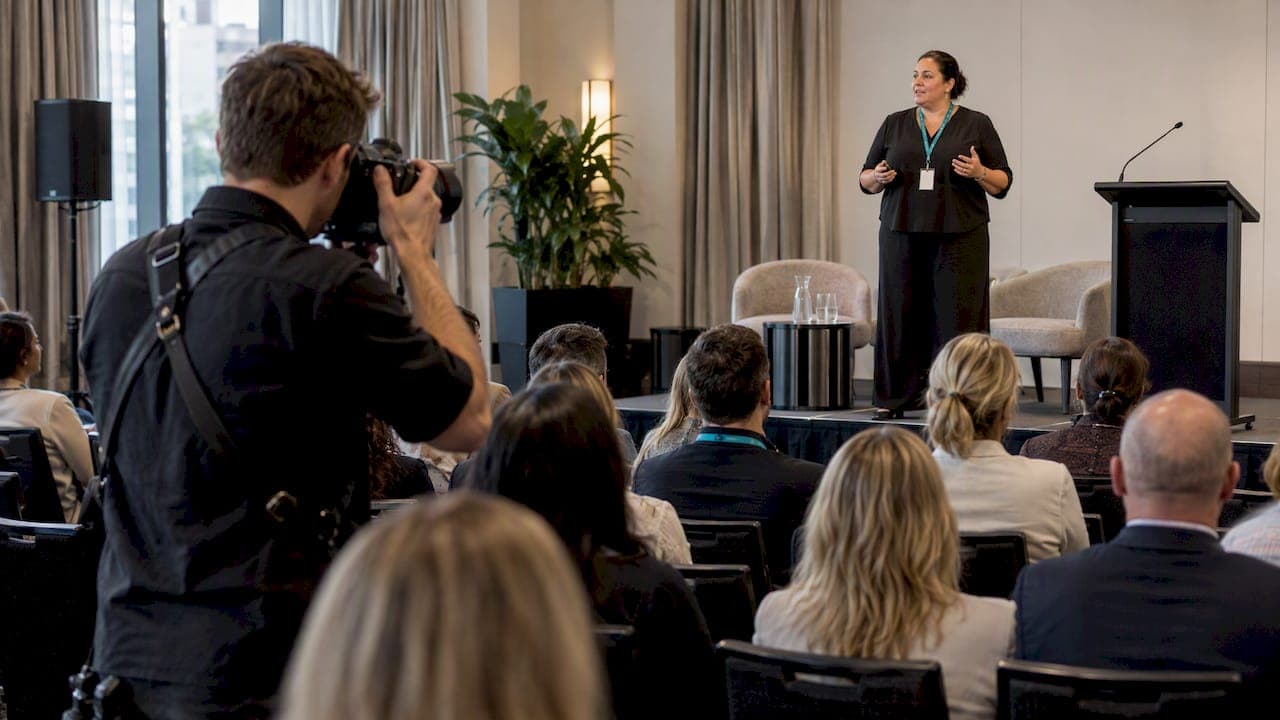
Prioritise five categories: venue and setup, speaker moments, networking interactions, team and group shots, and genuine candid reactions. Together, they cover the full brief most corporate events need, from PR and sponsor fulfilment to recruitment content and internal comms. Below, we break this down into a practical shot list you can hand straight to a photographer or brief a volunteer with.
TL;DR:
- Brief the photographer with the six highest priority moments first; if the schedule slips, capture venue setup, speakers, audience reactions, networking, team portraits, and candids.
- A 70 to 200 mm lens suits stage shots, while a 24 to 70 mm lens covers rooms; shoot RAW to correct mixed lighting later.
- Schedule headshots for 15 to 20 minutes near registration, and set delivery expectations early; PR and social teams may need edited images within 24 hours.
- Notify attendees before the event, offer an opt out, and get signed releases for commercial portraits; entry notice generally covers broad crowd and venue shots.
Table of Contents
- 1. Twelve shot ideas that cover every use case
- 2. Gear, settings and composition that make these shots work
- 3. Turning event photos into marketing, sponsor and recruitment assets
- 4. Privacy and consent considerations for event photography
- 5. Tips for engaging and directing subjects during corporate events
- 6. Creative photo ideas that reflect company culture and brand
- 7. A photographer's checklist for corporate events
- How Life in Style Photography can help with your next event
- FAQ
- Sources
1. Twelve shot ideas that cover every use case
A good corporate event shot list isn't about capturing everything. It's about capturing the handful of moments that get reused for months afterwards. We've ordered these by priority, so if time is tight, the first six matter most.
- Venue and stage setup before doors open. Shoot wide with a 16-35mm to show scale and branding; this becomes your hero image for recap posts and next year's sponsor deck.
- Speaker or keynote mid-gesture. A 70-200mm from the side of the stage catches expression without flattening the room; essential for press releases and LinkedIn highlights.
- Audience reaction during a key line or laugh. Sit a second shooter in the crowd with a fast prime; these humanise otherwise corporate content.
- Networking clusters in conversation. Shoot from a slight distance with a 50mm to avoid self-consciousness; ideal for social tiles showing genuine connection.
- Posed team or department group photo. Gather people quickly, shoot from slightly above eye level, and take three frames minimum; this is your go-to for the careers page and annual report.
- Candid social moments at breaks. Roam continuously rather than posing; these fill gaps in recap videos and newsletters.
- Sponsor branding and signage detail shots. Capture logos cleanly without people in frame; sponsors need this for their own fulfilment reporting.
- Registration and arrival at the welcome desk. A short burst as guests check in gives you authentic "doors open" energy for same-day social posts.
- Product or service demonstration moments. Get close with a 24-70mm to show hands-on engagement; useful for product marketing and internal training decks.
- Award or recognition moments on stage. Frame the handshake and the audience reaction in the same shot where possible; this is prime material for internal comms.
- Behind-the-scenes prep shots. Caterers plating, AV checks, name badges laid out; these add texture to recap content and show effort without boasting.
- Closing celebration or group toast. Wide shot with ambient light; this is the natural bookend for a recap video or end-of-event wrap post.
Pro Tip: Brief your photographer with this list in priority order before the event starts. A photographer who knows which six shots matter most will never miss them, even if the schedule runs late.
2. Gear, settings and composition that make these shots work
Getting the list right is only half the job. Execution depends on matching gear and settings to the scenario in front of you.
- For stage and speaker shots, a 70-200mm lens lets you stay out of the audience's sightline while still filling the frame.
- For the room and networking shots, a 24-70mm covers most situations without a lens change.
- For candid moments, a fast 35mm or 50mm prime with a wide aperture (f/1.8 to f/2.8) helps in low event lighting and keeps subjects sharp against a soft background.
- Mixed lighting (stage wash plus ambient room light) often causes colour casts; shoot in RAW so you can correct white balance later rather than guessing on the day.
- For group portraits, position people slightly off-centre and shoot from a touch above eye level to flatter most body types and avoid awkward stiffness.
Workflow matters as much as camera settings. Walk the venue before guests arrive to check light sources and plan your stage angles. Build a one-page cue sheet with the speaker running order and your priority shots against each segment. If headshots are part of the brief, block a dedicated 15-20 minute window near registration rather than trying to grab them on the fly.
Pro Tip: Agree on a delivery deadline with the event organiser before the event, not after. PR and social teams often need a handful of edited images within 24 hours, so flag that expectation early.
3. Turning event photos into marketing, sponsor and recruitment assets
The real value of corporate event photography shows up weeks later, not on the day. Authentic event storytelling can genuinely move the needle: Chia Sisters reported a 30% increase in domestic sales after leaning into real, unposed storytelling in their marketing.
- Use wide venue and candid shots as hero images on recap blog posts and landing pages.
- Crop networking and team shots to square or 4:5 ratios for social tiles.
- Sequence candid and award moments chronologically for recap videos.
- Send sponsors their branding shots with a short attribution caption and usage note.
- Tag and file images by department or team so internal comms can pull them for newsletters without re-requesting the shoot.
4. Privacy and consent considerations for event photography
Photographs taken in a business capacity count as personal information under the Privacy Act 2020, which gives attendees access rights and sets rules around how you collect and store their image.
- Notify attendees before the event through ticketing terms, the event registration page, or signage at entry; the Office of the Privacy Commissioner treats this as the baseline for meeting transparency obligations.
- Get signed releases for individual portraits or small group shots used commercially; verbal notice at entry is generally sufficient for broad crowd or venue shots.
- Offer an easy opt-out, such as a marked seating area or a sticker system, for anyone who'd rather not appear in published photos.
One access request can mean redacting an entire gallery: when someone asks to see or remove their image, organisations should secure the footage immediately and consider cropping or redacting to protect other people who appear alongside them.
5. Tips for engaging and directing subjects during corporate events
Most people tense up the moment a camera turns towards them at a work event, which is exactly why direction matters more than gear here. Giving a subject something specific to do, rather than asking them to "just be natural," almost always produces a better result.
For speakers, a quick pre-chat about where you'll be standing means they stop scanning the room for the camera and settle into their talk. For networking shots, approach after a conversation has already started rather than asking people to pose together; a genuine laugh beats a posed smile every time. For posed team photos, give clear, simple instructions: "turn slightly towards the person on your left" works better than "look natural," which tends to produce stiff results.

Keep instructions short and specific. "Chin down slightly" or "step half a pace closer" gets a better reaction than vague encouragement. For camera-shy executives or new staff, a short warm-up exchange before you start shooting, even just a comment about the room or the event, helps someone relax into the frame rather than freezing the second the lens points their way.
Roaming beats posing for most of the day. Reserve direct instruction for the handful of shots that need it, like the formal team photo or the award handshake, and let the rest of the day unfold in front of the lens.
6. Creative photo ideas that reflect company culture and brand
The strongest corporate event photos tell a story about people, place and purpose rather than simply lining subjects up and asking them to smile. A branded lanyard close-up, a hand reaching for a branded coffee cup, or a wall of company values photographed in context all say more about culture than a stiff group shot ever will.

Look for small, specific details: a team's inside joke mid-laugh, a founder genuinely engaged in a one-on-one conversation, or the particular way your office decorates for an event. These details carry brand identity in a way that generic "corporate" imagery never does.
Consider a few deliberately creative setups alongside the standard list: a photo wall or branded backdrop near the entrance gives guests a reason to pose and gives you a flexible studio-style shot; a series of "a day in the life" style candids across departments builds a library of authentic culture content; and a simple activation, like a branded photobooth, gives naturally camera-shy staff an easy, low-pressure way to get in front of the lens, aligned with nine community engagement ideas you can run this week.
7. A photographer's checklist for corporate events
We plan every event shoot around the same priority: capture real moments first, formal shots second. A relaxed brief and a clear shot list let even camera-shy staff settle into the day. Before you shoot, run through this: venue, speakers, networking, team, candids, sponsors.
— Rowan Freeman
How Life in Style Photography can help with your next event
If you'd rather hand the shot list to someone who's already run through it, our events photography service covers corporate functions of most sizes, with packages starting from the Events option at $345 NZD one-off. We work from a clear shot list, brief speakers and staff beforehand, and turn around a fast selection of edited images so your PR and social teams aren't waiting weeks for usable assets.
- Events coverage starts from a base price, scaled to your guest count and schedule; current prices are available on the pricing page.
- We can run a short headshot window alongside your main event using our headshot packages, from $345 NZD.
- Browse our event photography portfolio to see how these shot types look in finished galleries.
Get in touch through our event photography services page to check availability and get a quote tailored to your event.
FAQ
What are some creative ideas for a corporate photoshoot?
Beyond standard headshots and group shots, try branded detail close-ups, candid "day in the life" sequences across departments, and a photo wall or activation near the entrance. These give camera-shy staff an easy way to appear naturally rather than posing stiffly for a formal portrait.
What is the 20-60-20 rule in photography?
This isn't a formally defined industry standard, and definitions vary depending on who's using it. A common informal version suggests splitting your shoot time roughly into planned shots, flexible candid coverage, and buffer time for unexpected moments, though there's no single agreed rule.
What are some creative ideas for event photography?
Focus on venue atmosphere, speaker expression, genuine networking interactions, and behind-the-scenes prep shots alongside the expected posed group photos. A mix like this gives organisers content for PR, social media, sponsor packs and recruitment pages from a single event.
What are some creative ideas for a work team photo?
Try a candid version alongside the formal pose, such as mid-laugh or mid-conversation, and vary the angle by shooting from slightly above eye level for a flattering group composition. Giving the team one simple direction, like turning slightly towards each other, produces a more natural result than asking everyone to simply smile.
How do I handle privacy when photographing a corporate event?
Inform attendees before the event through ticketing terms, entry signage, or the event registration page, as required under the Privacy Act 2020. Offer a simple opt-out option and get signed releases for individual portraits used commercially.