An event photography shot list is a prioritised checklist of the exact images your event needs, organised by moment and ranked by priority. Copy the template below, apply the P1 to P3 system, and you'll walk out with the hero assets your client actually needs, not just a folder of nice-looking crowd shots. Life in Style Photography built this workflow across years of corporate and social event coverage, and Rowan Freeman breaks down how it holds up on a live event floor.
TL;DR:
- P1 shots, such as VIP portraits and keynotes, must be captured early and precisely, as missing these risks losing critical client assets.
- Prioritize shooting in line with the event's actual moments, focusing on establishing, stage, networking, and sponsor categories to maximize relevance.
- Use a pre-event brief including the program, VIP list, sponsor details, and usage rights to streamline coverage and meet the client's expectations.
- Assign specific coverage zones and priorities to lead and roving shooters, with one person responsible for verifying all P1 shots during breaks.
- Deliver images promptly with organized naming and tagging to ensure they are used effectively on social media, websites, or print.
Table of Contents
- Comprehensive event photography checklist by moment
- How do you prioritise shots with P1, P2, P3?
- What to include in your pre-event brief
- What does the day-of shooting sequence look like?
- How should you deliver and tag event photos?
- Why shot lists free you up to shoot better, not worse
- Book an Auckland event photographer who works from a shot list
- Sources
Comprehensive event photography checklist by moment
A shot list only works if it mirrors how an event actually unfolds. Break it into moments, not into generic categories, and each block earns its place because it maps to a real point in the run sheet.
Establishing and venue shots. Empty room details, signage, stage set before doors, registration desk styling. These get captured before guests arrive, when the space is still clean. They matter because marketing teams use them to set scene in recap videos and social posts.
Arrival and registration. Guests checking in, name badge handoff, welcome table branding, any photo-wall moment. This is where you catch genuine first impressions, before people settle into event mode.
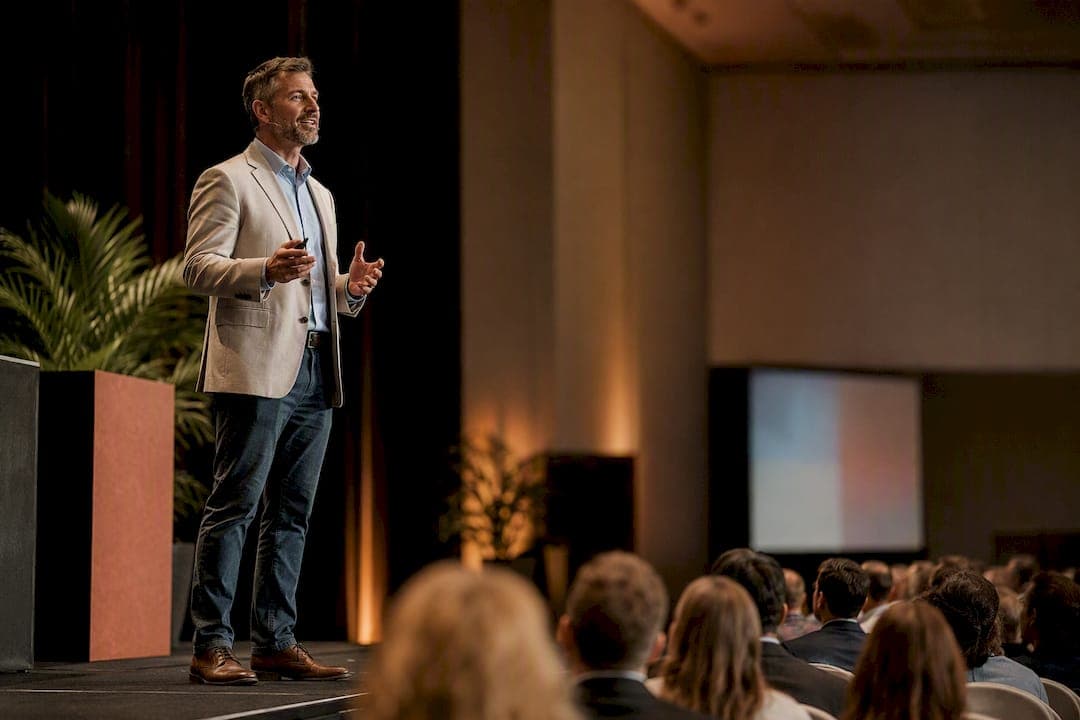
Stage and keynote. Wide shot of full stage and audience, medium shot of speaker with slide content visible, tight speaker hero shot, and at least one crowd reaction frame. A practical shot list built around moments like this turns a vague brief into something your team can actually execute against, rather than chasing "capture the vibe" instructions that mean nothing on the day.
Breakouts and panels. One wide establishing shot per room, one audience engagement frame, one speaker or panellist detail. Don't linger, these rooms run on tight schedules.
Expo and sponsor booths. Booth branding wide shot, staff interacting with attendees, product or signage detail, and any sponsor-specific "must-have" frame listed in the brief. This is the category clients scrutinise hardest, because sponsors expect proof of exposure.
Networking and candid coverage. Genuine conversation, laughter, handshakes. These carry the emotional weight of the event and tend to perform best on social media.
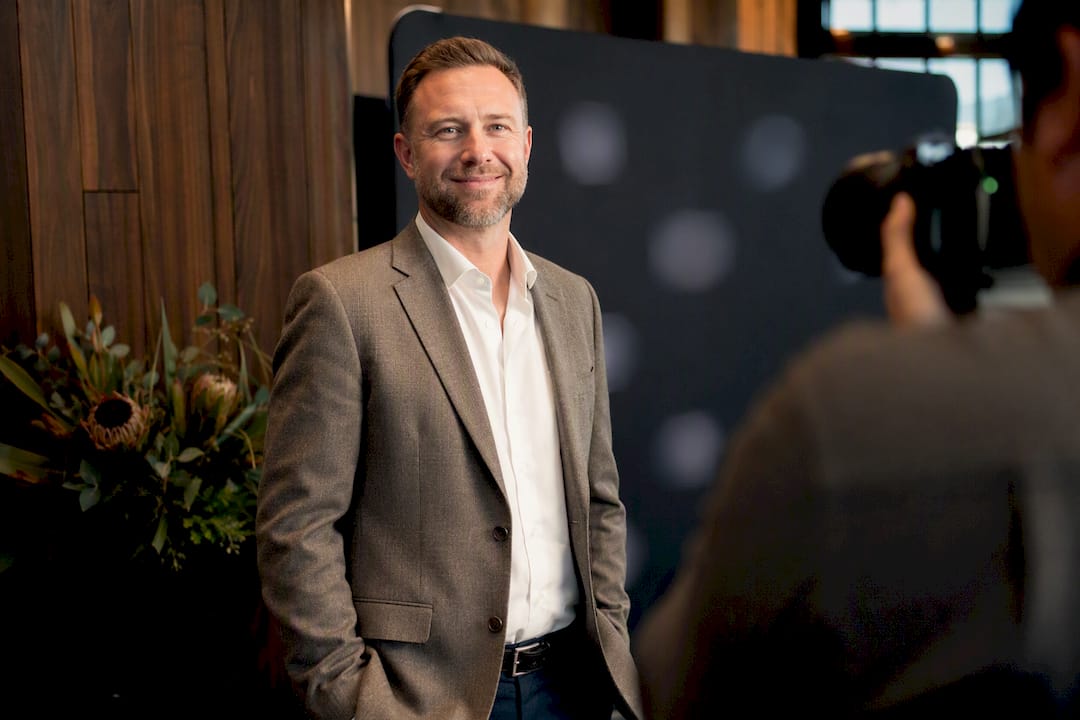
VIP and executive portraits. Individual portraits of named VIPs, small group shots with sponsors, and any staged handshake or award moment. These require identification ahead of time, which we cover in the pre-event brief section below.
Reception and closing. Toasts, awards, group photos, and the room emptying out. Don't pack up early. Some of the best candid material happens in the last twenty minutes.
Here's a condensed version you can copy straight into your notes app or shot-list tool:
- Establishing: empty room, signage, stage set (P2, wide/landscape)
- Arrival: registration, badge handoff, photo wall (P2, mixed ratios)
- Keynote: wide, medium, speaker hero, crowd reaction (P1, landscape + portrait crop)
- Breakouts: one wide, one engagement, one detail per room (P2)
- Expo: booth wide, staff interaction, sponsor detail shot (P1 for paying sponsors)
- Networking: candid conversation, laughter, handshake (P2/P3)
- VIP portraits: individual + small group (P1)
- Reception: toasts, awards, group shot, room clearing (P1/P2)
Structuring the list this way follows the pattern used in professional event photography checklists, which group must-capture shots into establishing, stage, networking, and brand-proof categories rather than a flat unordered list.
How do you prioritise shots with P1, P2, P3?
Not every shot carries equal weight, and treating them as if they do is how photographers miss the frames a client actually paid for. The P1 to P3 system fixes that.
P1 shots are non-negotiable: the keynote hero, VIP portraits, sponsor logo proof. Miss these and the client notices immediately. P2 shots are important but recoverable if a moment passes: breakout engagement, candid networking. P3 shots are bonus material: incidental candids, wide room atmosphere, detail shots with no specific deliverable attached.
On a single-shooter day, Revel's shot-list guidance recommends trimming your working list down to P1s and only the P2s you can realistically fit, rather than trying to run the full list solo. On multi-shooter teams, a lead shooter typically owns P1 stage and VIP coverage while a roving shooter handles breakouts, expo, and candid P2/P3 material.
| Owner | Coverage zone | Priority owned | Time window |
|---|---|---|---|
| Lead shooter | Main stage, VIP zone | P1 | Doors to end of keynote |
| Roving shooter | Breakouts, expo, networking | P2/P3 | Throughout event |
| Shot-list owner | Whole floor | Checks off P1s | Every break |
Pro Tip: Give one person, ideally not the lead shooter, the job of physically ticking off P1 shots on a printed or app-based list during every break. It takes two minutes and it's the single easiest way to catch a missed VIP portrait before the guest leaves the building.
What to include in your pre-event brief
Turn up without the right paperwork and you'll spend the first hour guessing who matters and what the client actually wants. Request these before the day:
- The programme or run-sheet, with timings for every session
- A floor plan showing stage, breakout rooms, expo layout, and sponsor booths
- A VIP list with names, titles, and reference headshots so you can identify people you've never met
- Sponsor deliverables list, spelling out exactly which logo walls or booth shots are contractually owed
- Photo release terms, confirming what usage rights the client has for attendee images
Defining image usage upfront, hero assets in landscape for a website banner versus square crops for Instagram, matters because reworking usage after delivery wastes everyone's time and often means reshooting or recropping under deadline pressure.
Your VIP identification sheet should be one page, containing name, title, organisation, a small reference photo, and any specific instruction ("photograph with the sponsor banner behind them", "avoid the left side of the stage").
Pro Tip: Ask the client one blunt question in every brief: "If we only get five photos right today, which five?" The answer is your real P1 list, whatever the official brief says.
What does the day-of shooting sequence look like?
A reliable sequence protects your P1 shots while leaving room to catch the candid, unscripted material that makes a gallery feel alive rather than staged.
- Before doors: capture the empty venue, signage, and stage set. This is your only clean shot at these frames.
- Doors open: cover arrivals and registration for roughly the first fifteen minutes, then shift attention to the stage.
- Keynote: work wide to medium to speaker hero to crowd reaction, in that order, repeating the sequence every few minutes to vary your coverage.
- Breakouts and expo: rotate on a time-box, spending 10 to 15 minutes per priority room and grabbing one wide, one interaction, and one detail shot before moving on.
- Reception and closing: cover toasts, awards, and group shots, then stay for the room clearing out.
Fit VIP portraits into natural gaps, just before a keynote starts or during a scheduled break, rather than pulling people aside mid-networking. That keeps your main coverage running while still ticking off the P1 portraits the client is counting on.
Pro Tip: If a VIP is hard to pin down, brief the event coordinator to text you the moment that person arrives. It saves you scanning a crowded room for a face you've only seen in a headshot.
How should you deliver and tag event photos?
Delivery speed and organisation decide whether your images actually get used, or sit unopened in a folder while a marketing deadline passes.
Use a consistent file-naming structure such as date_eventname_session_usagetag, so anyone on the client side can find what they need without opening the gallery software. Tag images by session, speaker, and intended usage (hero, social, sponsor) at export, because tagging at delivery rather than after saves the client hours of manual sorting later.
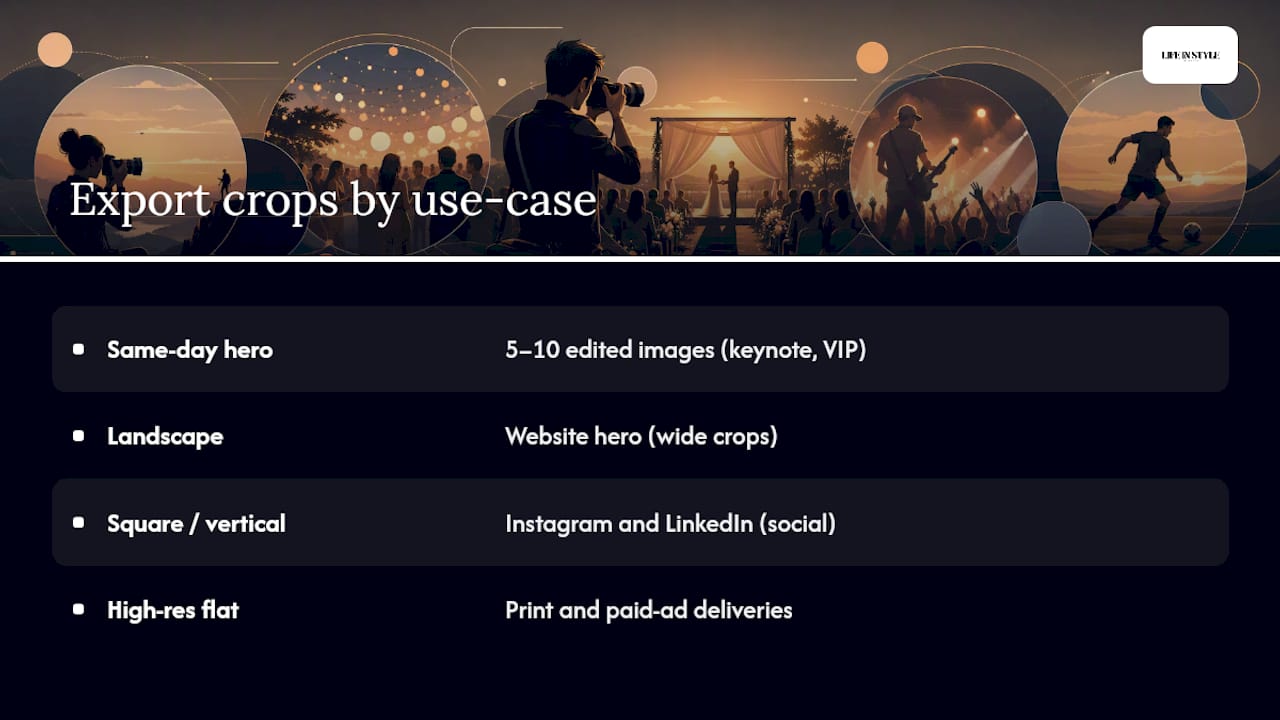
Same-day hero delivery, typically five to ten edited images covering the keynote and top VIP portraits, has become the standard expectation for PR and social teams working on tight publishing windows. Decide this number in the brief, not on the fly.
Match your export ratios to real use-cases: landscape for a website hero, square or vertical crops for Instagram and LinkedIn, and high-resolution flat files for print or paid ad campaigns. Getting this right the first time means nobody has to come back and ask for a recrop.
Why shot lists free you up to shoot better, not worse
A good shot list isn't a script that boxes you in. It's a safety net that lets you chase the unscripted moment without the constant background anxiety of wondering whether you've missed something the client actually needs.
That's the mindset behind how Life in Style Photography approaches event coverage: lock down the P1s early, then spend the rest of the day hunting for the candid frame nobody asked for but everyone loves. Packaged event deliverables typically pair a same-day hero set with a full gallery delivered within days, matching what corporate and social clients increasingly expect. You can see how that plays out across real coverage in the event photography portfolio.
— Rowan Freeman
Book an Auckland event photographer who works from a shot list
Most event photographers hand you a folder of photos and hope it covers what you needed. Life in Style Photography works the other way around, starting from your run-sheet, your VIP list, and your sponsor obligations, so the gallery you receive matches what your marketing team actually has to publish.
That approach suits corporate conferences, brand activations, and social events alike, anywhere a client needs guaranteed hero shots alongside genuine, unposed moments. If you're planning an event in Auckland and want a photographer who treats your brief as a working document rather than a suggestion, browse the event photography services page and get in touch for a quote tailored to your run-sheet and priority list.
Sources
- Event shot list template — StudioBinder
- The professional event photography checklist — Koma Productions
- Event photography brief & shot list template — PIIX