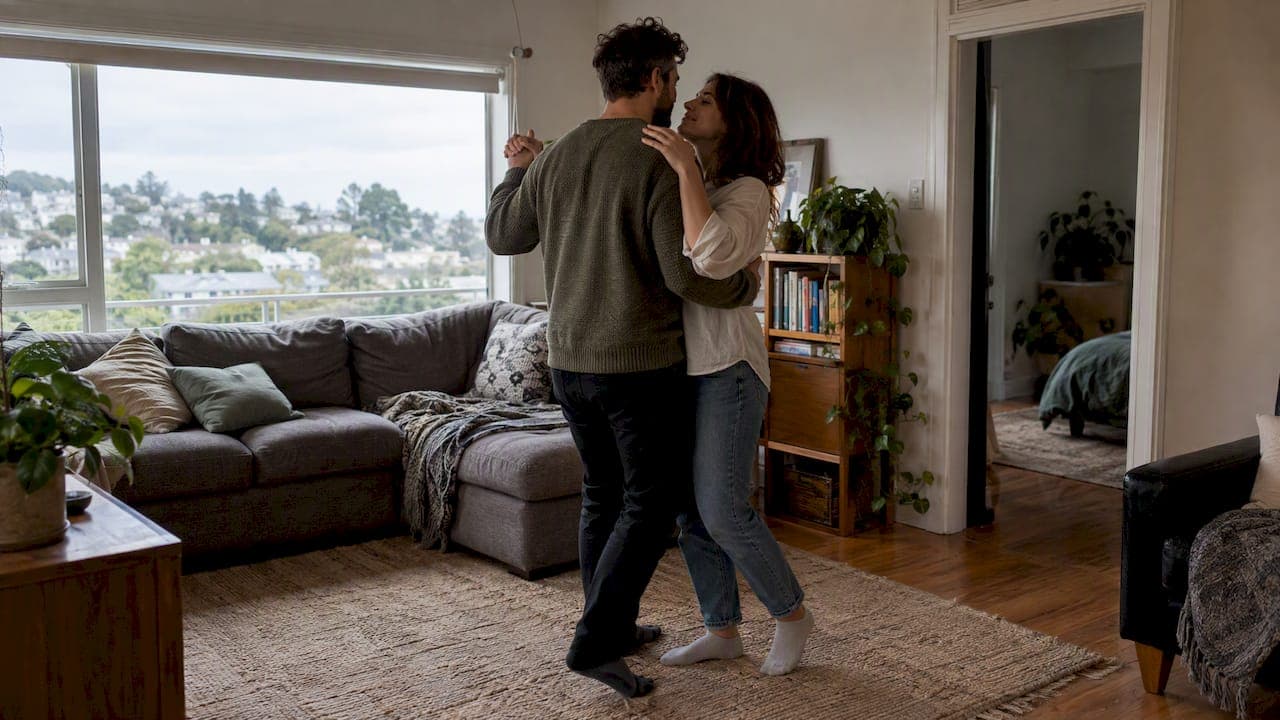
The best couple photos at home look like your actual life: coffee on the couch, a kitchen dance, a lazy Sunday in bed. You don't need a studio or a big budget. You need decent window light, a loose plan, and a few minutes of play. Below is how we approach it, whether you're shooting on a phone yourselves or thinking about bringing in a photographer.
TL;DR
- Shoot beside a large window in the morning or late afternoon, and turn off the overhead lights so the colour stays consistent.
- Pick activities rather than poses (making breakfast, reading, dancing) and let the camera catch you in between.
- Wear comfortable layers in tones that suit your walls and furniture, and bring a second outfit.
- If a photographer takes the photos, agree in writing who owns them and whether they can use them in their portfolio.
- Print your favourites. A small set on the wall does more than a thousand images on a phone.
Table of Contents
- Why home works so well for couples
- Get the light right first
- Prepare the space in ten minutes
- What to wear
- Ideas that look natural, not staged
- Poses that work without feeling posed
- Taking the photos yourselves
- When it helps to bring in a photographer
- Who owns the photos? A New Zealand note
- Our perspective: what we've learned about couples at ease
- Make the photos last: print and display
- A session with us
- A simple plan for your own shoot this weekend
- FAQ
- Sources
Why home works so well for couples
Most people tense up the moment a camera appears. At home, you already know where to sit, which side of the couch is yours, and what makes your partner laugh. That familiarity is what shows up in the photos.
A home shoot also removes the usual friction. There's no travel, no parking, no checking the weather at Piha or Mission Bay, and no worry about strangers watching. If you're camera-shy, this is often the easiest place to start.
There are limits, and it's better to know them early. Small rooms can feel cramped, mixed lighting can turn skin orange, and clutter shows up in every frame. All of this is fixable, and most of it takes about twenty minutes of preparation.

Get the light right first
Light matters more than the camera. A phone in good light beats an expensive camera in a dim room.
- Find your biggest window. Check it at different times. In many Auckland homes, a north-facing window gives soft, bright light through the middle of the day, while east-facing rooms glow in the morning.
- Turn the lamps off. Warm bulbs mixed with daylight give you two colour casts in one frame. Pick daylight and switch the rest off.
- Face the window. Place yourselves so the light falls on your faces from the side or slightly in front. If the window is behind you, you'll end up as silhouettes, which can look lovely, but only if you want that.
- Soften harsh sun. On a bright day, a sheer curtain or a white sheet over the window spreads the light and avoids hard shadows.
- Overcast days are fine. Grey Auckland weather gives even, flattering light indoors. Open the curtains fully and move closer to the glass.
If your living room is dark, try the bedroom, a sunroom, or a doorway that opens onto a deck. Even a few minutes on the back step, with the house behind you, gives you a different look.
Prepare the space in ten minutes
You don't need to stage your home like a magazine. You do need to clear what distracts.
- Remove piles of mail, charging cables, laundry baskets and anything with a loud logo.
- Straighten the bed or couch and plump the cushions.
- Leave a few things that say something about you: a record player, a shelf of books, a plant, a mug you both fight over.
- Open the curtains and wipe any mirrors or glass in the background.
- Look at each corner through your phone screen. If it looks messy on screen, it will look messy in the photo.
What to wear
Comfortable clothes make for comfortable faces. Soft knits, a good shirt, or the jersey you steal from each other all work well. Avoid very busy patterns and large logos, and try not to match exactly. Aim for tones that sit well together, such as cream with denim, or olive with rust, and check them against your walls and couch.
If you're unsure how to coordinate colours, this practical guide to styling for photos (in Portuguese) covers choosing outfits that flatter you on camera, and the principles translate easily. Bring a second outfit as well. We cover the thinking behind that in our post on bringing two outfits to every photoshoot.
Ideas that look natural, not staged
The strongest at-home couple photos come from doing something together. Here are scenarios that work in almost any home.
Morning in bed
Pyjamas, a pot of tea, a book or the weekend paper. Sit close, lean on each other, and actually read. Let one of you whisper something to the other. Photographers often find that the in-between moments are better than the main moment.
Making breakfast or dinner
The kitchen is full of natural interaction. One of you stirs, the other steals a taste. Flour on a nose, a clink of glasses, a shared laugh over a burnt piece of toast. These frames carry a lot of movement and warmth.

Dancing in the lounge
Put on a song that means something to you. Slow dance in socks. You will feel silly for about thirty seconds, then it gets easy. Keep going longer than feels necessary.
On the couch
Tuck your legs under each other, share a blanket, watch a show, argue about what to watch. Look at each other, not the lens.
The doorway or back step
Sit on the step with a drink, lean forehead to forehead, or walk toward the camera hand in hand. The light is usually good, and the house frames you nicely.
Your story objects
Bring in what matters: the first photo you printed together, a letter, the ticket stub from a trip, a pet who refuses to stay out of the frame. A small detail can anchor an entire set.
Poses that work without feeling posed
If the word "pose" makes you wince, think of these as starting positions rather than instructions. Hold one, then let it fall apart naturally.
| Starting position | How to do it | What it gives you |
|---|---|---|
| Forehead to forehead | Stand close, eyes closed or looking down, hands on each other's arms | Quiet, intimate |
| Walking together | Hold hands and walk slowly across the room toward the camera | Movement, easy smiles |
| One looking at the other | One looks at the lens, the other looks at their partner | Variety within one frame |
| Wrapped-up hug | Arms around the shoulders, one chin resting on the other's head | Warm and close |
| Sit and lean | Side by side on the couch, shoulders touching, heads leaning in | Relaxed, comfortable |
| Whisper | One leans toward the other's ear | Real laughter follows |
For a longer list, see our post on 10 poses for couples that actually look natural on camera. Two tips apply to all of them. Relax your hands (hold something, or rest them on your partner), and breathe out before each frame.
Taking the photos yourselves
You have two practical options: a phone on a tripod, or a friend behind the camera.
- Use a tripod or prop the phone up at about chest height, a few metres away, so you aren't looking up or down at each other.
- Use the timer or a remote shutter. Burst mode catches the laugh after the pose, which is often the keeper.
- Shoot more than you need. Aim for 100 or more frames and expect to keep a dozen.
- Set a mini shot list. For example: one on the couch, one in the kitchen, one at the window, one dancing, one detail. Five scenes of five minutes each is a plenty.
- Stop when it stops being fun. Tired smiles show.
Selfies work too, and they suit the closeness of a home setting. Hold the phone slightly above eye level, near a window, and avoid the extreme wide-angle if you want your faces to look natural.
When it helps to bring in a photographer
DIY is great for fun and memories. A photographer is worth considering when you want something you'll hang for years, or you're marking a specific moment: an engagement, a new home, a pregnancy announcement, a wedding anniversary.
The real advantage is direction. A good photographer reads the room, keeps you moving, picks the angles that suit you, and fixes the light so you can forget about it. You don't need to know how to pose, and they edit and deliver a cohesive gallery.
Things to ask before you book:
- Do they shoot at clients' homes, or only on location or in a studio?
- How long is the session, and how many edited images will you receive?
- What are the usage and copyright terms (see the next section)?
- How do they handle camera-shy people?
If you're newly engaged, our engagement photo ideas for NZ couples will help you think about locations beyond the living room. Looking at a photographer's couples portfolio is also the quickest way to see whether their style matches yours.
Who owns the photos? A New Zealand note
This part surprises many couples. Under New Zealand law, the person who takes a photograph generally owns the copyright unless a contract says otherwise. The Clendon Feeney guide to NZ photography law sets out that copyright exists in every photograph from the moment it's taken, and that the owner is not always the photographer, depending on the arrangement.
There is a useful protection for you, though. Section 105 of the Copyright Act 1994 deals with the right to privacy of certain photographs. According to Tāwhia, Copyright Aotearoa, this is one of the moral rights that applies even when someone else owns the copyright. In practice, a photograph taken for private or domestic purposes, such as a couple's session at home, can't be published or shown to the public without your consent.
The simplest way to avoid any argument is to put it in writing. Agree beforehand:
- Whether the photographer can use your images in their portfolio, website or social media.
- Whether you receive a personal-use print licence, and for how long.
- Whether images of the inside of your home can be shared, since they show your address and belongings.
If a photographer asks to use your photos for promotion and you're unsure, the Citizens Advice Bureau explains your position on exactly this question. You are free to say no, or to ask for certain images to be kept private.
Our perspective: what we've learned about couples at ease
We photograph couples across Auckland, and the pattern is consistent. The photos people love most are rarely the ones they planned. They're the second laugh after a joke, the hand that squeezes a bit tighter, the glance between two people who've forgotten the camera is there.
That's why we run every session in a relaxed, conversational way. We don't expect you to know how to pose. We plan the session with you beforehand, guide you through it with clear, simple directions, and keep an eye on your comfort throughout. If you're nervous, say so at the start. It helps us pace the session.
For couples, our view is that a home setting (or any place that feels like yours) is the best place to start if you're shy. The environment does half the work. What we'd ask of you is to treat the session as a date, not an assignment. Put on music, make a coffee, and be yourselves. We'll take care of the light and the framing.
— Rowan Freeman
Make the photos last: print and display
A phone gallery rarely gets looked at twice. Choose your favourites and print them.
- Pick a theme. Five to nine images from one session look good in a grid or a gallery wall.
- Think about size. Square layouts need enough resolution. For a collage destined for print, HappyMoose, a Dunedin print studio, suggests exporting at maximum quality and at least 2000 x 2000 pixels for a square layout.
- Free apps are fine for layouts. MOLDIV, Fotor and PhotoScape X are widely used in New Zealand for simple collages.
- Mix scales. One large print with a few small ones looks better than eight identical frames.
- Match your space. Hang pictures near where you actually spend time: the hallway, the bedroom, or beside the couch.
If you worked with a photographer, ask for high-resolution files sized for printing, and confirm you're allowed to print them wherever you like.
A session with us
If you'd like us to guide the shoot, our Couples Session options are simple. The Full Session (our most popular) is $575 NZD, and the Extended Session is $800 NZD. Both are fixed-price packages, and you can see the details and book an enquiry on our couples photography page. Have a particular setting in mind, such as your home or a favourite spot nearby? Mention it when you get in touch, and we'll talk through what's possible for your session. For wedding plans, our wedding photography page covers the collections, including a proposal shoot at $575 NZD.
A simple plan for your own shoot this weekend
- Pick the time. Choose a window of 60 to 90 minutes when the light is good and neither of you is hungry or rushed.
- Tidy three spots. The couch, the bed or kitchen, and one by a window.
- Choose outfits. Two options each, comfortable and in complementary tones.
- Set the phone. Tripod or a stack of books, chest height, burst on, timer ready.
- Warm up. Spend five minutes dancing or talking before you take anything serious.
- Shoot three activities. Ten minutes each, with breaks to look through what you've got.
- Choose and print. Pick your top five within a week, while the day is still fresh.
If it goes well, you'll want to do it again. If it feels awkward, that's normal for the first few minutes. It usually passes.
FAQ
How do I make couple photos at home look professional?
The biggest upgrades are light and tidiness. Use a large window, switch off the lamps, clear clutter from the background, and shoot from chest height. Then pick the best few and edit them lightly, rather than applying heavy filters.
What should we wear for couple photos at home?
Choose comfortable, well-fitting clothes in tones that work together without matching exactly. Avoid large logos and busy patterns. Check your outfits against your couch and walls, and bring a second option.
Can my photographer share photos taken in our home?
Not without your consent for private or domestic photos, according to the right to privacy under the Copyright Act 1994. Still, it's best to agree in writing whether they may use the images in their portfolio or social media, and whether interior shots can be shared.
How many photos should we take?
Take far more than you need. For a 60 to 90 minute DIY session, 100 or more frames is normal, and you might keep ten to fifteen. Burst mode and a timer help you capture natural moments rather than stiff ones.
What if we're awkward in front of the camera?
Most couples are, at first. Give yourselves activities to focus on, like cooking, dancing or reading, and keep going past the initial self-consciousness. A photographer who gives clear direction can help a lot, which is why we focus on keeping sessions relaxed.
Sources
- The Clendon Feeney Guide to New Zealand Law Relating to Photography
- Copyright Act 1994, New Zealand Legislation
- What is the right to privacy? Tāwhia, Copyright Aotearoa
- Citizens Advice Bureau: photographer wants to retain the right to use photos
- Three steps to create a collage wall dot, HappyMoose
- A step-by-step guide to creating your first photo collage, HappyMoose