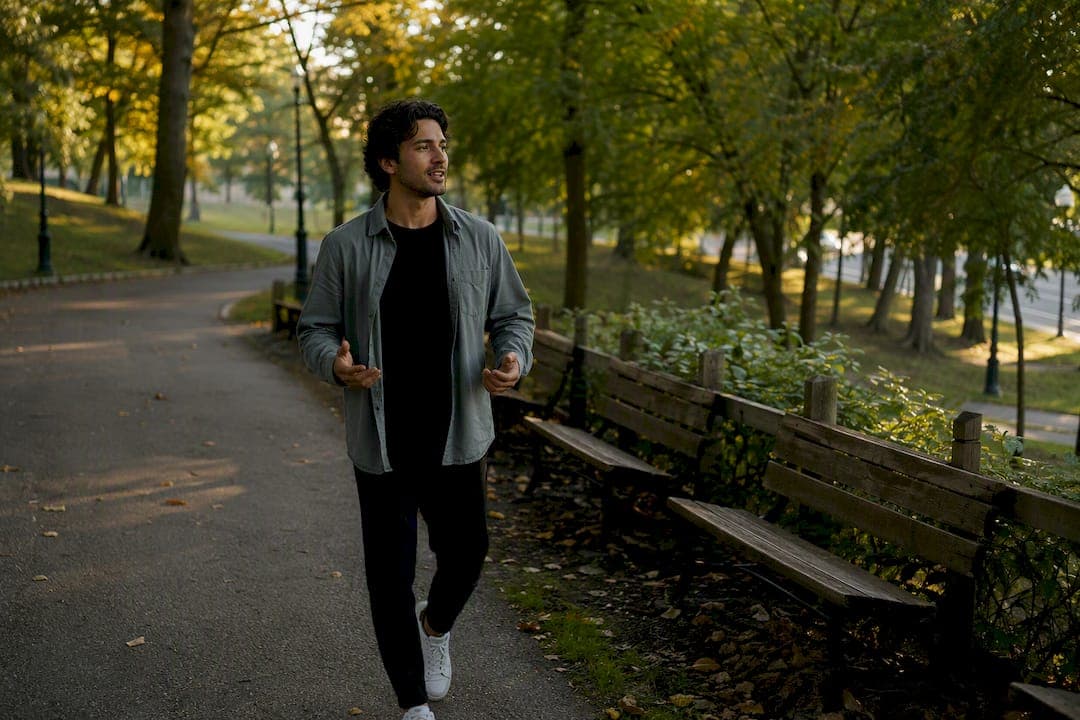
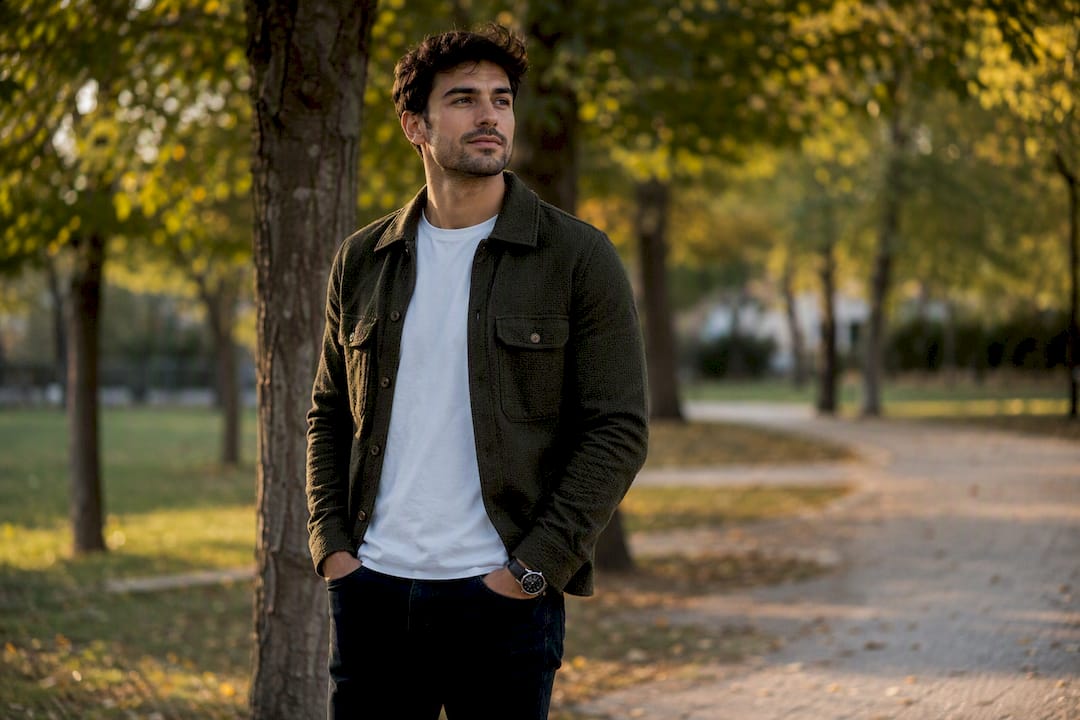
Start with three moves: thumbs hooked in the pockets, a two-thirds torso turn away from the camera, and a slight chin push forward and down. Add a seated lean and a walking shot, and you have a starter kit that covers most awkward-hands, stiff-shoulders problems before they happen.
These five work because they solve the two things that make men look uneasy in photos: idle hands and a flat, front-on stance. A turned torso creates a slimming line, a forward chin defines the jaw, and pocketed thumbs give restless fingers somewhere purposeful to go.
- Thumbs in pockets — feet shoulder-width, weight on the back foot, chin forward.
- Two-thirds torso turn — shoulders angled 30 to 45 degrees from the lens, head turned back toward camera.
- Seated lean — elbows on knees, hands loosely clasped, spine slightly rounded forward.
- Walking shot — mid-stride toward or across the frame, arms swinging naturally.
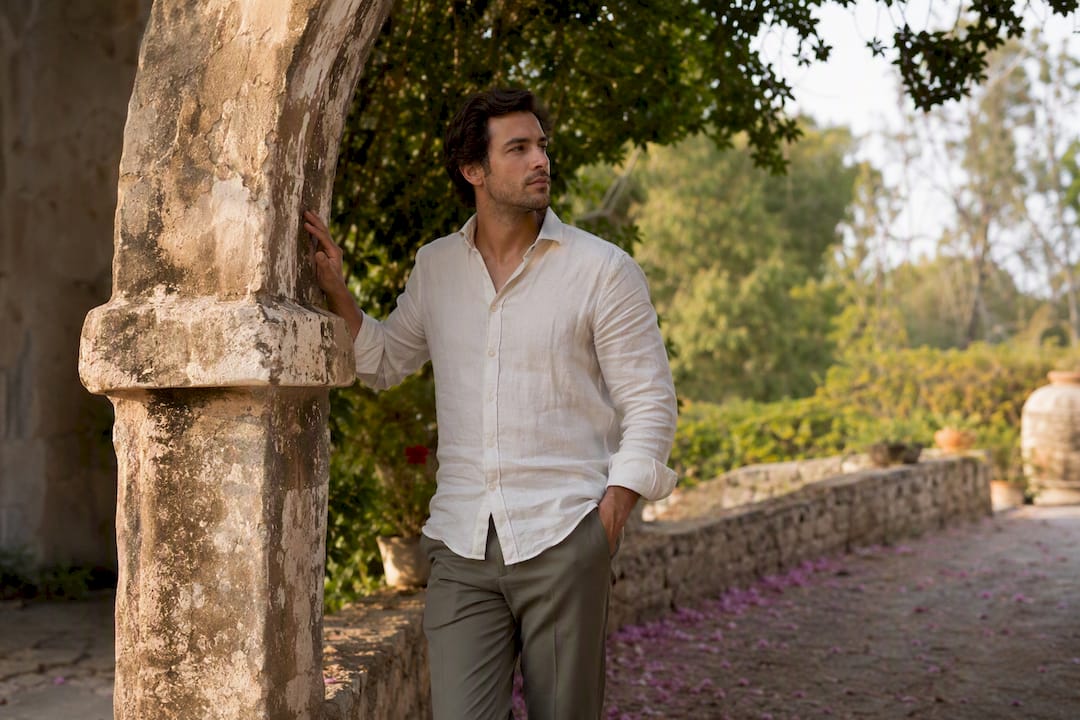
- Doorway or wall lean — one shoulder against the surface, opposite leg crossed at the ankle.
Key Takeaways
Confident male portraits come from a small, reliable pose repertoire, purposeful hand placement, and shooting movement rather than only static holds.
| Point | Details |
|---|---|
| Start with five poses | Thumbs in pockets, torso turn, seated lean, wall lean and a walking shot cover most sessions. |
| Solve hands first | Give hands a job (pocket, prop, cuff) rather than letting them hang idle. |
| Shoot the transitions | Movement between poses often produces more natural expressions than static holds. |
| Adjust to the build | Torso angle, camera height and weight distribution should change with each subject's frame. |
| Book it if you'd rather not DIY | Life in Style Photography runs a warm-up-to-headshot session flow for men who want direction, not homework. |
Table of Contents
- Posing men for photos: 21 pose ideas with quick directions
- How do you get natural-looking hands and jawlines in photos?
- Adjusting poses for different body types and heights
- How do you pose men who have never been photographed before?
- Using props, clothing and environment as posing tools
- What does a 20 to 30 minute posing session actually look like?
- How Life in Style Photography approaches shoots with men
- Book a session instead of directing it yourself
- Frequently asked questions
- Sources
Posing men for photos: 21 pose ideas with quick directions
A working pose list beats a mood board every time, because it gives you something to say the moment the shutter finger gets twitchy. The 21-pose framework (non-primary source) remains one of the most practical structures going around, and the list below builds on that idea with quick variations and set-ready direction lines.
Standing poses
- Classic thumbs-in-pockets. Feet shoulder-width, weight back, chin forward. Variation: one thumb in, one hand relaxed at the side. Say: "Rock your weight onto your back foot and relax your shoulders."
- Arms crossed. Shoulders squared, chin slightly down. Variation: cross at the wrists instead of folding fully for a softer look. Say: "Cross your arms like you're people-watching, not defending yourself."
- Hands in blazer or jacket pockets. Elbows slightly forward, not pinned to the ribs. Variation: leave the jacket unbuttoned for movement in the fabric. Say: "Let your elbows breathe away from your sides."
- Power stance. Feet wider than shoulder-width, hands on hips, chest open. Variation: one hand on hip, one hanging loose. Say: "Plant your feet and own the ground under you."
- Arm behind the back. One hand tucked behind, the other relaxed. Variation: adjust a cuff with the free hand for a natural gesture. Say: "Pretend you're about to shake someone's hand."
- Adjusting a cuff or watch. Gives the hands a job and the eyes somewhere to look. Variation: glance at the watch rather than the lens. Say: "Check your watch like you're running late."
- Hand in hair or on jaw. Works well for editorial or personal branding shots. Variation: light touch, not a full grip. Say: "Run your hand through your hair once, then hold."
Seated poses
- Forward lean. Elbows on knees, hands clasped, spine curved. Variation: one hand supporting the chin. Say: "Lean in like you're about to tell me a secret."
- Reclined seat. One arm draped over the chair back, legs extended. Variation: ankle crossed over the opposite knee. Say: "Get comfortable. Sink into it."
- Straddled chair. Arms resting on the backrest, chin tilted slightly. Variation: chin resting on stacked forearms. Say: "Rest your chin here and look past my shoulder."
- Steps or ledge seat. Forearms on knees, hands loosely together. Variation: one foot on a lower step for asymmetry. Say: "Drop one shoulder and look down the lens."
Leaning poses
- Wall lean, shoulder in. One foot crossed at the ankle, hands in pockets or crossed. Variation: forearm against the wall instead of the shoulder. Say: "Lean like you're waiting for a mate."
- Doorway frame. One arm raised to the frame, weight on one hip. Variation: head tilted into the raised arm. Say: "Hold the frame and look straight down the barrel."
- Car or railing lean. Lower back against the surface, ankles crossed. Variation: arms folded loosely. Say: "Settle your weight back and relax your face."
- Tree or post lean. Shoulder blade against the trunk, one knee bent. Variation: hand resting on the bark. Say: "Give the tree a bit of your weight."
Action and walking poses
- Mid-stride walk toward camera. Natural arm swing, eyes either on the lens or past it. Variation: shoot from a slight low angle for length. Say: "Walk toward me like you've got somewhere to be."
- Walking away, looking back. Captures a candid over-the-shoulder glance. Variation: hand in pocket while turning. Say: "Keep walking, then glance back on three."
- Jacket-over-shoulder walk. Adds movement to fabric and a reason for one hand. Variation: jacket held by one finger. Say: "Sling it over your shoulder and keep moving."
- Jumping or dynamic movement. Best for fitness or lifestyle briefs. Variation: freeze mid-motion rather than full airborne. Say: "Give me a little bounce, nothing dramatic."
Headshot and close-crop poses
- Classic three-quarter headshot. Chin forward and down slightly, camera at eye height. Variation: switch the shoulder angle left to right for two looks in one setup. Say: "Chin forward, now down just a touch."
- Squinted-eye smile (the squinch). Subtle eye tension instead of a full grin. Variation: pair with a closed-mouth smirk. Say: "Squint like there's sun in your eyes, but keep it soft."
Pro Tip: Keep a mental shortlist of five poses you can call out without thinking. When a subject tenses up, switching poses fast keeps momentum and stops overthinking on both sides of the camera.
How do you get natural-looking hands and jawlines in photos?
Hands give away nerves faster than any other body part, and a flat, front-on jaw photographs heavier than it looks in real life. Fix both and most of the "awkward photo" problem disappears.
- Give hands a job: a pocket, a jacket collar, a coffee cup, a cuff to adjust. Idle fingers curl or clench; busy fingers relax.
- Avoid "clawed" hands resting flat on a surface. Angle the wrist slightly and let fingers curve loosely instead.
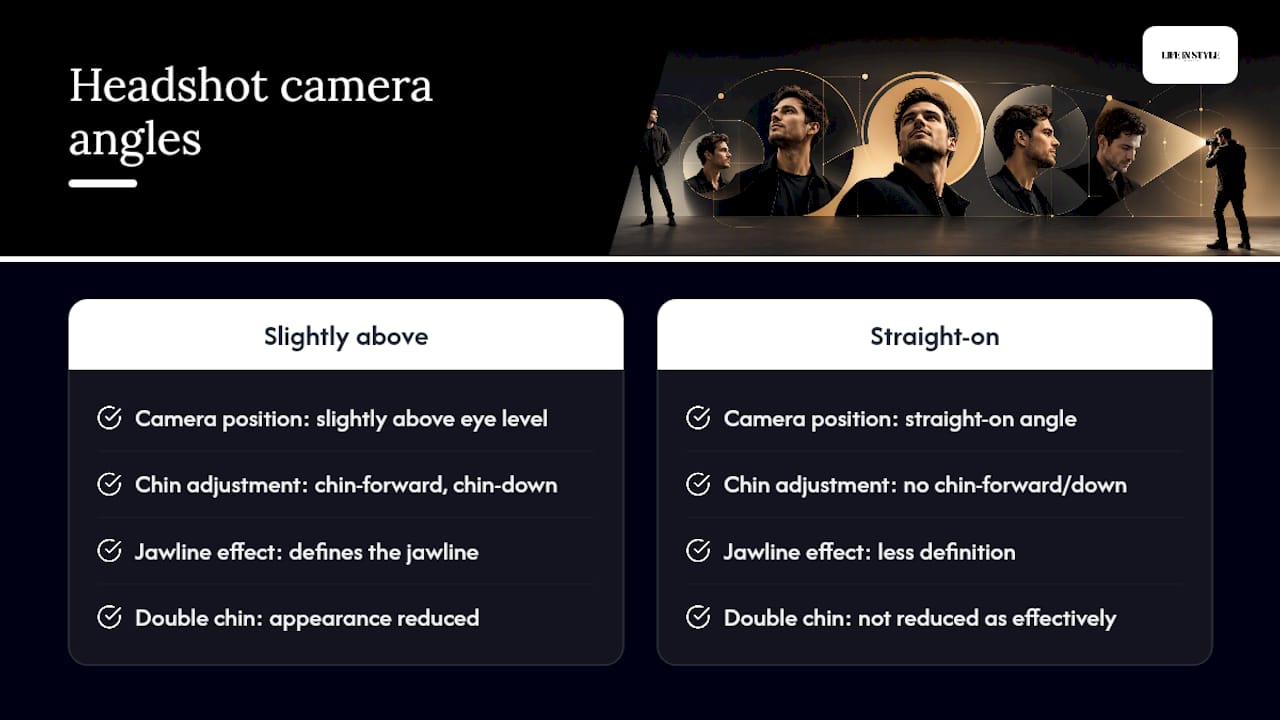
- Shoot from slightly above eye level and ask for a small chin push forward and down. This tightens the jawline and reduces the appearance of a double chin, a technique described in traditional masculine portraiture (non-primary source).
- For full-body shots, stand back and use a focal length around 85mm to 135mm on a full-frame equivalent. This compresses features flatteringly and avoids the nose-and-hand distortion you get from wider lenses shot too close.
- For headshots, 50mm to 85mm at a comfortable working distance keeps proportions natural without flattening the face.
- Light matters as much as pose. Loop lighting (a small shadow beside the nose) suits most men's faces, while Rembrandt lighting, with its signature triangle of light on the cheek, adds a moodier, more editorial edge. Butterfly lighting from directly in front tends to broaden the face, so use it sparingly on square or wide jawlines.
Pro Tip: If a subject's chin doubles up on screen, don't just say "lift your chin" — that tilts the face up and looks unnatural. Say "chin forward, then down a touch" instead. It's a subtler move that reads as confident rather than corrected.
Adjusting poses for different body types and heights
No single pose flatters every build, and forcing one rigid formula onto every subject is where a lot of amateur sessions go wrong. Posing works best when it responds to the person's actual proportions rather than a fixed set of rules, an idea echoed in discussions of posing based on individual features rather than gender assumptions, as in gendered posing (non-primary source).
- Slim builds: use torso turns and a slight shoulder-forward lean to add visual weight and presence. Structured jackets or layered clothing help too.
- Broader or muscular builds: avoid squared-off, boxy stances that exaggerate width. Open the chest slightly and angle the torso rather than facing it dead-on.
- Shorter subjects: shoot from slightly below eye level, angle the front knee, and lean the torso a touch forward to lengthen the line of the body.
- Larger frames: angle the torso 30 to 45 degrees from the lens and balance weight across both feet. This slimming line does more work than any amount of clothing choice alone.
Pro Tip: Ask every subject to shift their weight onto their back foot before you shoot, regardless of build. It's a small adjustment that reads as relaxed confidence in almost every body type.
How do you pose men who have never been photographed before?
Most men who dread being photographed aren't camera-shy, they're just unfamiliar with what to do with their bodies when someone's watching. The fix isn't more direction, it's less pressure and more movement.
- Warm up with walking. Ask them to walk toward you, then away, before you've even mentioned "posing." It gets the body moving naturally.
- Give a simple physical task. Adjusting a jacket, checking a phone, tying a shoelace. Small actions relax the shoulders faster than "look natural" ever will.
- Prompt genuine smiles, not held ones. Ask a quick, slightly ridiculous question between frames rather than saying "smile" and counting to three.
Shooting the movement between two poses, rather than only the static holds, is where genuinely relaxed expressions often appear when shooting transitions between poses, as discussed in how to pose men not used to being on camera (non-primary source). Ask about anything they'd rather you avoid (scars, a preferred side, sensitivities around weight), keep instructions to one clear sentence at a time, and use a bit of humour early. In the first five minutes: introduce yourself properly, explain what's about to happen, take two throwaway shots before the "real" ones start, and put on some music if the space allows it.
Using props, clothing and environment as posing tools
A simple prop solves the "what do I do with my hands" problem instantly and gives a subject something to interact with instead of the lens.
- Jacket over the shoulder: hooked on one finger, mid-walk, for movement in the shot.
- Chair: straddled, leaned on, or used as a seat for forward-lean poses.
- Coffee cup or sunglasses: held loosely, occasionally used, never gripped tight.
- Doorways, ledges and trees: treat these as posing aids, not just backdrops, giving a natural place to lean or rest a hand.
Stick to solid colours and simple patterns in clothing. A well-fitted shirt or jacket does more for posture and silhouette than any pose direction can.
Pro Tip: Urban ledges and rustic archways work as built-in posing supports outdoors. Point a subject toward one before you even mention where to put their hands.
What does a 20 to 30 minute posing session actually look like?
A loose plan beats winging it, especially when nerves are running the show.
- Minutes 0 to 5: warm-up walk, two throwaway frames, quick chat.
- Minutes 5 to 12: standing pose set (thumbs in pockets, arms crossed, power stance).
- Minutes 12 to 18: seated and leaning poses (forward lean, wall lean, doorway frame).
- Minutes 18 to 24: movement and walking set, shooting the transitions.
- Minutes 24 to 30: headshots and a final "give me your favourite look" frame.
- Full-body: 15 to 20 frames per pose set.
- Three-quarter and torso-up: 10 to 15 frames.
- Headshots: 20 to 30 frames across small chin and angle shifts.
Pro Tip: End on the walking or movement set, not the headshots. Subjects are usually most relaxed by then, and that loosened energy often produces the keeper shot of the whole session.
How Life in Style Photography approaches shoots with men
Our approach leans on warmth over rigid direction: music, a proper warm-up, and short, clear prompts rather than stiff instructions. In one recent branding session, a client who arrived visibly tense only relaxed once we shot him walking mid-conversation. That candid transition became his final chosen image.
Book a session instead of directing it yourself
Reading a pose list is one thing. Having someone read your particular shoulders, jawline and nerves in real time is another, and that's the gap Life in Style Photography closes for men who'd rather show up and be directed than manage a tripod and a self-timer.
A session with us runs much like the flow above: a proper warm-up, a pose progression from seated through to movement shots, and space for an outfit change if your booking calls for it. Whether you need personal branding photography for LinkedIn and your website, sharp headshot photography for a corporate profile, or groom and wedding-party portraits, you'll leave with a set of retouched images chosen from your own favourites, not a stiff formal grid. Have a look through our headshot portfolio to see how these poses translate into finished images, then check our photography packages and get in touch to lock in a date.
Frequently asked questions
What's the easiest pose to start with when posing men for photos? Thumbs in the pockets with weight on the back foot and a slight chin forward is the most reliable opener. It solves hand placement and jawline definition in one simple instruction.
What do you do with a man's hands during a photoshoot? Give them a purposeful action, a pocket, a jacket collar, a prop to hold, rather than asking them to "just relax." Functional hand placement reads as natural; idle hands tend to curl or stiffen.
How do you pose a man who isn't a model and feels awkward? Warm up with a simple walk before any formal posing starts, keep directions to one short sentence at a time, and shoot the movement between poses rather than only static holds.
What camera angle is most flattering for men's headshots? Slightly above eye level with a chin-forward, chin-down adjustment. It defines the jawline and reduces the appearance of a double chin far more effectively than a straight-on angle.
Should men smile or keep a serious expression in photos? Both work depending on the mood you're after. A soft "squinch" (light eye tension without a full grin) reads as confident and approachable, while a closed, relaxed jaw suits a more serious, editorial look.
Sources
- Photographing Men
- 21 sample poses to get you started with photographing men
- How to Pose Men Who Are Not Used to Being in Front of the Camera
Recommended
- 5 Tips to Look Your Best in Professional Headshots - Auckland Portrait, Branding & Wedding Photographer | Life in Style Photography
- Portfolio - Auckland Portrait, Branding & Wedding Photographer | Life in Style Photography
- Auckland Fashion Photographer - Auckland Portrait, Branding & Wedding Photographer | Life in Style Photography
- Auckland Headshot Photography portfolio - Auckland Portrait, Branding & Wedding Photographer | Life in Style Photography