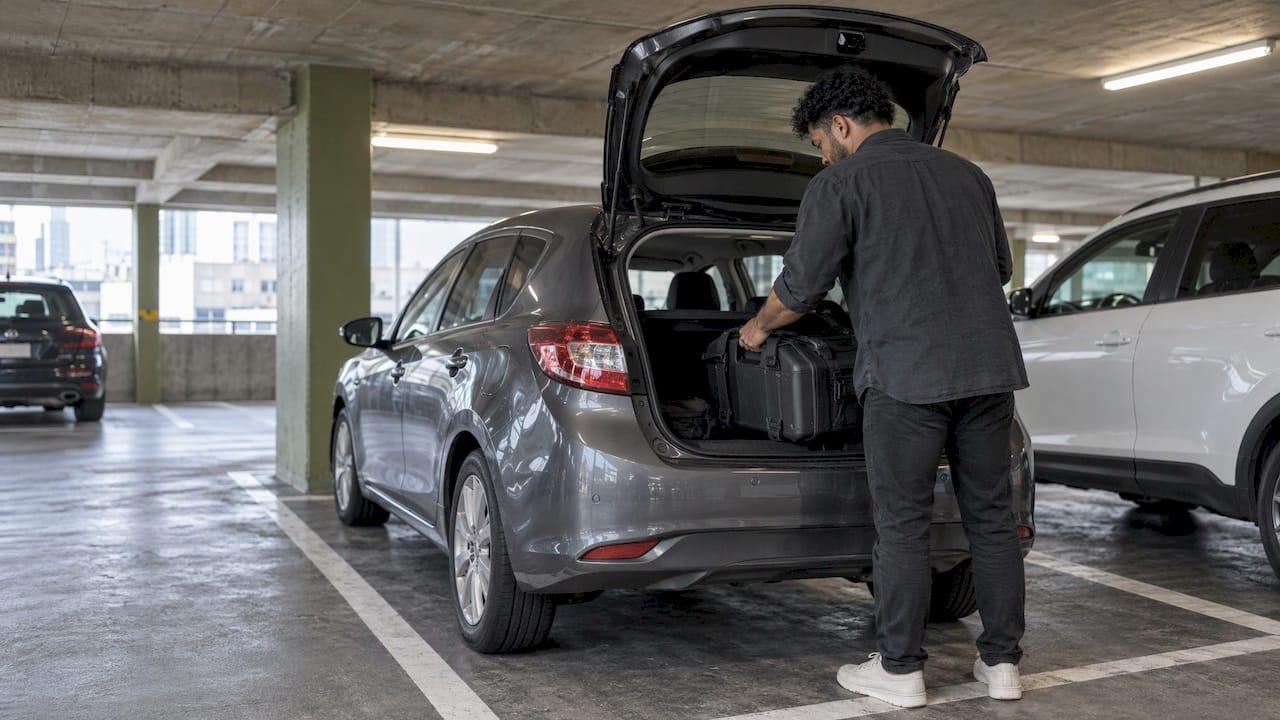
For most Auckland photoshoots, the easiest parking is a council-run car park building or open-air car park within a short walk of the shooting spot. Check its hours and rates, and confirm you can unload gear legally. Never leave a car on a berm, yellow line or park lawn. A good plan takes ten minutes and saves you from a fine, a late start and a stressed face in your first photos.
This guide covers central Auckland and the North Shore, what parking costs in 2026, the rules for parks and beaches, and how to handle gear and walking distance. It is written for people booking a portrait, couple, family, brand or event session, not film crews. We mention film permits only so you know where the line sits.
TL;DR
- Use an Auckland Transport car park building or open-air car park close to your location, and check the live availability before you leave.
- Central on-street parking is zoned, with higher rates nearer the city centre. Paid parking in 2026 is 50 cents an hour higher than in 2025 in most areas.
- Never park on park land, reserves or beaches unless it is a designated parking area. Never park on broken yellow lines, bus stops or in no-stopping zones.
- Allow time for the walk from the car to the shooting spot, especially with outfits, a stroller or equipment.
- A small portrait session does not need a film permit, but a production with crew, vehicles and equipment on public land does.
Table of Contents
- Where to park for a photoshoot in Auckland
- What parking costs in Auckland in 2026
- The rules that catch people out
- A parking checklist for the day
- How to check for restrictions on the day
- Parking by type of shoot
- Why a photographer who plans the location saves you the hassle
- Our view on parking and photo sessions
- Book a session with the location sorted
- FAQ
- Sources
Where to park for a photoshoot in Auckland
Auckland Transport (AT) runs the main public parking information, and its Central Auckland parking page lists the Civic, Fanshawe Street and Victoria Street car park buildings, along with open-air and on-street parking in the central suburbs. Each listing shows nearby landmarks, which makes it easy to match a car park to a photo location.
A few starting points for common shoot areas:
- Aotea, Queen Street and the Civic precinct. The Civic car park at 299 Queen Street opens from 6am, with weekday rates from $6 an hour and weekend rates from $3 an hour, according to the same AT page. It sits close to the Civic Theatre, Town Hall and Aotea Centre, so it suits architecture and street-style portraits.
- Viaduct, Wynyard and the waterfront. Use the central car park buildings and walk. Waterfront streets are busy with deliveries and events, and kerbside space disappears quickly.
- Takapuna, Devonport, Milford and Browns Bay. AT's North Auckland parking page lists public parking in Takapuna, including Toka Puia, Anzac Street and Killarney Street, and open-air facilities in Devonport, Browns Bay, Birkenhead, Hauraki, Mairangi Bay, Milford and Northcote. Beach and cliff shoots on the North Shore usually start from one of these.
If you are after ideas for where to shoot in the first place, our guides to the best photo locations in Auckland and rooftop photo locations show what each place looks like and what to expect on arrival.
Car park building or street parking?
For a shoot, a car park building is usually the calmer option. You pay once, you are not watching a meter, and you can usually unload in a sheltered space. Street parking is cheaper for short stays but comes with zone rules, time limits and a higher chance of a clash with a clearway or loading zone. If your session is more than an hour or you are carrying a lot, choose the building.
What parking costs in Auckland in 2026
Rates change, so treat the figures below as 2026 examples and confirm them on the day.
| Type | Example from AT | Notes |
|---|---|---|
| Civic car park building | From $6 an hour weekdays, from $3 an hour weekends | Opens from 6am |
| Central on-street, higher-rate zone | $7 an hour for the first two weekday hours, then $12 for each extra hour (four hours costs $38) | Rates vary by zone and time |
| Symonds Street | $4 an hour, Monday to Saturday, 8am to 6pm | $6 evening flat rate, free Sundays and public holidays |
| Short stop | Under 10 minutes is free | Useful for dropping off gear |
The on-street figures come from AT's page on on-street and open-air parking. It explains that central paid parking is divided into numbered, colour-coded zones, with higher rates nearer the city centre, and that the street machine shows the rate and enforcement hours for that spot.
AT also announced that from 1 February 2026 on-street parking and AT-managed car parks rose by 50 cents an hour across the region, except in areas that had already changed. If you are working from an older figure, add that.
How to pay
On-street and open-air spaces use pay-by-plate machines or the AC Parking app. AT's regional parking page says the app can search and pay for parking buildings and paid on- and off-street spaces. Signs state time limits and payment details, and AT's North Auckland page notes that drivers must follow them to avoid fines. Photoshoots run long, so pick a time limit that covers the shoot plus a buffer.
The rules that catch people out
The most common mistakes are small ones: stopping on a yellow line to unload, or driving onto a reserve because the grass looked firm.
Places you must not stop
AT's parking and road rules highlight broken yellow lines, operating bus or transit lanes, no-stopping signs, marked bus stops and taxi stands as places where you must not park, stop, set down or pick up passengers. National law is consistent with that: the Land Transport (Road User) Rule 2004 prohibits stopping, standing or parking contrary to a sign or marking. It also covers parking in a clearway or no-stopping area, using a mobility space without a displayed permit, parking in an EV charging space unless you are charging, and parking alongside broken yellow lines.
That last pair matters for photo days. A mobility space or EV bay right beside your location is not a loading shortcut.
Parks, reserves and beaches
Many of Auckland's best backdrops are on council land. The Vehicle Use and Parking Bylaw 2025 applies to land controlled by Auckland Council and Auckland Transport, including parks, reserves and beaches. Under the bylaw text, you may not park on a park, reserve, domain or recreational area unless it is a place designed and authorised for parking. Vehicles are generally prohibited on beaches, with exceptions such as authorised parking areas, boat launching, permits and special authorisation for activities including filming.
In practice: park in the marked car park, then walk onto the grass or sand. Do not drive a car, van or trailer onto the beach to be closer to the sunset.

Do you need a film permit?
Auckland Transport says a film permit is required for filming or placing filming equipment on roads, footpaths, parks, beaches and other public facilities, and that Screen Auckland manages the process. That is aimed at productions. A couple walking along a beach with one photographer is a different situation from a commercial shoot with crew, stands, vehicles and a site map.
If your shoot is larger, Screen Auckland's application page asks for dates, locations, equipment, crew numbers, technical vehicles and parking requirements, plus a site map, a risk assessment and public liability insurance of at least $5 million. It says complete applications need five full working days, and shoots involving road closures or changes to public parking need at least 20 working days because public notification is required. Even then, a permit does not itself authorise technical vehicles to occupy road spaces, so parking and loading need separate planning, according to the Screen Auckland Protocol 2026. Film-parking permits reserve spaces only for essential equipment vehicles, not crew cars.
If you are booking a corporate or brand shoot that involves more than a photographer and a few people, raise this early with whoever is organising the location.

A parking checklist for the day
The Screen Auckland protocol sets out good habits that apply just as well to a small shoot. Work through these before you leave home.
- Pick the car park first, then the shot list. Choose a car park building or open-air car park near the location and confirm its opening and closing times.
- Check height and access. Building entrances have height limits, and not every car park suits a tall vehicle with roof gear.
- Measure the walk. Look at the route from car to shooting area. Allow extra time for heels, a baby bag, a pram, a wedding dress or a rack of outfits.
- Find a legal place to unload. Loading zones may be used only for their signed purpose and duration. Keep driveways, footpaths, berms, accessways and wheelchair routes clear.
- Pay for more time than you think. If the machine or app allows, add a buffer. Golden hour does not respect a two-hour limit.
- Take a photo of your bay and sign. It helps if you return to a different level or street in the dark.
- Plan for the walk back. Evening sessions finish after dark, so know where the lit route is.
The protocol says vehicles must park legally and not block driveways, footpaths, berms or accessways, and it asks that on-street parking be kept to a minimum to preserve access for residents, businesses, deliveries and services. A private shoot owes the neighbours the same courtesy.
Access needs
If anyone in your party uses a wheelchair, walking frame or pram, parking is the first accessibility question. Look for step-free routes from the car park to the location. Our guide to accessible photo locations in Auckland covers step-free spots, and the same thinking applies to pet-friendly sessions, where you also need to consider the walk from the car with a dog (see our pet-friendly photo spots guide).
How to check for restrictions on the day
Temporary closures and events can change a plan overnight, particularly around the CBD and waterfront. Before you go:
- Open the AC Parking app or AT's parking page for the area. The Central Auckland page shows live availability that refreshes every 60 seconds.
- Read the signs at the car park entrance and on the pay machine. They state time limits, payment details and enforcement hours.
- Look at the kerb on arrival. Temporary no-stopping signs can appear for events or works, and a sign overrides what you expected.
- Have a second car park in mind, a few minutes further away, in case your first choice is full.
We have not found one single official page that lists every temporary closure, so rely on the signs on site and the live information from AT, and leave an extra 20 minutes for arrival if you are shooting in a busy part of the city.
Parking by type of shoot
The right parking plan depends on what you are booking.
- Headshots and corporate portraits. These are often in an office, studio or nearby street. Book parking near the building, and if you are bringing a team, stagger arrival times so cars are not circling.
- Couples and engagement shoots. Beaches, parks and city lanes are popular. Park in the formal car park, then walk. Wear shoes that suit the walk, and bring a spare pair for the car.
- Maternity and baby sessions. Keep the walk short and the route level. Choose a car park that lets you leave the car close to the first location.
- Fitness shoots. Gyms, parks and waterfronts mean gear bags. Allow time to carry equipment and pick locations where you can park and unload legally.
- Events. A few hundred metres matters when you are carrying camera gear all day. Ask the venue where staff and supplier parking is.
Why a photographer who plans the location saves you the hassle
Parking is a small piece of a bigger question: how much of the planning do you want to do yourself? Most people booking a portrait or couple session would rather spend their energy on looking relaxed than on reading car park signs.
At Life in Style Photography, careful planning and clear guidance are part of every session, whatever the genre, and you are not expected to know how to pose. That planning starts before the shoot, with choosing a location that works for the look you want and for how you will get there. We are based in Auckland and shoot on location and in the studio, so if you want to avoid the parking question, a studio session is a good fit.
Our view on parking and photo sessions
Most of the stress on a shoot day has nothing to do with the camera. It is the last ten minutes before the session: finding a bay, feeding the meter, carrying a dress across a car park. That tension shows up in the first frames.
We plan around it. When we help someone pick a location, we think about where they will leave the car, how far they will walk and whether the light is right when they get there. Our sessions are designed to put even camera-shy people at ease, and that is far easier when you arrive calm and on time.
If you are choosing between two locations that look equally good, pick the one with easy parking. A short, simple arrival gives you more relaxed time in front of the camera, and relaxed time is where natural photos come from.
Rowan Freeman
Book a session with the location sorted
If you would like a photographer who plans the day with you, we offer sessions across Auckland. Our headshot packages start from $345, with The Standard one at $575. Our couples sessions include the Full Session at $575 and the Extended Session at $800. Personal branding sessions run from $575 for the Starter Brand Session to $1,495 for the Complete Brand Session. You can see more pricing in our guide to portrait photography prices in Auckland.

Tell us the kind of shoot you want and where you are thinking of, and we will help you shape a plan that includes the practical side. Get in touch through our website.
FAQ
Where is the best place to park for a photoshoot in central Auckland?
A car park building such as Civic at 299 Queen Street is the simplest choice for city shoots, with weekday rates from $6 an hour in 2026. It is close to the Civic Theatre, Town Hall and Aotea Centre. For the waterfront, use a central car park building and walk.
Can I park on the beach or in a park for a photoshoot?
No, not unless it is a designated and authorised parking area. Auckland's Vehicle Use and Parking Bylaw 2025 prohibits parking on parks, reserves and domains outside authorised places, and generally prohibits vehicles on beaches. Park in the car park and walk to the spot.
Do I need a permit for a photoshoot in Auckland?
A film permit through Screen Auckland is required for filming or placing equipment on roads, footpaths, parks, beaches and other public facilities. Smaller private portrait sessions are a different case, but if your shoot involves crew, vehicles or equipment on public land, check with Screen Auckland before you book.
How much does parking cost in Auckland in 2026?
It depends on the zone and time. Examples include $7 an hour for the first two weekday hours in a central zone, then $12 an hour, and $4 an hour on Symonds Street from Monday to Saturday between 8am and 6pm. Stays under 10 minutes are free in central on-street spaces, and AT raised hourly rates by 50 cents from 1 February 2026 in most areas.
How do I pay for parking in Auckland?
Use a pay-by-plate machine or the AC Parking app. The app can search and pay for parking buildings and paid on- and off-street spaces, and the street machine shows the current rate and enforcement hours.
Sources
- Find parking in Central Auckland, Auckland Transport
- Parking in North Auckland, Auckland Transport
- On-street and open-air parking, Auckland Transport
- Small increase to public transport fares and paid parking, Auckland Transport
- Find car parking across Auckland, Auckland Transport
- Parking and road rules, Auckland Transport
- Land Transport (Road User) Rule 2004
- Vehicle Use and Parking Bylaw 2025, Auckland Council
- Vehicle Use and Parking Bylaw 2025 (full text)
- Filming opportunities, Auckland Transport
- Apply for a film permit, Screen Auckland
- Screen Auckland Protocol 2026